Episode Details
Back to Episodes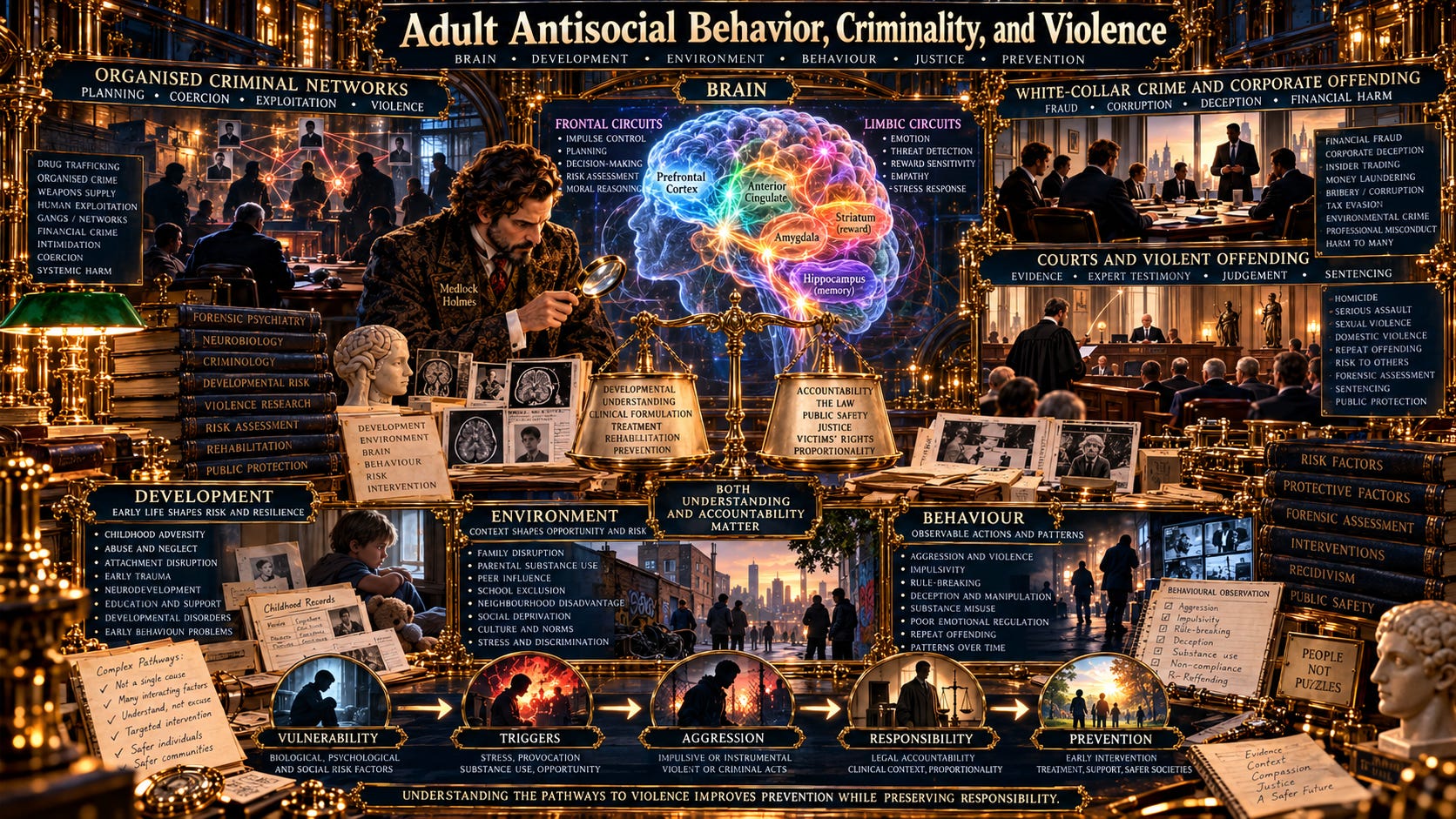
PSYCH 158: Adult Antisocial Behavior, Criminality, and Violence
Description
Medlock Holmes enters The Chamber of Violence, where the question is not simply who committed a crime, but why human beings become capable of harming others.
His investigation begins with an unexpected contrast: the organised criminal who maintains a stable family life, the corporate executive whose financial decisions destroy thousands of livelihoods, and the impulsively violent offender whose behaviour appears almost beyond conscious control.
Holmes discovers that criminality, antisocial behaviour and violence are related but distinct phenomena. Neither criminal behaviour nor violence automatically indicates psychiatric illness.
The Anatomy of Violence
In the chamber’s centre stands an illuminated brain, its frontal and limbic circuits connected by brass wires.
Holmes traces the systems involved in moral judgement, empathy, threat perception, emotional regulation and impulse control.
The orbitofrontal and ventromedial prefrontal regions contribute to evaluating consequences and regulating behaviour. The amygdala participates in emotional salience and threat processing. Their interactions help determine whether anger becomes action.
But biology is only part of the investigation.
Childhood maltreatment, genetic vulnerability, head injury, substance misuse, social deprivation and exposure to violent environments may combine to increase risk.
Holmes writes:
NEUROBIOLOGY × DEVELOPMENT × TRAUMA × SOCIAL CONTEXT → VIOLENCE VULNERABILITY
This is a formulation of interacting risks, not a deterministic prediction.
The Three Faces of Criminality
Holmes examines three different rooms.
In the first, organised crime reveals how loyalty, hierarchy and social reinforcement can sustain criminal behaviour without necessarily implying psychopathy.
In the second, white-collar crime demonstrates that deception and exploitation may produce enormous harm without physical confrontation.
In the third, interpersonal violence raises questions about impulsivity, psychopathy, psychiatric disorders, substance use and neurological impairment.
He recognises that violence cannot be explained by a single criminal personality.
The Childhood Archive
Holmes opens files documenting early adversity, neglect, physical and sexual abuse, neurological injury and developmental disturbance.
Some pathways towards later violence begin long before the offence.
Yet most people exposed to adversity do not become violent.
The challenge is to understand how vulnerabilities accumulate, how protective factors interrupt harmful pathways and why individuals respond differently to similar experiences.
The Courtroom of Responsibility
The final chamber contains a courtroom.
A defendant may understand that an act is legally wrong yet have substantial difficulties regulating emotion or controlling impulses.
Holmes confronts the distinction between knowing what is wrong and being able to regulate one’s behaviour.
Neuroscience can inform questions of responsibility, mitigation and treatment, but it cannot independently determine legal culpability.
He closes the investigation with a final observation:
“To understand violence is not to excuse it. It is to discover the conditions that make it possible, the vulnerabilities that shape it, and the opportunities through which it might be prevented.”
Key Takeaways
1. Understanding Antisocial Behaviour, Criminality and Violence
1. Adult antisocial behaviour encompasses a broad range of actions that violate social expectations, laws or the rights of others.
2. Criminality refers to behaviour prohibited by law, whereas violence involves the actual, attempted or threatened use of physical force.
3. These categories overlap but are not interchang