Episode Details
Back to Episodes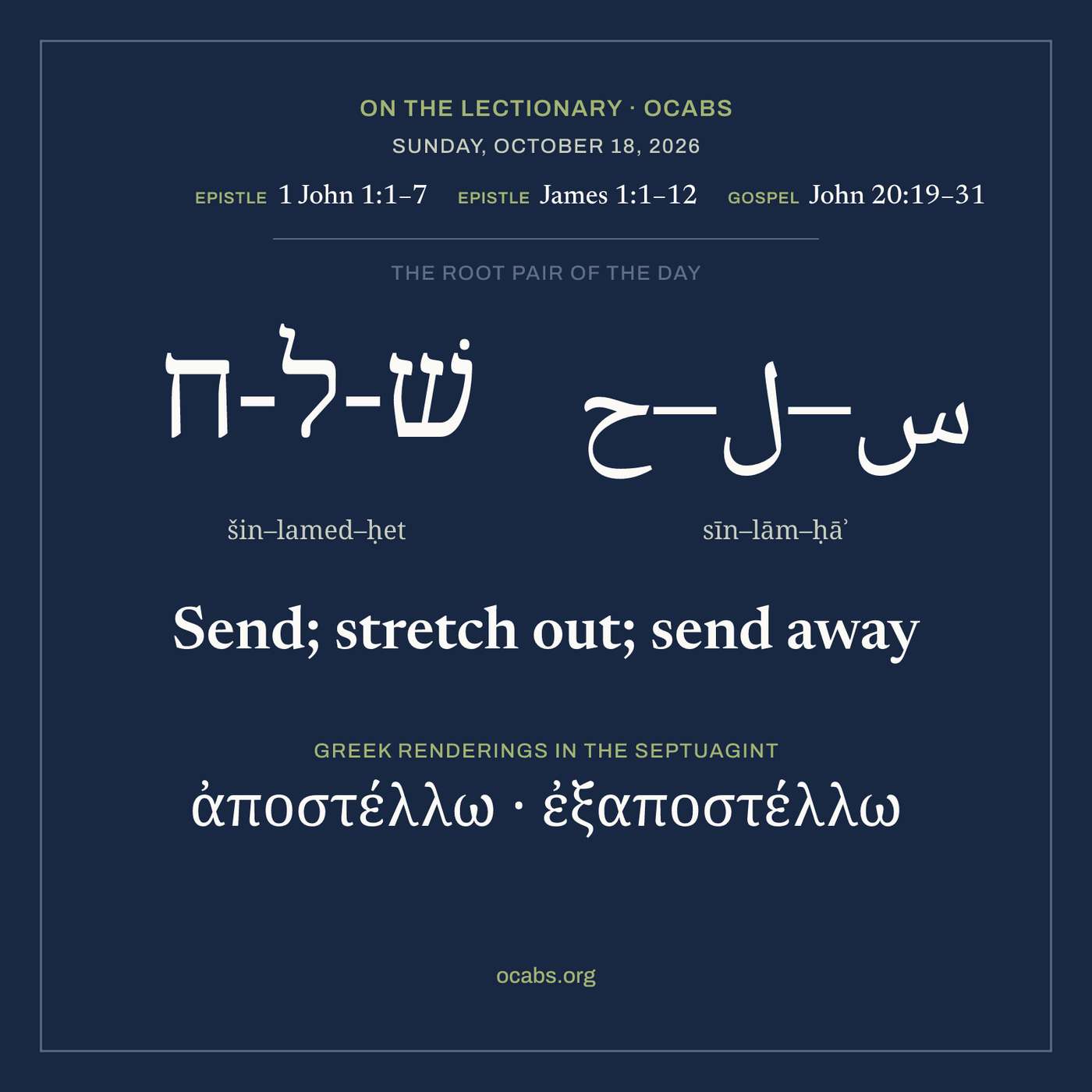
1 John 1:1-7 · James 1:1-12 · John 20:19-31 · Luke 10:16-21 · Galatians 1:11-19 · Luke 8:5-15 — Sunday, October 18, 2026
Description
A daily note from the team at OCABS.ORG, drawing on the published works of Fr. Paul Nadim Tarazi, with citations to his books and lectures.
Readings: 1 John 1:1-7; James 1:1-12; John 20:19-31; Luke 10:16-21; Galatians 1:11-19; Luke 8:5-15.
The passages collected for 1 John 1:1-7 are only index listings of scripture citations, with no discussion of the text itself, so nothing can be drawn from them for this reading.
James identifies himself as "servant of God," an appellation the New Testament elsewhere applies only to Moses, marking him as a singular figure among the apostles. He addresses his letter "to the twelve tribes which are in the Dispersion," language that echoes Jesus' own promise to the apostles that they would sit "judging the twelve tribes of Israel." Fr. Paul identifies the "circumcision party" that pressured Peter at Antioch with James and his entourage, the leaders of the Jerusalem church and of Jewish Christianity at large. Yet this authoritative figure, writing to those same twelve tribes, endorses the primacy of love for the needy neighbor found throughout the Pauline letters, insisting that "faith by itself, if it has no works, is dead."
The Gospel passage states its own purpose directly: the signs are written "that you may believe that Jesus is the Christ, the Son of God, and that believing you may have life in his name." Fr. Paul compares this closing note to Deuteronomy, the book of Moses' words, so that John stands as the book of the logos expressed in Jesus' own words, an unchangeable testament of what is necessary and sufficient for salvation. What the book records is not everything Jesus did, but a testimony meant to produce faith and so life. Within this written testimony, the giving of the Spirit "through faith" promised in Galatians is what John narrates in the scene after the resurrection, when Jesus breathes on the disciples.
The root pair of the day · שׁ-ל-ח šin–lamed–ḥet, שָׁלַח šalaḥ · س–ل–ح sīn–lām–ḥāʾ, أَسْلِحَت ʾasliḥat · send; stretch out; send away. The root šalaḥ and ʾasliḥat name the sending that shapes both readings. Jesus tells the disciples, 'As the Father has sent me, even so I send you,' corresponding to Greek apostello or exapostello, as in John 17:3, 'the only true God, and him whom you sent.' James writes to the twelve tribes of the dispersion, extending that same sending, while Luke's 'sent the rich away empty' echoes his warning that the rich will fade away. cf. The Consolation of Consonants
Sources: Tarazi, The New Testament: An Introduction, vol. 3, Johannine Writings, p. 283; Tarazi, Galatians: A Commentary, p. 0; Tarazi, 1 Corinthians: A Commentary, p. 269; Tarazi, The Rise of Scripture, p. 348; Tarazi, The Pastorals: A Commentary, p. 171; Tarazi, Galatians: A Commentary, p. 77; Tarazi, The New Testament: An Introduction, vol. 3, Johannine Writings, p. 31; Tarazi, The New Testament: An Introduction, vol. 4, Matthew and the Canon, p. 102; Tarazi, The New Testament: An Introduction, vol. 3, Johannine Writings, p. 244; Tarazi, The Rise of Scripture, p. 84; Tarazi, The Rise of Scripture, p. 352; Tarazi, The Old Testament: An Introduction, vol. 1, Historical Traditions, p. 141; Tarazi, The Old Testament: An Introduction, vol. 3, Psalms and Wisdom, p. 128.
Opening music: Taksim Arbi, Bichi Slama, oud (Tunis, Archives de la Parole, 1930s), public domain. Source: gallica.bnf.fr / BnF.
The digital voice Fāṭima (فَاطِمَة) is named in honor of the learned women of al-Andalus, particularly Fāṭima bint Yaḥyā al-Maghāmī, Fāṭima al-Sharrāṭ, and Fāṭima bint al-Muthannā, whose legacies embody the Andalusian traditions of scriptural scholarship, jurisprudence, education, and wisdom.