Episode Details
Back to Episodes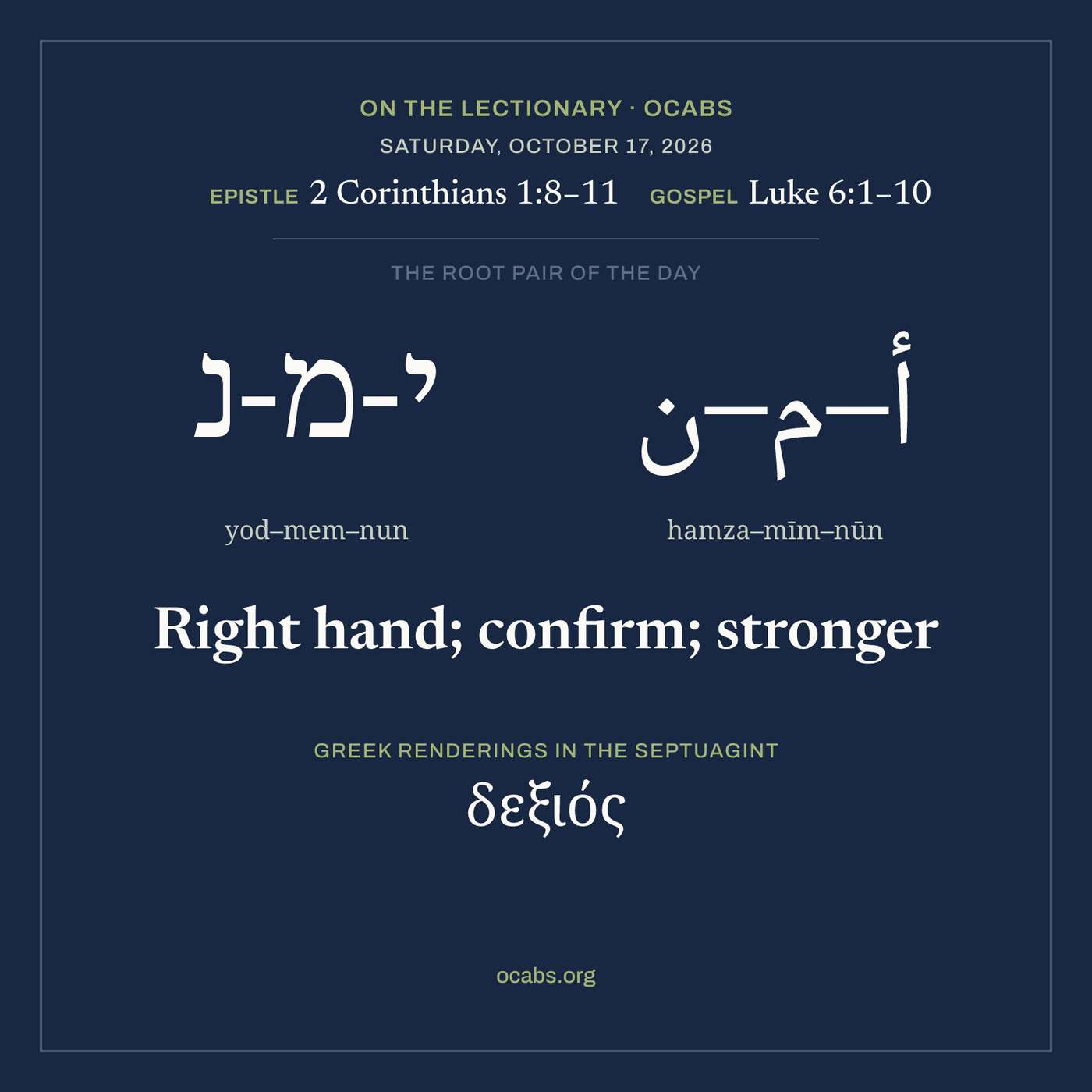
2 Corinthians 1:8-11 · Luke 6:1-10 — Saturday, October 17, 2026
Description
A daily note from the team at OCABS.ORG, drawing on the published works of Fr. Paul Nadim Tarazi, with citations to his books and lectures.
Readings: 2 Corinthians 1:8-11; Luke 6:1-10.
Paul's affliction in Asia, where he says they were "so utterly, unbearably crushed that we despaired of life itself," is read by Fr. Paul as a real near-death ordeal in the Roman arena at Ephesus, the same event recalled when Paul speaks of fighting wild beasts. He notes that the harder, preferred reading of verse 10 is plural, "so great deaths" (tēlikountōn thanatōn), pointing to repeated brushes with death. This led Paul "to rely not on ourselves but on God who raises the dead," and to ask that many give thanks "for the blessing granted us in answer to many prayers."
The opening of the letter calls God the "Father of mercies and God of all comfort." Fr. Paul traces this comfort, paraklēsis, to the verb for God's call, kalō, concluding that Paul's wording shows God is "not only its sole source but also, and more importantly, its originator and promoter." Affliction and comfort thus bind Paul and the Corinthians together, each sharing in the other's suffering and consolation.
In his lectures on Luke, Fr. Paul reads these two sabbath stories as part of a sequence of showdowns, with Jesus acting as "the new David that is doing the same thing, but as son of man who is teaching the new teaching." He notes the same watching motif recurs at Luke 6:6-11 and 14:1-6. The scribes' "watching" him, paratēreō, is a legal term meaning to watch someone closely "in order to catch him making a mistake," the very verb used of sabbath surveillance in Mark 3:2 and again in Luke 6:7, 14:1, and 20:20. Against this surveillance Jesus asks whether it is lawful "to do good or to do harm, to save life or to destroy it," and stretches out the man's hand in full view of his accusers.
The root pair of the day · י-מ-נ yod–mem–nun, יָמִין yamin · أ–م–ن hamza–mīm–nūn, آمَنَ ʾāmana · right hand; confirm; stronger. The root mut and mawt, 'die, death,' underlies Paul's language of thanatos in 2 Corinthians: the sentence of death within him, the great death from which God delivered him, and his trust in God who raises the dead. The note highlights the harder reading 'so great deaths,' tēlikountōn thanatōn, as repeated brushes with mortality, matching this root's sense of dying and being put to death. cf. The Consolation of Consonants
Sources: Tarazi, 2 Corinthians: A Commentary, p. 36; Tarazi, 2 Corinthians: A Commentary, p. 33; Tarazi, 2 Corinthians: A Commentary, p. 22; Tarazi, 2 Corinthians: A Commentary, p. 23; Tarazi, 2 Corinthians: A Commentary, p. 113; Orthodox Audio Bible Commentary, Luke (vol. 42), part 1, at 2:05:25; Tarazi, The New Testament: An Introduction, vol. 2, Luke and Acts, “The Prodigal Son (11–32)”; Tarazi, The New Testament: An Introduction, vol. 2, Luke and Acts, “The Prodigal Son (11–32)”; Tarazi, Galatians: A Commentary, p. 223.
Opening music: Taksim Arbi, Bichi Slama, oud (Tunis, Archives de la Parole, 1930s), public domain. Source: gallica.bnf.fr / BnF.
The digital voice Fāṭima (فَاطِمَة) is named in honor of the learned women of al-Andalus, particularly Fāṭima bint Yaḥyā al-Maghāmī, Fāṭima al-Sharrāṭ, and Fāṭima bint al-Muthannā, whose legacies embody the Andalusian traditions of scriptural scholarship, jurisprudence, education, and wisdom.