Episode Details
Back to Episodes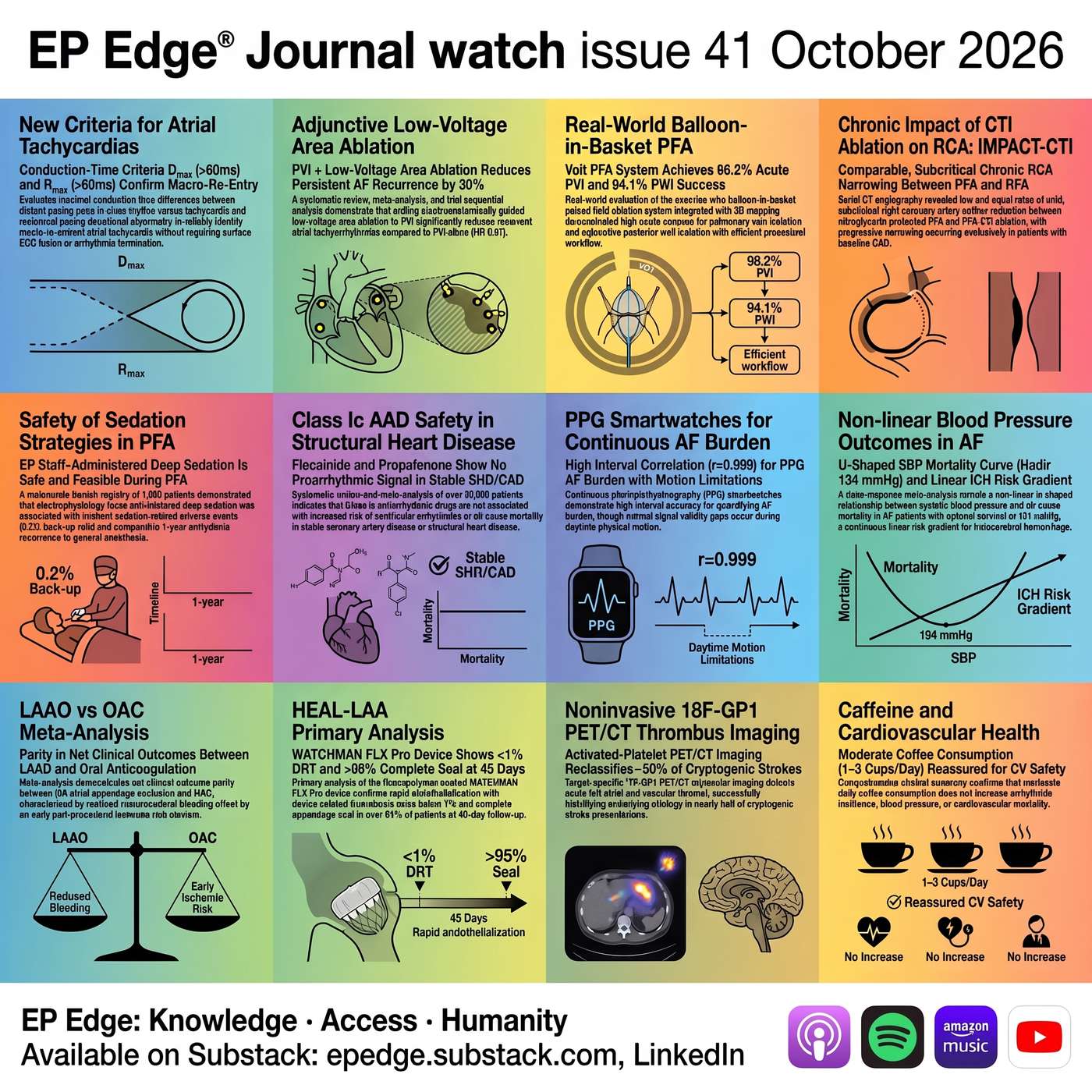
EP Edge® Journal Watch: Issue 41 October 2026: AF Ablation, PFA Coronary Safety, Smartwatches and LAA Closure
Description
EP Edge® Journal Watch 41 | October 2026: AF Ablation, PFA Coronary Safety, Smartwatches and LAA Closure
When does a more extensive ablation strategy improve outcomes, how should we assess coronary safety after pulsed field ablation, and can wearable rhythm monitoring or left atrial appendage closure change clinical decisions?
In Issue 41 of EP Edge Journal Watch, Dr. Sharma examines atrial fibrillation treatment, procedural safety, rhythm monitoring, and stroke prevention. Four featured discussions explore low-voltage area ablation, the IMPACT-CTI study, smartwatch assessment of AF burden, and randomized evidence comparing left atrial appendage closure with oral anticoagulation. Shorter reviews connect these findings with everyday electrophysiology practice.
Designed for cardiac electrophysiologists, cardiologists, fellows, and allied professionals, this episode explains the relevant statistics, limitations, and clinical implications through the EP Edge Take. Articles are listed below in newsletter order.
- Correa Velasquez: New Criteria to Demonstrate Entrainment and Macro-Re-Entry in Atrial Tachycardias. Brief review of two conduction-time maneuvers comparing pacing during tachycardia with sinus rhythm, or conduction in opposite directions. We consider their diagnostic performance and the need for independent validation. Article DOI. Accompanying Boyle editorial.
- Virk: Adjunctive Low-Voltage Area Ablation in Persistent Atrial Fibrillation. Featured discussion. Seven randomized trials suggest reduced recurrence with additional substrate ablation. We examine the pooled hazard ratio of 0.67, why IDEAL-AF influenced heterogeneity, the leave-one-out sensitivity analysis, additional procedural exposure, and unresolved reporting discrepancies. Article DOI.
- Xhakupi: Balloon-in-Basket Pulsed Field Ablation for Pulmonary Vein Isolation and Extra-Pulmonary Vein Sites. This cohort included both paroxysmal and persistent AF. We review acute feasibility of posterior wall isolation, mitral lines, CTI ablation, roof lines, and superior vena cava isolation, while distinguishing technical success from proven incremental clinical benefit. Article DOI.
- Nair: IMPACT-CTI and Chronic Right Coronary Artery Changes After Ablation. Featured discussion. Pulsed field ablation, radiofrequency ablation, and untreated controls are compared using serial coronary imaging. We examine baseline coronary disease, modest vessel narrowing, and why the absence of clinical ischemia does not settle delayed coronary safety. Article DOI.
- Prior evidence is considered separately: Tam’s longitudinal intracoronary imaging study and Malyshev’s nitroglycerin and coronary spasm study. Preventing acute spasm and preventing chronic structural change are different questions.
- Alhede: Three Sedation Strategies During Pulsed Field Ablation for AF. The Danish registry compares deep sedation delivered by electrophysiology staff, deep sedation delivered by an anesthesia nurse, and intubated general anesthesia. Similar observed recurrence rates do not establish equivalent safety across different staffing and patient-selection models. Article DOI.
- Singireddy: Flecainide and Propafenone in AF With Structural Heart Disease. This systematic review examines ventricular arrhythmias, mortality, and cardiovascular events in patients with coronary disease, heart failure, or left v