Episode Details
Back to Episodes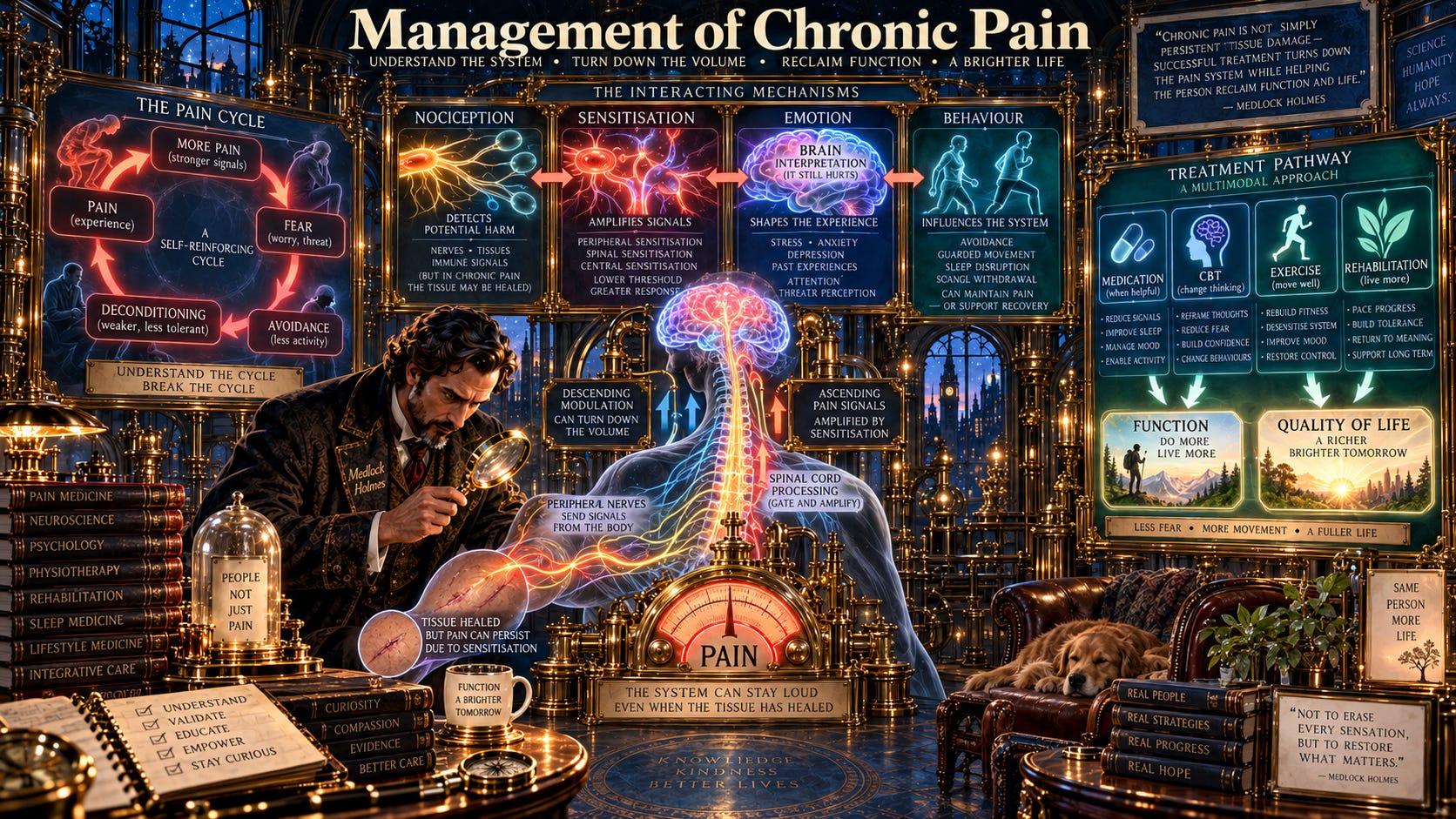
PSYCH 156: Management of Chronic Pain
Description
behaviour and social context combine to sustain suffering and disability.
Medlock Holmes enters The House of Persistent Pain.
At first, the investigation seems straightforward. A red warning light labelled PAIN is flashing on the wall, so Holmes begins searching for the injury that triggered the alarm.
But something is wrong.
In one room, the tissue has healed - yet the alarm continues.
In another, a light touch produces severe pain.
In another, an amputated limb that no longer exists still hurts.
And in another, an MRI shows abnormalities while the person standing beside it experiences almost no pain.
Holmes realises that pain cannot simply be read from anatomy.
PAIN ≠ TISSUE DAMAGE ALONE
Pain is simultaneously a sensory and emotional experience, and chronic pain emerges from interactions between the body, nervous system, thoughts, emotions, behaviour and environment.
The first task is to distinguish the pathways.
Nociceptive pain begins with activation of nociceptors following tissue injury or disease.
Somatic pain arises from structures such as skin, muscle and bone and is often relatively well localised.
Visceral pain arises from internal organs and tends to be more diffuse and difficult to localise.
Neuropathic pain, however, results from disease or damage affecting the somatosensory nervous system and may feel:
BURNING • SHOOTING • STABBING • ELECTRIC
But chronic pain introduces another process.
The alarm system itself begins changing.
Holmes follows the signal from peripheral nociceptors through the dorsal horn and ascending spinal pathways towards the brain.
Repeated nociceptive activity alters these circuits.
Thresholds fall.
Responses become amplified.
Pain spreads beyond its original boundaries.
Even normally innocuous stimuli can become painful.
This is sensitisation.
At the periphery:
INJURY → INFLAMMATORY MEDIATORS → LOWER NOCICEPTOR THRESHOLD → PERIPHERAL SENSITISATION
Within the spinal cord and brain:
REPEATED INPUT → NEURAL PLASTICITY → AMPLIFIED PAIN SIGNALLING → CENTRAL SENSITISATION
The nervous system has learned pain too well.
But Holmes notices that the ascending signal is only part of the story.
Pain reaches systems concerned not merely with sensation, but with emotion, motivation, memory and meaning.
The question therefore changes from:
“Where is the damage?”
to:
“What processes are now generating, amplifying and maintaining this person’s experience of pain?”
That question leads into psychiatry.
Depression and chronic pain have an intimate bidirectional relationship.
PAIN → DEPRESSION → GREATER PAIN → WITHDRAWAL → DISABILITY → MORE DEPRESSION
Anxiety creates another loop.
A patient experiences pain during movement.
They conclude:
“Movement means damage.”
Movement becomes frightening.
Activity is avoided.
Muscles weaken.
Physical conditioning deteriorates.
Movement becomes harder and more painful.
Fear appears confirmed.
Holmes draws the fear-avoidance cycle:
PAIN → CATASTROPHISING → FEAR → AVOIDANCE → DECONDITIONING → DISABILITY → MORE PAIN
This is not imaginary pain.
It is a real pain experience being maintained partly through interactions between biological signalling, prediction, emotion and behaviour.
Catastrophising magnifies threat:
“This pain is unbearable.”
“Something terrible must be happening.”
“I