Episode Details
Back to Episodes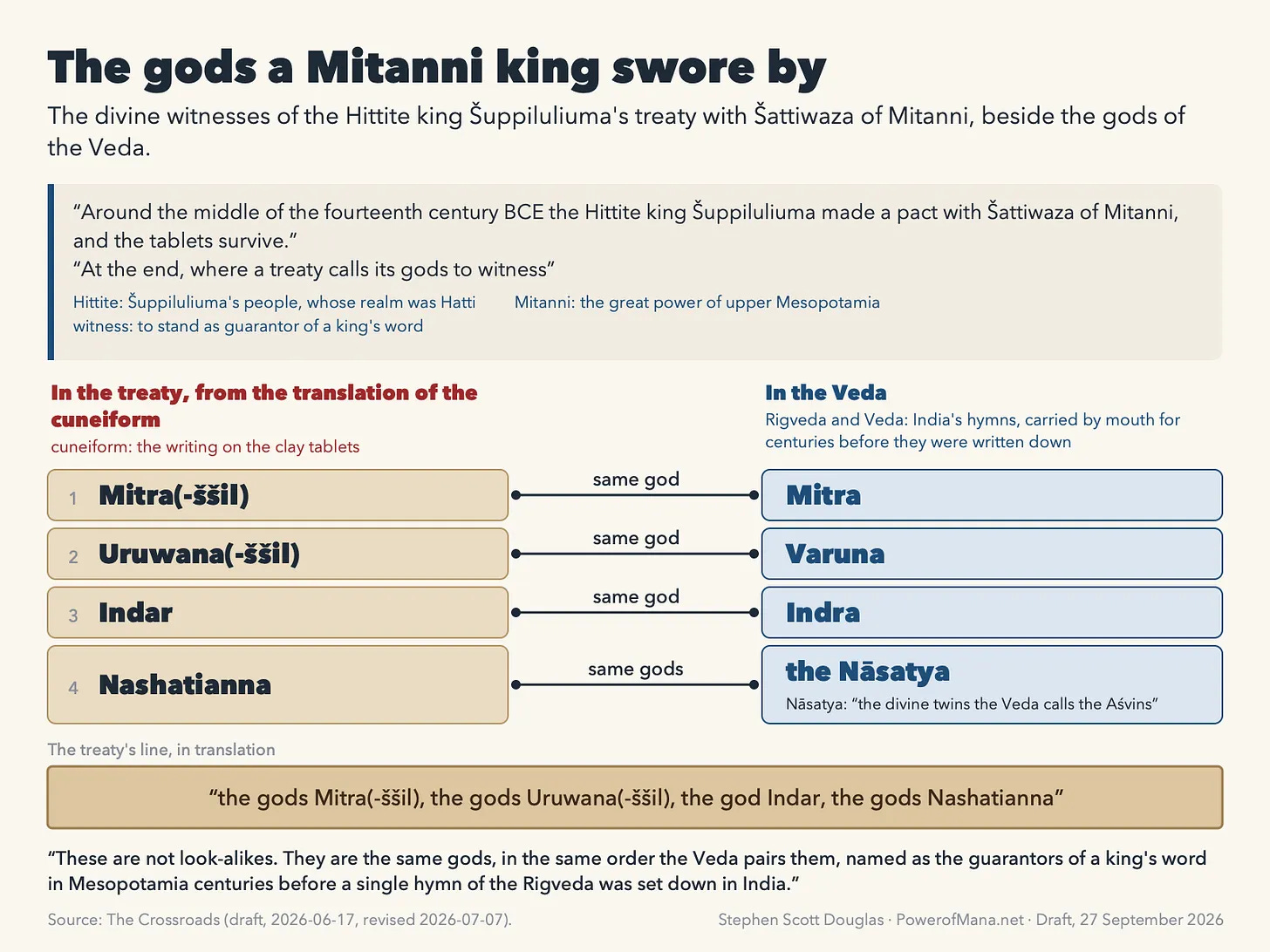
Podcast | India’s gods before India
Description
The gods before the Veda
So, we go to the crossroads, in the middle of the second millennium before the common era. The great power of upper Mesopotamia was a kingdom called Mitanni. The M-N- is in Mitanni. Its people spoke Hurrian, a tongue that is, as the handbooks put it, “neither Indo-European nor Semitic.”
But the Mitanni kingdom was ruled, and this is the thing, by an Indo-Aryan aristocracy. Indo-Aryan here means, in effect, Indo-European. The Oxford Companion to World Mythology says it without fuss: the Mitanni Hurrians “were themselves ruled by an Indo-Aryan aristocracy with some allegiance to Indian deities.”
This is 1400 BCE. The Rigveda was properly systematised around 1200 BCE. It was not written down for centuries after that, and was carried in song and prayer. So from the Mitanni we have a treaty of around 1400 BCE. The earliest writing from India comes centuries later. The best guess we have is that the Indo-Europeans reached the Indian subcontinent around 1200 or 1300 BCE. So the Mitanni Hurrians left written artefacts, which I have seen with my own eyes in the museum in Istanbul, a hundred or two hundred years before the first Indo-Europeans reached India.
Parity of esteem
The Oxford Companion calls the gods named in that treaty Indian gods. Yet our evidence that these gods are Indian comes from a later period.
People sometimes tell me I am being anachronistic when I call Proto-Indo-European ancient Ukrainian. The Yamna, the community from which all living Indo-European languages come, lived six thousand years ago in Mykhailivka, in what is today Ukraine. Linguists call the language they spoke Proto-Indo-European. I say we can now carry the proper name back: ancient Ukrainian. We do that for ancient Greek and ancient Indian. People say, that is anachronistic, you cannot do that.
Well, here is the Oxford Companion to World Mythology doing it. It carries a category back onto deities we know the Mitanni worshipped, because they swore oaths on their names, centuries before India became India.
So it is legitimate to carry a name back this way. It may be anachronistic. I will not quibble with the Oxford Companion when it calls these Indian deities. But I will explain, as I just have, what it is doing. It is an anachronism. It calls these gods Indian centuries before India existed, before the first Indo-Europeans reached India and set up their culture there.
Some Indo-Europeans may have reached India earlier. But we know from the genetic evidence, in a 2019 paper in Science, that a group associated with the Painted Grey Ware culture brought steppe ancestry into the aristocracy there. They became the Brahmins, who systematised the Rigveda and finally wrote it down. We have written evidence of these gods’ names from the Mitanni long before any of that, long before India became India.
So parity of esteem demands this. If the Oxford Companion to World Mythology may call those gods Indian centuries before they became Indian, when we have this treaty from before then, then strictly we should call the Indian deities Mitanni deities. That would be ridiculous, because they truly caught fire in India. They gave their name to India: the N-D-, the Indra in India.
We will come back in future episodes to that N-D- sound, the reversal of the D-N- in the Don, the Donets, the Dnipro, the Dnister and the Danube. By the rule of first attestation in writing we could even call these Indian gods Hurrian gods. Of course we do not. Like Timothy Snyder, we have learnt that many lines of evidence besides writing help us understand our past, our identities, the origins of our language and culture, and why we say what we say today.
So we will not