Episode Details
Back to Episodes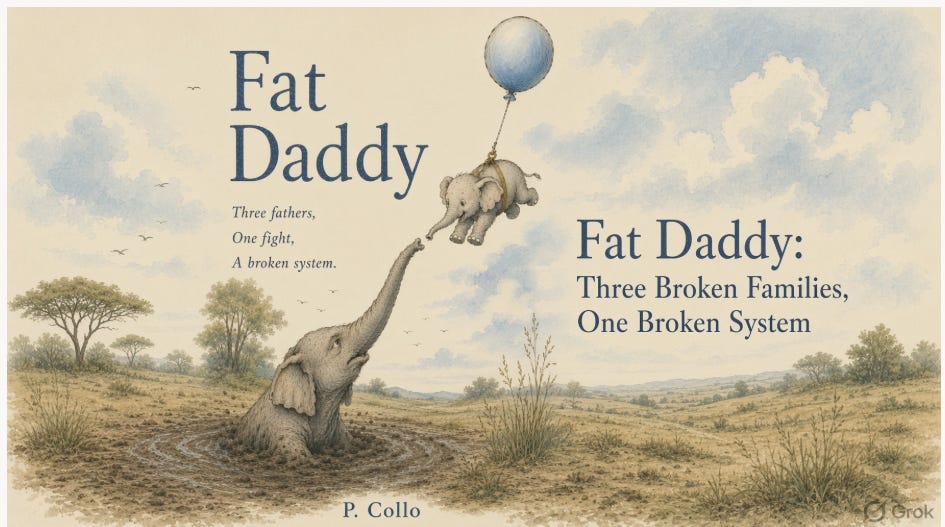
Fat Daddy: Three Broken Families, One Broken System
Description
Fat Daddy arrives at a moment when Australia’s family law system remains one of the country’s most contested and least trusted institutions. Interweaving three harrowing personal narratives with analytical chapters on the structural realities of the court, the book confronts the crises facing many modern fathers: restricted access to children, weaponised allegations, financial extraction through child support, parental alienation, and elevated male suicide risk.
At 394 pages, it is both case study and indictment.
The three central stories are ordinary men pushed to extremes. Richard discovers his partner’s infidelity; three months later she has remarried and cut off his access to their daughter. Forced to self-represent, he eventually secures visitation, yet leaves the process appalled by what he has witnessed and determined to pursue reform. Morris returns home to an empty house and an abandoned teddy bear. Two weeks later he is told his daughter has undergone a sexual assault examination on the strength of allegations for which, the book stresses, there is zero evidence. Years of fighting to clear his name follow; he regains contact but loses faith in the institutions that processed the claim. Nick, restricted to weekend access and living in a tent while still paying the mortgage on the family home, is cut off entirely. Despair drives him to a suicide attempt. He survives, returns to court, and ultimately becomes the sole parent when his ex-partner abandons the children.
These accounts are not presented as isolated tragedies. Between them sit chapters that examine the incentives and biases embedded in the system: the ease with which allegations can halt contact, the practical consequences of child-support formulas that continue even when access is denied, the documented patterns of parental alienation, and the disproportionate toll on fathers’ mental health. Collo’s framing is that the system too often treats the non-resident parent—statistically more often the father—as a financial resource and a risk to be managed rather than a continuing parent whose relationship with the child is presumed valuable.
The book’s timing is pointed. Australian family-law commentary has long documented high rates of unsubstantiated abuse allegations in contested matters, the difficulty of restoring contact once it is interrupted, and the correlation between post-separation exclusion and male suicide. Fat Daddy does not claim these patterns are universal; it argues they are sufficiently common, and the procedural safeguards sufficiently weak, that ordinary men can be reduced to the status of “Fat Daddy”—present enough to pay, absent enough to be rewritten out of their children’s lives. The title itself functions as both description and rebuke.
What distinguishes the work is the combination of close narrative and structural analysis. The reader is taken inside the specific humiliations and procedural traps each man encounters—self-representation, police involvement on the basis of untested claims, the sudden collapse of contact—then stepped back to the broader mechanics that make such outcomes possible. Accountability, the book suggests, is asymmetrically applied; the parent who controls the narrative and the household holds the practical advantage, while the excluded parent must repeatedly prove fitness under conditions that assume the opposite.
Print copies become available this week. For readers already familiar with the long record of family-law inquiries, stalled reforms, and the lived experience of excluded parents, Fat Daddy supplies three further, carefully rendered illustrations of how the system currently operates and why so many fathers emerge from it broken, alienated, or worse. It is not a cheerful book. It is a necessary one.
--
John Stapleton
Commissioning Editor
A Sense of Place Publishing
ABN: 8589 215 7567
Emails:
john.stap