Episode Details
Back to Episodes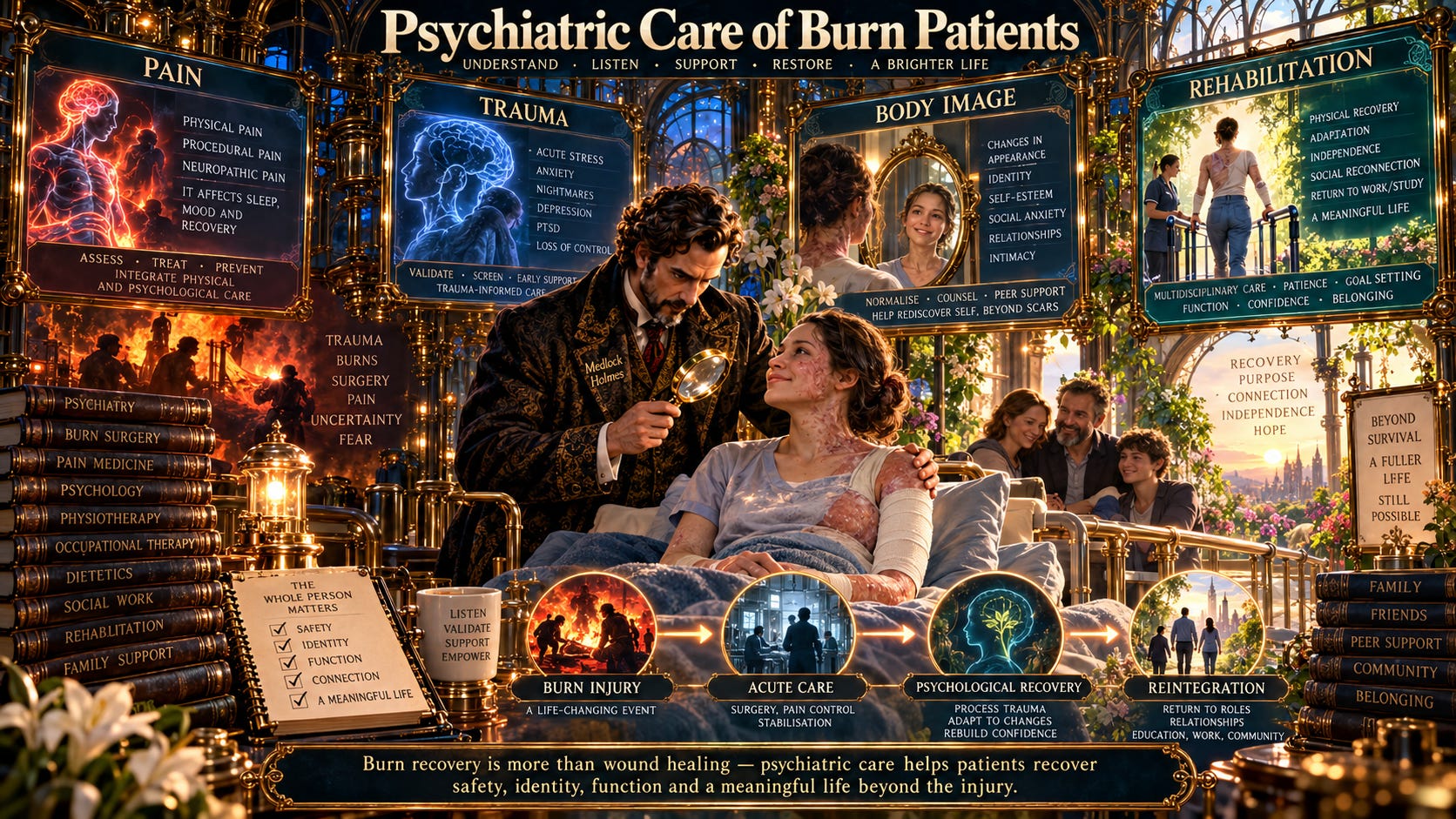
PSYCH 155: Psychiatric Care of Burn Patients
Description
from survival towards recovery.
Medlock Holmes enters The House of Fire and Recovery.
At the entrance stands a patient whose burns have been dressed, whose vital signs have stabilised and whose surgeons are cautiously optimistic.
The immediate danger has passed.
Yet the patient cannot sleep.
Every time they close their eyes, they see the flames.
They recoil when a nurse approaches to change a dressing.
They are frightened of looking in the mirror.
And when their family arrives, they turn their face away.
Holmes realises that the medical team is treating one injury while another dimension of suffering is only beginning to emerge.
He writes:
BURN INJURY → PHYSICAL TRAUMA + PSYCHOLOGICAL TRAUMA + SOCIAL DISRUPTION
Burn injuries create a particularly complex psychiatric challenge because they combine severe physical injury with pain, prolonged treatment, altered appearance, functional disability and sometimes profound psychological trauma.
But Holmes immediately identifies an important distinction.
Not everyone who sustains a severe burn develops a psychiatric disorder.
Some experience intense distress and gradually recover.
Others develop depression, anxiety, post-traumatic stress disorder or persistent difficulties with body image and social reintegration.
The outcome depends on far more than the percentage of skin burned.
PSYCHOLOGICAL OUTCOME ≠ BURN SEVERITY ALONE
Pre-existing vulnerability, the circumstances of the injury, perceived threat, pain, treatment experiences, coping strategies and social support all matter.
Holmes begins by examining the circumstances of the fire.
Was it accidental?
Was it occupational?
Was it the result of interpersonal violence?
Was it self-inflicted?
Was the patient trapped?
Did they witness others being injured or killed?
Did they believe they were about to die?
The circumstances matter because the burn is not always the whole trauma.
For some patients, the most disturbing memory is the fire itself.
For others, it is the experience of helplessness, the screams of another person, or the terrifying moment when escape seemed impossible.
And for some, the greatest psychological challenge emerges much later, when they confront a changed body and a changed life.
Holmes therefore follows the patient’s journey through four interconnected stages:
ACUTE SURVIVAL → HOSPITAL TREATMENT → REHABILITATION → COMMUNITY REINTEGRATION
Each stage presents different psychiatric challenges.
The Acute Phase - Survival and Stabilisation
In the first room, the patient is critically ill.
The immediate priorities are resuscitation, airway management, wound care, analgesia and medical stabilisation.
But psychiatric assessment remains important.
The patient may be frightened, disorientated or overwhelmed.
Sleep deprivation, medications, infection and physiological disturbances may contribute to confusion.
Holmes notices that one patient is agitated and attempting to remove medical equipment.
A junior clinician assumes the patient is experiencing panic.
Holmes examines the chart.
The patient has fluctuating attention, impaired awareness and disturbed sleep–wake rhythms.
The correct diagnosis may be delirium.
AGITATION AFTER BURNS ≠ ALWAYS ANXIETY
Delirium may arise from multiple interacting causes, including critical illness, infection, metabolic disturbances, organ dysfunction, medication effects and withdrawal.
It requires prompt medical assessment.
The psychiatric task is not simply to sedate the patient but to identify and address the causes of altered mental status while maintaining safety and comfort.
The Treatment Phase - Pain, Fe