Episode Details
Back to Episodes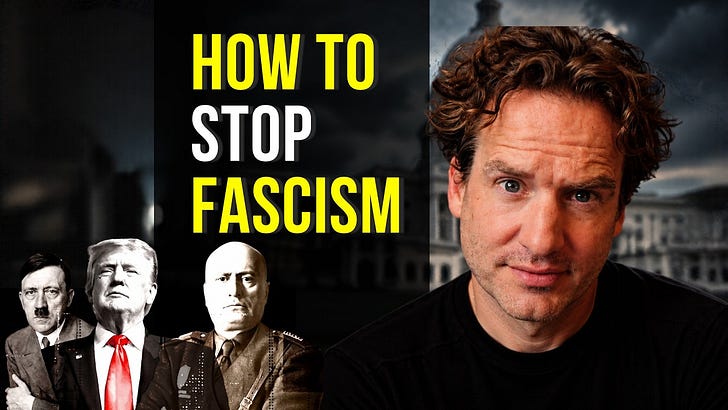
How to Stop Fascism
Description
Most people who recognize what is happening in their country right now share one thing in common. They don’t know what to do about it.
They vote. They post. They argue at Thanksgiving. And then they go back to their lives and hope someone else figures it out. This is not cowardice. It is the absence of a plan. And the absence of a plan is one of the most studied problems in the history of political science.
For the better part of a century, researchers across psychology, political science, and conflict studies have been asking the same question: what actually stops authoritarian movements? Not in theory. Not in a seminar. In practice, in the real world, with real dictators and real populations. The answers they found are remarkably consistent, remarkably specific, and remarkably underused.
This piece walks through six researchers whose work, taken together, forms a blueprint for how ordinary people defeat fascism. Not with armies. Not with violence. With behavior.
The Playbook That Toppled Dictatorships
Gene Sharp never held public office, never led a protest, and never ran an organization with more than three employees. For the last fourteen years of his life, he ran the Albert Einstein Institution out of two rooms in a brick townhouse in East Boston, near Logan Airport, where he also grew rare orchids.
He was, by almost every account, the most consequential political scientist of the twentieth century that most people have never heard of.
Sharp was born in 1928, the son of a traveling minister in Ohio. As a young man, he refused the draft during the Korean War and spent nine months in federal prison in Danbury, Connecticut. While preparing for his sentence, he wrote a letter to Albert Einstein at Princeton asking if the physicist would contribute an introduction to his book on Gandhi. Einstein, a pacifist, agreed. Sharp later named his institution after him.
Over the next five decades, Sharp produced an enormous body of work on a single subject: the mechanics of political power. His central insight was deceptively simple. All political power, including the power of dictators, depends on the obedience and cooperation of the population. No regime can function when enough of its people withdraw that cooperation. The military can’t deploy if soldiers refuse. The economy can’t run if workers stop. The government can’t govern if citizens stop complying.
In 1973, Sharp published his three-volume masterwork, The Politics of Nonviolent Action, in which he catalogued 198 specific methods of nonviolent resistance. Boycotts. Strikes. Sit-ins. Tax refusal. Slow compliance. Deliberate inefficiency. Each method was documented from real historical examples.
Twenty years later, in 1993, a Burmese exile asked Sharp to write something shorter. Something that ordinary people could read and use in the field. The result was From Dictatorship to Democracy, a 93-page manual that compressed four decades of research into a step-by-step framework for dismantling authoritarian regimes without firing a single shot.
The Burmese military junta sentenced anyone caught with the book to seven years in prison. That did not stop it from spreading. The book was translated into more than 30 languages. It was smuggled into Serbia, where the student resistance movement Otpor used it as a field manual to organize the campaign that brought down Slobodan Milosevic in 2000. Oleh Kryenko, one of the leaders of Ukraine’s Orange Revolution, said publicly that Sharp’s book was “the bible” of the resistance. In Egypt, copies circulated in Tahrir Square during the 2011 revolution.
Sharp died in January 2018, at ninety years old, in the same East Boston townhouse where he had worked for decades. His obituary in the Washington Post called him a “preacher’s son whose own gospel of nonviolent struggle inspired velvet revolutions that toppled dictators on four continents.” A Scott