Episode Details
Back to Episodes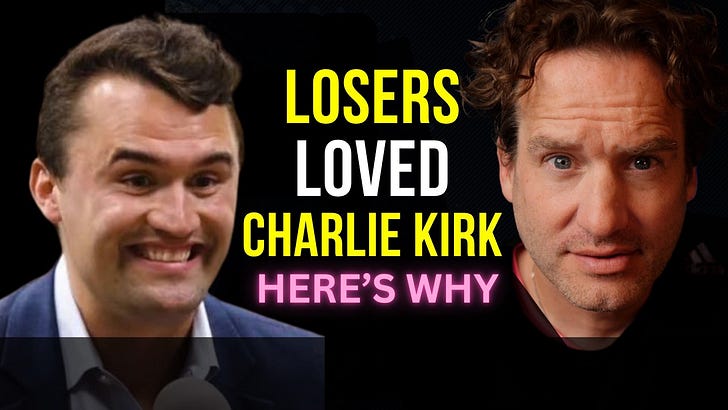
Why Losers Loved Charlie Kirk
Description
Charlie Kirk never graduated from college. He applied to West Point, was rejected, and instead of trying again somewhere else, he built a career telling other people that college was the problem. That decision, and the audience it attracted, is one of the cleanest real-world examples of a psychological phenomenon that researchers have been studying for years.
In 2020, psychologist Hallgeir Sjåstad at the Norwegian School of Economics published a study with co-authors Roy Baumeister at the University of Queensland and Michael Ent at Towson University that investigated what happens inside a person’s psychology after they fail to reach a goal they genuinely wanted. The finding was not that people feel bad and move on. The finding was that people rewrite the goal itself. After failure, the thing they wanted becomes the thing they never really wanted in the first place. Sjåstad and his co-authors called this the sour-grape effect, after Aesop’s fable of the fox who, unable to reach the grapes hanging above him, walked away declaring they were probably sour anyway.
The most striking part of the research was that this revision is not a conscious lie. Participants in Sjåstad’s experiments genuinely believed their diminished assessment of the goal was what they had always felt. The original desire had been overwritten. The failure was not denied. It was erased and replaced with a new narrative that never included wanting the thing in the first place.
This is the psychological engine that powered Charlie Kirk’s entire career.
The Audience Kirk Built
Kirk’s audience was not random. It was psychologically specific. His core following was built from young men in their twenties and thirties who did not go to college and needed a story for why that was the right outcome. Some of them could not afford it. Some were not academically prepared. Some were afraid to leave their small towns. The reasons varied but the emotional need was the same. They needed college to be a scam so that not going to college was not a failure.
Kirk provided that story on camera, over and over, hundreds of times. He would walk onto college campuses with a microphone and a film crew and engage college students in exchanges designed to produce a very specific visual: a confident adult making a teenager look foolish. The format was rigged from the start. Kirk was thirty years old, had spent years practicing rapid-fire talking points, and controlled the microphone. The students were eighteen or nineteen, standing in public, often encountering these arguments for the first time. The outcome was never in question.
But the content of those exchanges was almost irrelevant. What mattered was the image. A man who did not go to college standing on a college campus and appearing to dominate the people who did. For Kirk’s audience, every one of those clips was a piece of evidence in the story the sour-grape effect had already written for them. College is worthless. The people who go there are not that smart. Not going was the right call.
The fact that Kirk’s method relied on talking over people, cutting off responses, and rattling through false claims faster than anyone could fact-check them in real time did not matter to his audience. They were not watching for intellectual rigor. They were watching for confirmation. And Kirk delivered it by the hour.
What the Research Tells Us About Why This Worked
Sjåstad’s study revealed something important about who is most susceptible to the sour-grape effect. Not everyone in his experiments responded to failure by devaluing the goal. People with high achievement motivation, those who were internally driven and comfortable with setbacks, were less likely to revise their assessment. They could fail and still acknowledge the goal was worth pursuing.
The people most prone to the sour-grape effect were those whos