Episode Details
Back to Episodes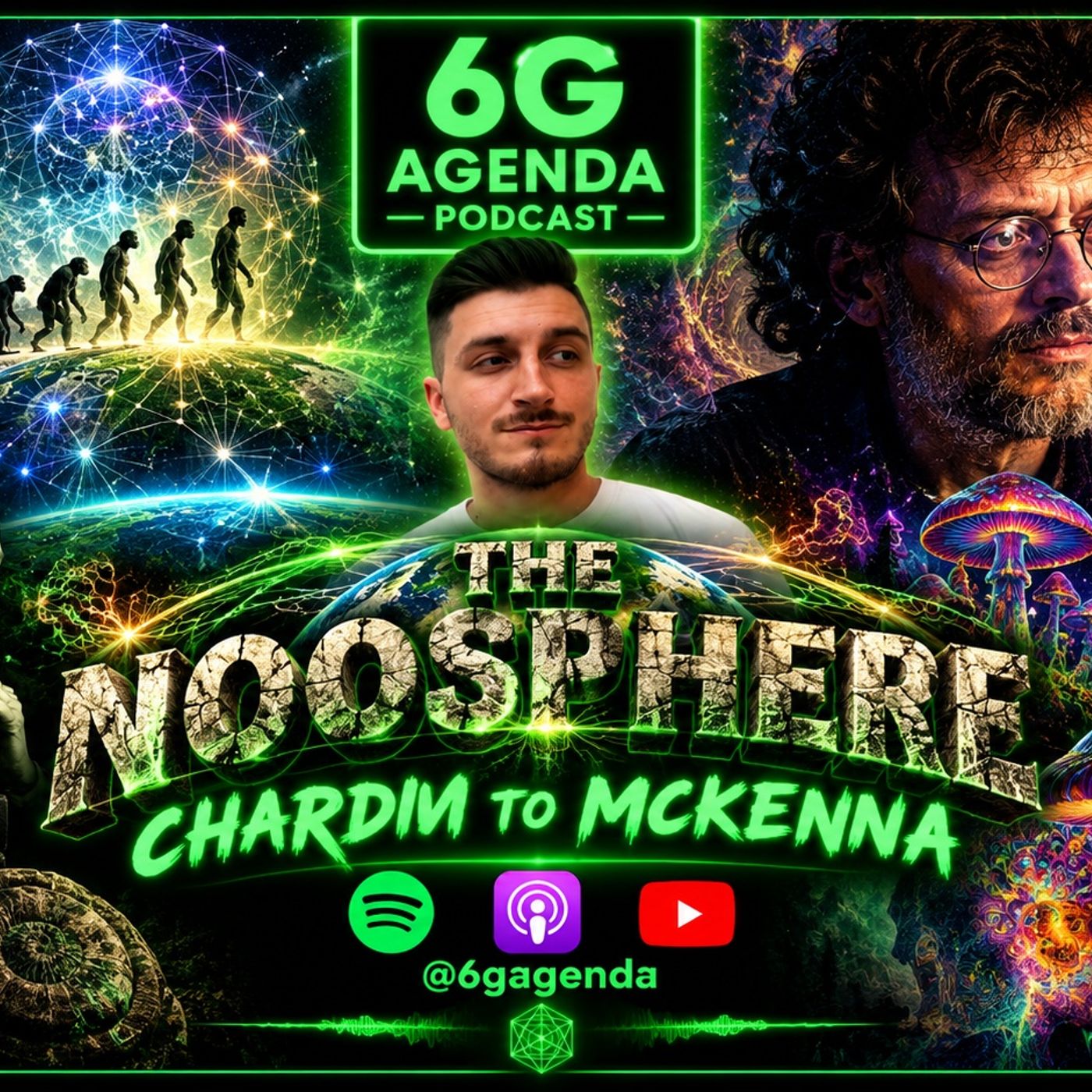
#175: The Noosphere: Chardin to Mckenna
Season 1
Episode 175
Published 1 week, 5 days ago
Description
Yes, those ads are annoying, but it helps support the show!
For Early Access, Ad-Free video episodes become a member on Spotify, YouTube or Join Patreon!
In this episode of 6G Agenda, we investigate the concept of the Noosphere, tracing its evolution from the philosophical and theological writings of Pierre Teilhard de Chardin to the psychedelic futurism of Terence McKenna and the consciousness movement surrounding California’s Esalen Institute.
The Noosphere describes a sphere of human thought and collective consciousness emerging alongside the biosphere. But what happens when this concept is connected to theories of evolutionary progress, technological convergence, global governance and the idea that humanity is moving toward a fundamentally different state of existence? We begin with Teilhard de Chardin, the Jesuit priest and paleontologist who envisioned evolution as a process moving toward increasingly complex consciousness and ultimately toward what he called the Omega Point. His ideas helped establish a philosophical framework for thinking about humanity as an interconnected system evolving toward a higher level of consciousness.
From there, we move into Terence McKenna, whose psychedelic philosophy explored the Noosphere, novelty, technological acceleration and the possibility of a profound transformation in human consciousness. We examine how McKenna’s ideas about humanity’s future intersect with the broader Esalen movement and its experiments in psychology, spirituality, human potential and altered states of consciousness.But this episode takes a different angle. We connect these spiritual and evolutionary philosophies to the history of American elite organizations, Fabian socialism, Malthusian population theory and the eugenics movement. We investigate the historical relationships among these intellectual circles and ask whether apparently different visions of human progress sometimes share an underlying assumption: that humanity can—and perhaps should—be deliberately transformed.
This brings us to Julian Huxley and Aldous Huxley, two brothers whose work explored human evolution and the future of civilization from different perspectives.Julian Huxley was a prominent evolutionary biologist, a leading figure in the history of modern evolutionary synthesis, and an advocate of eugenics during part of his career. He also popularized the term transhumanism in his 1957 essay of the same name, describing the possibility that humanity could transcend its existing limitations through conscious evolutionary change.His brother Aldous Huxley, author of Brave New World, explored psychological conditioning, social control, consciousness and the dangers of technologies that could shape human behavior. Aldous also participated in the Esalen community, where his interests in human potential and expanded consciousness overlapped with the work of figures such as Alan Watts and other influential thinkers.
The central question is whether these seemingly separate currents—Theosophy, evolutionary spirituality, eugenics, Malthusianism, Esalen’s human-potential movement and transhumanism—can be understood as part of a wider history of attempts to direct humanity’s future.
Topics covered include:
- The Noosphere and the evolution of collective consciousness
- Pierre Teilhard de Chardin
- Teilhard’s Omega Point
- Evolution, complexity and consciousness
- Terence McKenna and the Noosphere
- McKenna’s ideas about novelty and the future
Listen Now
Love PodBriefly?
If you like Podbriefly.com, please consider donating to support the ongoing development.
Support Us