Episode Details
Back to Episodes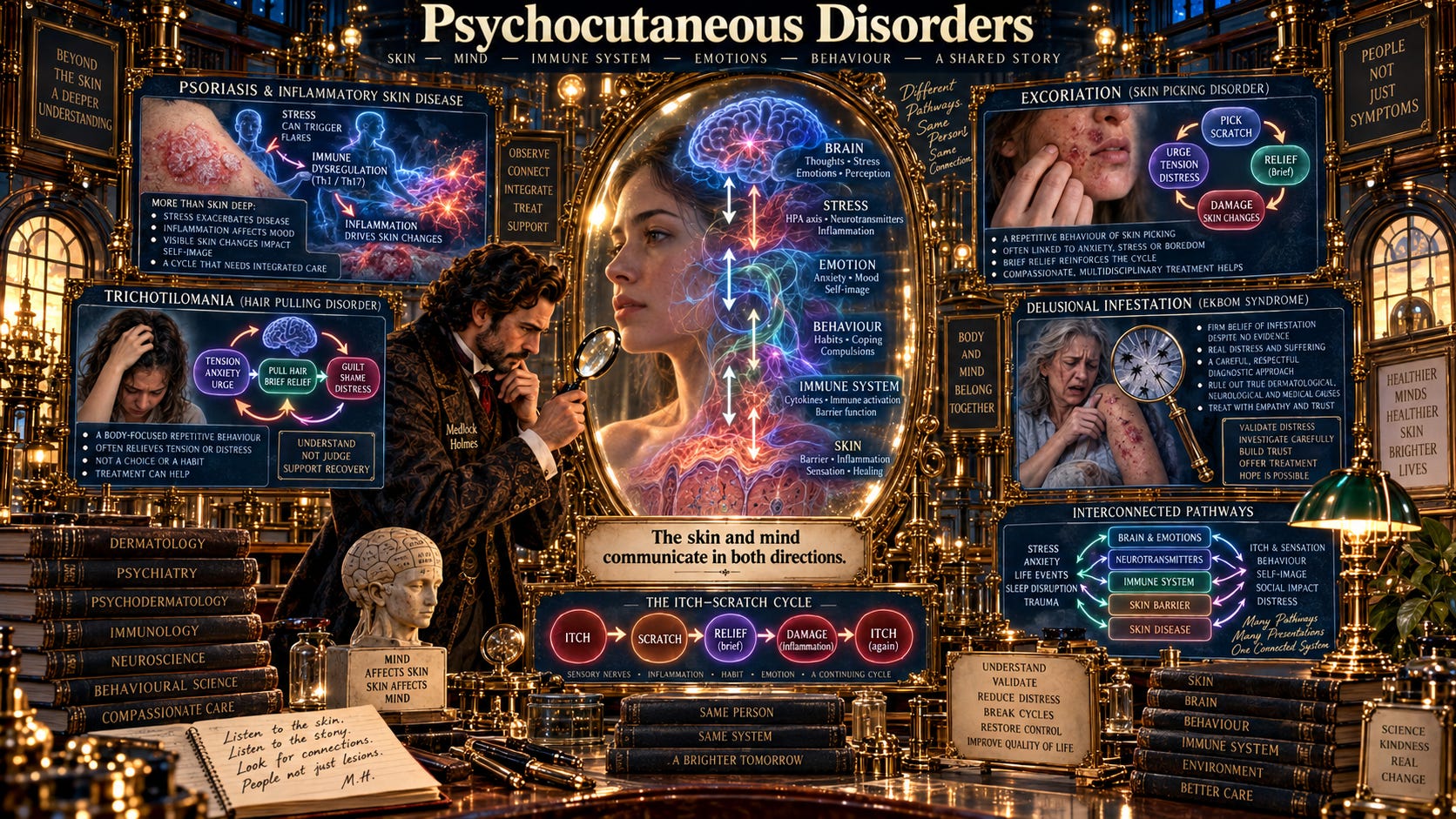
PSYCH 153: Psychocutaneous Disorders
Description
how visible skin disease can reshape identity, relationships and mental health.
Episode Description
Medlock Holmes enters The Gallery of the Skin, an unusual medical chamber lined entirely with mirrors.
Unlike the hidden organs of the body, the skin cannot easily conceal its illness.
A lesion may be painful or itchy - but it can also be seen.
A scar can change appearance.
Hair loss can change identity.
Acne can transform adolescence.
Psoriasis can affect intimacy.
And an itch can provoke scratching that produces further inflammation, which creates still more itch.
Holmes quickly discovers why the skin occupies a unique place in psychiatry.
It is simultaneously:
ORGAN • SENSORY SURFACE • SOCIAL SIGNAL • BOUNDARY • BODY IMAGE
And there is another remarkable connection.
The brain and skin both arise embryologically from ectoderm, and both participate in networks involving neurotransmitters, hormones, immune mediators and responses to stress.
Psychodermatology therefore investigates a multidirectional relationship:
MIND ↔ BRAIN ↔ SKIN
The first mistake Holmes avoids is assuming that a psychological contribution means that a skin disorder is imaginary.
Stress can alter autonomic, endocrine and immune processes and exacerbate genuine dermatological disease.
Conversely, genuine dermatological disease can produce depression, anxiety, shame, social withdrawal and disturbances of body image.
And psychiatric disorders can themselves produce skin manifestations through scratching, picking, pulling, self-injury or fixed beliefs about the skin.
Holmes therefore divides the gallery into several rooms.
The first contains psychophysiological disorders.
Here there is genuine dermatological disease, but psychological factors - particularly stress - can influence its onset or severity.
Examples include:
PSORIASIS • ATOPIC DERMATITIS • URTICARIA • ACNE • ALOPECIA AREATA
The relationship can become circular:
STRESS → SKIN FLARE → DISTRESS → MORE STRESS → FURTHER FLARE
The second room contains primary psychiatric disorders presenting through the skin.
Here the principal pathology lies within psychiatric processes, although genuine skin injury may subsequently develop.
Holmes finds several important examples:
DELUSIONAL PARASITOSIS
EXCORIATION DISORDER
TRICHOTILLOMANIA
BODY DYSMORPHIC DISORDER
FACTITIOUS DERMATITIS
The third room reverses the direction.
These are secondary psychiatric consequences of skin disease.
A patient may begin with psoriasis, acne, alopecia, scarring or another visible dermatological condition and subsequently develop:
DEPRESSION • ANXIETY • SHAME • SOCIAL WITHDRAWAL • LOW SELF-ESTEEM
Holmes notices something important.
The psychological burden is not necessarily proportional to the dermatological severity.
A medically minor lesion on the face may produce enormous distress.
More extensive disease hidden beneath clothing may sometimes produce less.
The psychiatrist must therefore distinguish:
OBJECTIVE SKIN SEVERITY
from
SUBJECTIVE PSYCHOLOGICAL IMPACT
The mirrors in the gallery become particularly important when Holmes encounters body dysmorphic disorder.
The person sees a defect that appears minimal or nonexistent to others, yet experiences it as profoundly disturbing.
They may repeatedly check mirrors, camouflage the perceived defect, compare themselves with others, seek reassu