Episode Details
Back to Episodes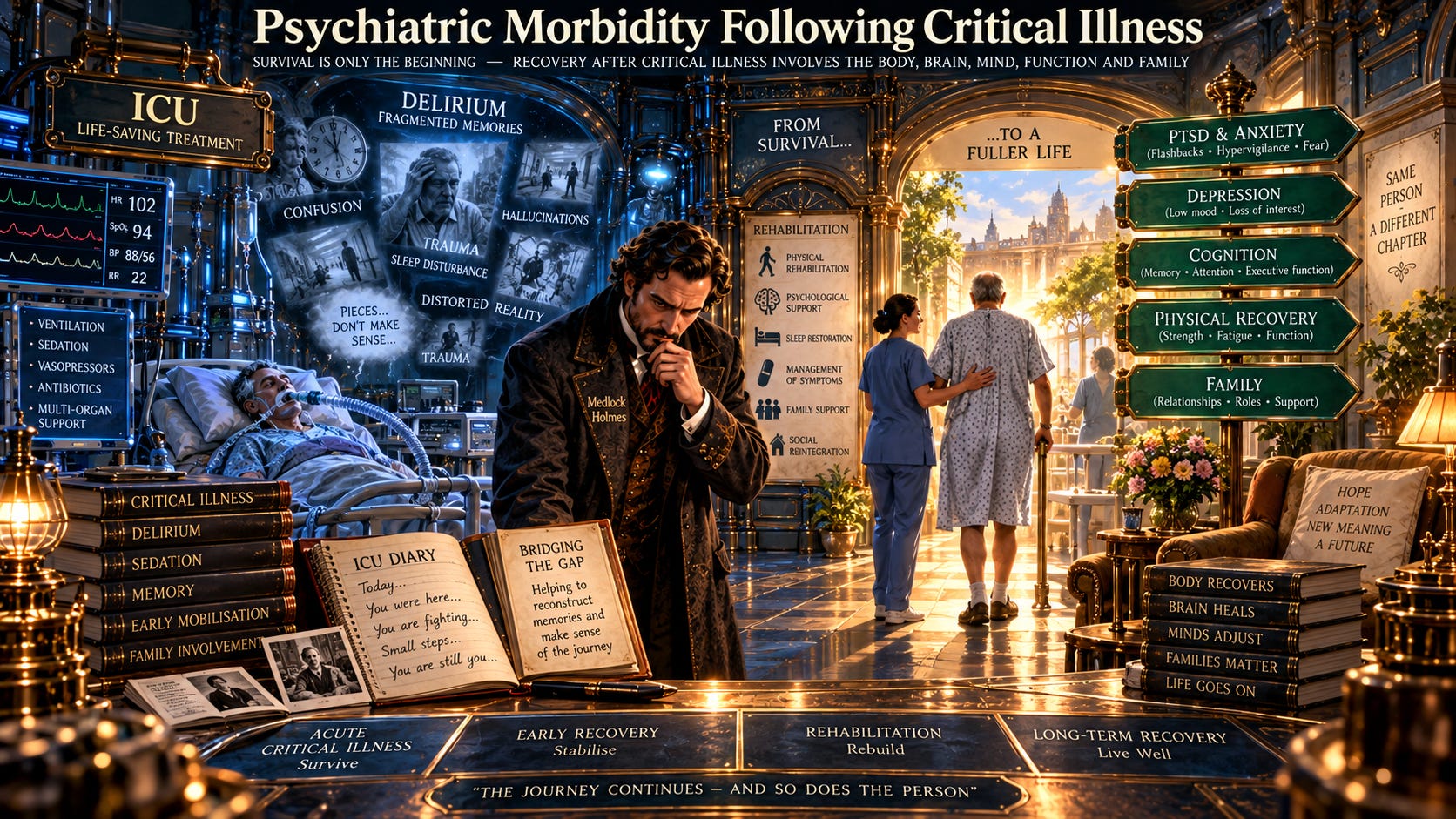
PSYCH 152: Psychiatric Morbidity Following Critical Illness
Description
and the difficult task of rebuilding an ordinary life.
Medlock Holmes enters The Recovery Ward.
The monitors have stopped alarming. The ventilator has been disconnected. The infection has been treated. The patient has survived.
By conventional medical measures, the emergency is over.
Yet Holmes notices something strange.
The patient cannot remember parts of his admission, but vividly remembers terrifying hallucinations. He startles at the sound of medical equipment. A minor cough makes him fear that he is dying again. He cannot concentrate as he once could. His muscles remain weak. He has lost confidence in his body, his work and his future.
His family survived the crisis too - but they have not necessarily recovered from it.
This is the central mystery of psychiatric morbidity following critical illness:
What happens after medicine saves the body, but the experience of almost dying continues to affect the brain, mind, body and family?
The modern answer is captured by the concept of post-intensive care syndrome.
Critical illness can leave difficulties across three overlapping domains:
PSYCHIATRIC MORBIDITY + COGNITIVE IMPAIRMENT + PHYSICAL DYSFUNCTION
And surrounding all three is a fourth:
FAMILY DISTRESS
Holmes therefore reconstructs what an ICU admission actually feels like from the patient’s perspective.
There may be respiratory failure, invasive procedures, endotracheal intubation, suctioning, arterial and central lines, urinary catheters and chest tubes.
There may be pain.
There is often profound loss of autonomy.
Communication may become impossible.
But perhaps most importantly, the brain itself may not be functioning normally.
Infection, systemic inflammation, organ failure, hypoxia and sedative medication can contribute to acute brain dysfunction. Reality becomes unreliable.
A procedure performed to save someone’s life may be incorporated into a terrifying delusion. Staff trying to provide care may appear threatening. Hallucinations can become extraordinarily vivid.
The ICU can therefore generate an unusual form of memory:
REAL EVENTS + DELIRIUM + HALLUCINATIONS + FRAGMENTED MEMORY
For the patient, these experiences may all feel equally real.
Holmes discovers why this matters when he examines the numbers.
Among adult survivors of critical illness, the chapter describes clinically significant symptoms of approximately:
PTSD - 20%DEPRESSION - 30%ANXIETY - 35%
These symptoms can contribute substantially to the reduced health-related quality of life experienced after critical illness.
But the ICU does not create vulnerability from nothing.
One of the strongest clues is previous psychiatric illness.
Other risk markers include greater exposure to benzodiazepines or sedatives, mechanical ventilation, frightening memories of psychotic experiences in intensive care and substantial emotional distress soon after leaving the ICU.
This makes the early recovery period clinically important.
EARLY DISTRESS → GREATER RISK OF PERSISTENT MORBIDITY
Holmes then enters the paediatric recovery ward.
Children and adolescents can also develop substantial psychiatric symptoms following critical illness. PTSD symptoms are reported in a significant minority, as are depressive symptoms.
Again, pre-existing psychiatric or developmental difficulties are particularly important predictors.
But here Holmes finds another interconnected system:
CHILD ↔ PARENT
A critically ill child does not experience illness in isolation.
Parental PTSD, anxiety and depression correlate with psychia