Episode Details
Back to Episodes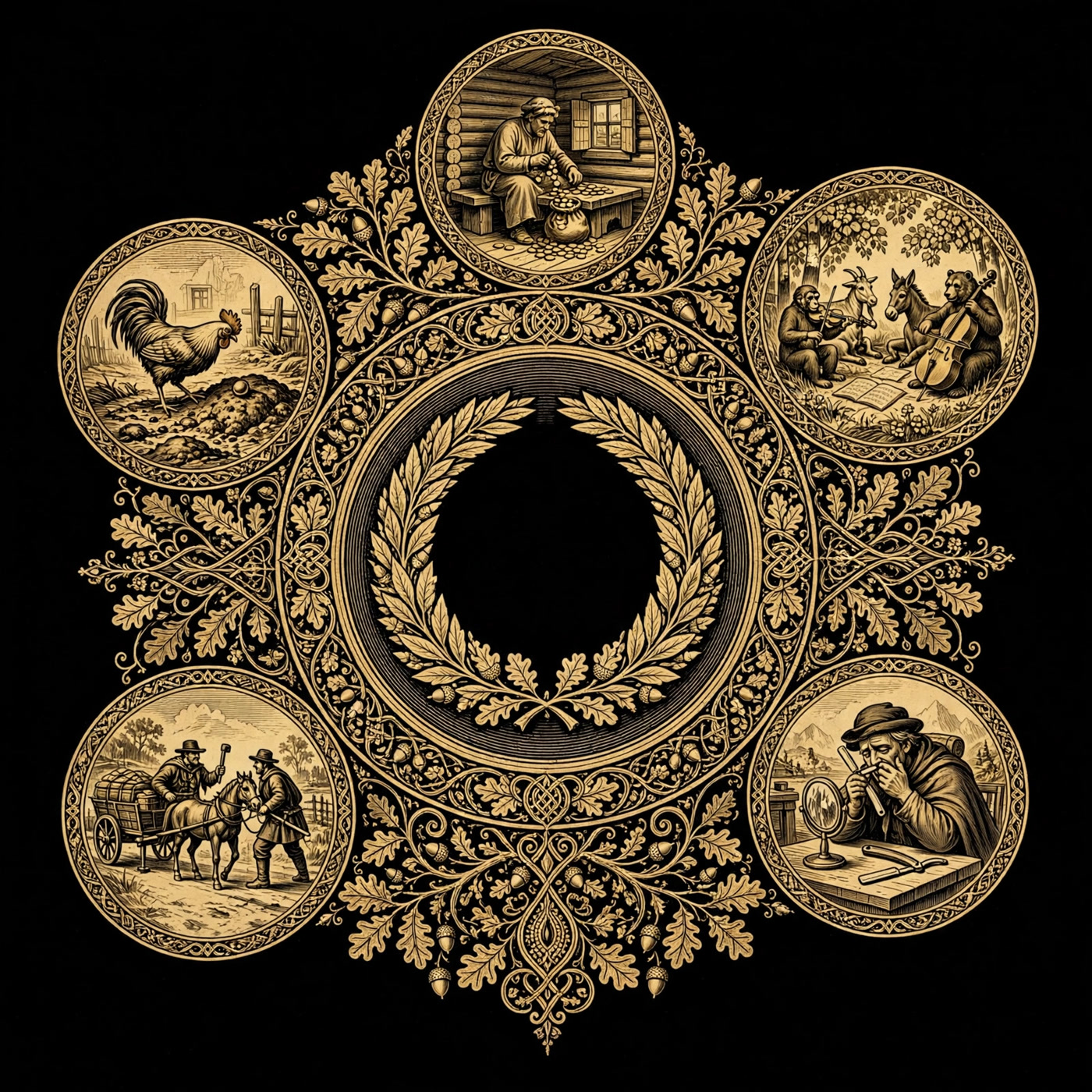
The Fables of Ivan Krylov — Episode Thirty-One
Description
The Fables of Ivan Krylov — Episode Thirty-One
Five fables by Ivan Krylov (1769–1844), in new English verse translations made for this show, read aloud over a gentle instrumental bed.
The Poor Rich Man (Бедный Богач, Book VIII, No. 9) — A Poor Man in his low hut reasons that wealth is a torment when a man never eats, never sleeps, and only heaps up gold: give him riches, and he would feast, be heard of far away, and do good to others. Through a crack in the wall comes a visitor — a sorcerer, some say; a demon, say others — with a purse that holds one gold piece, and always one more: he may draw without end, but he may not spend a single coin until the purse goes into the river. Krylov lets the counting do the rest.
The Quartet (Квартет, Book IV, No. 1) — The mischievous Monkey, the Donkey, the Goat and the club-footed Bear get hold of the music — a bass, an alto, two violins — and sit down under the lindens to charm the world with their art. They strike the bows and tear away, and nothing comes of it. It must be the seating! They rearrange, they sit in a row, they quarrel over who should sit where — until the Nightingale flies in on the noise and gives Krylov's most famous closing verdict.
Razors (Бритвы, Book VIII, No. 7) — Two travellers share a night's lodging, and in the morning one of them shaves — groaning, sighing, screwing up his face at the mirror as if he were being flayed. His razors are not razors at all but cleavers, and he knows they are blunt: he keeps them because he is afraid of cutting himself with sharp ones. Krylov answers him on the spot, and then turns the tale on everyone who fears clever people and prefers fools around them.
The Robber and the Coachman (Разбойник и Извозчик, Book IX, No. 8) — At dusk a Robber lies in the bushes by the road like a hungry bear, watching a loaded wagon roll toward the fair — cloth, damask and brocade, surely; the day will not be wasted. But the Coachman is no lout: he meets the cudgel with a stout plank and stands for his goods like a mountain. The fight is long and cruel, and the Robber wins it at the price of a dozen teeth, a smashed arm and an eye. Krylov's closing line asks what, exactly, he had won.
The Rooster and the Pearl Grain (Петух и Жемчужное зерно, Book II, No. 18) — Raking through a dungheap, a Rooster finds a Pearl Grain — and cannot see the use of it. What an empty thing! Is it not foolish that men prize it so high? He would far rather have a grain of barley: not so fair to look at, but filling. Krylov's two-line closing moral is for every ignoramus who calls a thing a trifle because he cannot make sense of it.
Krylov Fables.
KacheliTV — Russian classics, read aloud.