Episode Details
Back to Episodes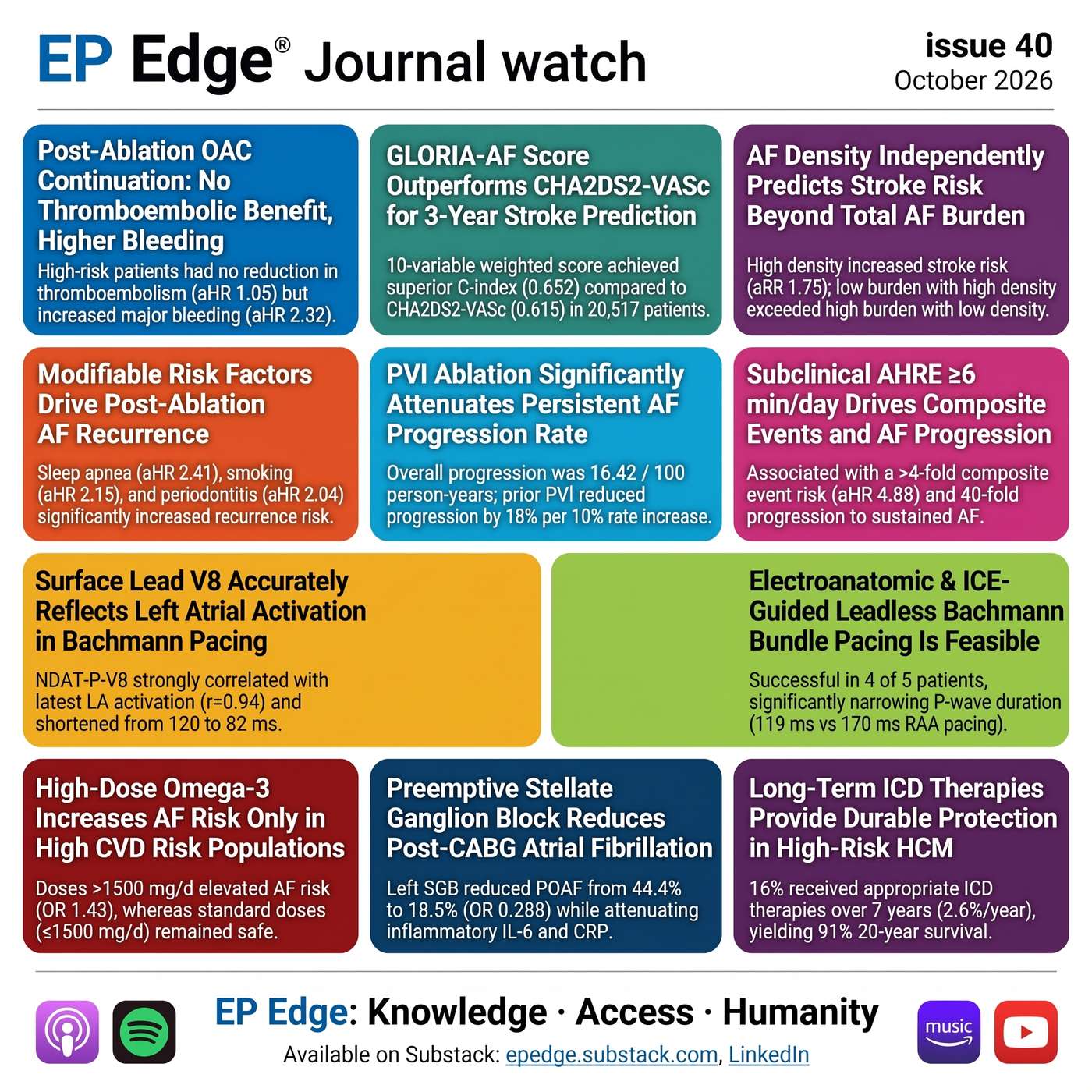
EP Edge® Journal Watch 40, October 2026: AF Ablation, Anticoagulation, Stroke Risk, GLORIA-AF, Stellate Ganglion Block, and ICD Outcomes
Description
EP Edge® Journal Watch | Issue 40 | October 2026
Beyond AF Burden: Stroke Risk, Rhythm Progression, Atrial Pacing, and Sudden Death Prevention
Should oral anticoagulation continue after successful atrial fibrillation ablation? Does AF density provide better stroke-risk information than conventional burden measurements? Can the GLORIA-AF score improve thromboembolic risk prediction? And could autonomic modulation or advances in pacing and defibrillator therapy change electrophysiology practice?
In Issue 40 of EP Edge® Journal Watch, Dr. Sharma examines eleven research papers, with detailed analysis of five major studies and concise reviews of six additional publications.
The episode explores study methodology, statistical interpretation, clinical relevance, and the distinction between promising associations and evidence sufficient to change practice.
Featured Studies
1. Anticoagulation After AF Ablation | Ren et al.
A prospective observational analysis of 13,669 patients examines continuation versus discontinuation of oral anticoagulation following catheter ablation.
Continued anticoagulation after six months was not associated with a statistically significant reduction in thromboembolism across stroke-risk categories, while major bleeding was higher in anticoagulated high-risk patients. The interpretation is complicated by nonrandom treatment selection, differences in baseline stroke risk, and incomplete quantitative AF burden assessment.
We discuss adjusted hazard ratios, absolute event rates, confidence intervals, confounding by indication, and the implications of contemporary randomized evidence, including ALONE-AF, OCEAN, and OPTION.
The accompanying editorial by Alhassan and Kwaku provides additional context for individualized anticoagulation strategies after ablation.
Ren et al. DOI:
https://doi.org/10.1161/JAHA.125.047527
2. AF Density and Ischemic Stroke | Rosman et al.
Can the temporal clustering of atrial fibrillation episodes improve stroke prediction beyond total AF burden?
This observational study of 12,868 patients with implanted cardiac monitors evaluates AF density, a measure of how concentrated or dispersed arrhythmia episodes are over time.
Higher AF density was associated with greater modeled ischemic stroke risk, even when cumulative AF burden was considered.
We examine the parametric g-formula, adjustment for time-varying covariates, competing risks, and why a prognostic association does not establish a treatment threshold for anticoagulation.
Rosman et al. DOI:
https://doi.org/10.1093/eurheartj/ehag203
3. GLORIA-AF Stroke Weighted Risk Score | Xie et al.
A new weighted stroke-risk score incorporating ten routinely available clinical variables is developed in 20,517 patients and externally validated in 8,309 patients from European and Asia-Pacific AF registries.
The score demonstrated statistically better stroke discrimination than CHA₂DS₂-VA, with external validation C-index values of 0.652 versus 0.616.
We examine discrimination, calibration, integrated discrimination improvement, net reclassification improvement, and decision-curve analysis.
A central question is whether better statistical prediction produces sufficiently meaningful improvement to influence anticoagulation decisions, particularly when many patients in the derivation cohort were already anticoagulated.
Xie et al. DOI:
https://doi.org/10.1093/europace/euag236
4. Stellate Ganglion Block and Postoperative AF | Tian et al.
A randomized controlled trial evaluates preempti