Episode Details
Back to Episodes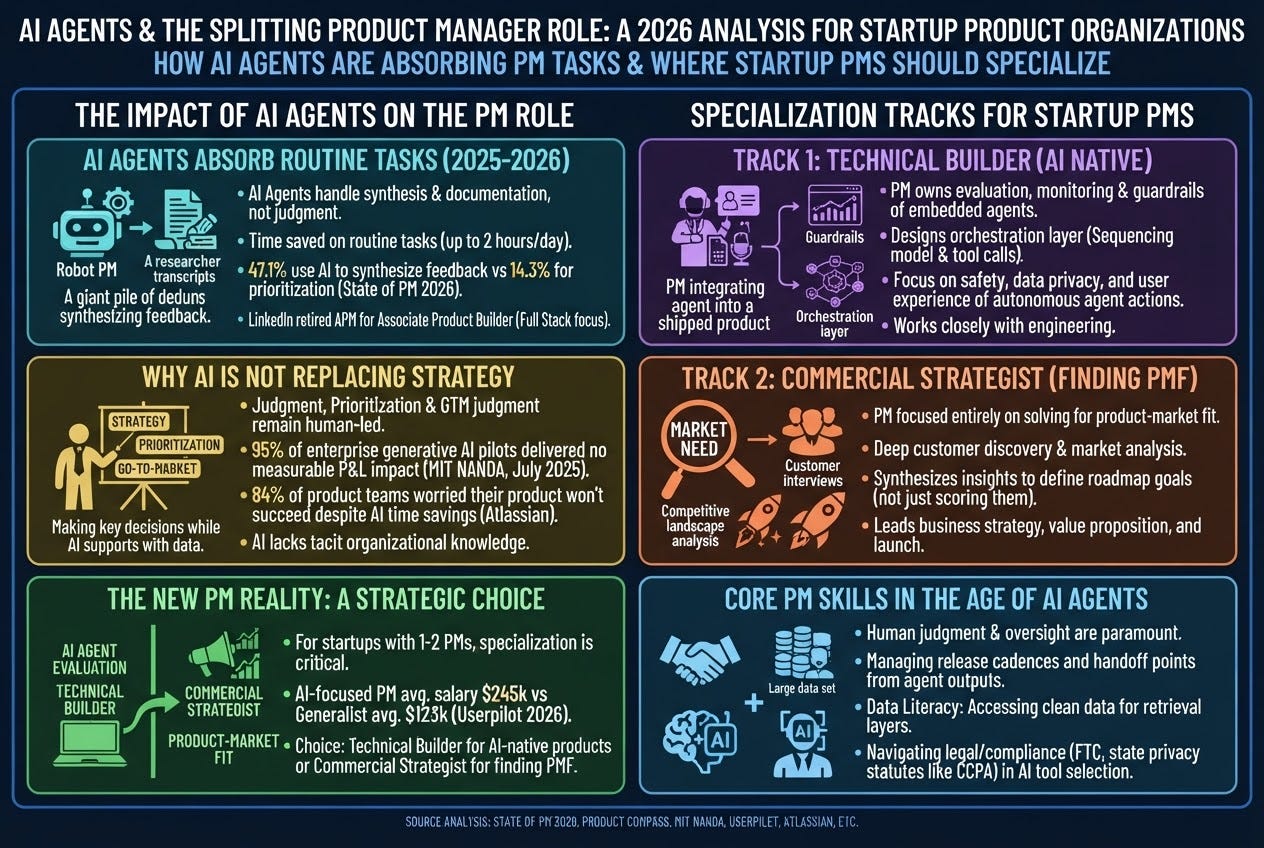
AI Agents Absorb Product Manager Tasks
Description
AI agents in 2026 are absorbing product management’s feedback synthesis and documentation work, and LinkedIn retired its Associate Product Manager program in favor of an Associate Product Builder track. A State of Product Management 2026 survey of roughly 250 professionals found 47.1 percent of respondents already hand feedback synthesis to AI, while only 14.3 percent trust AI with prioritization, the judgment call that still separates one product manager from another. A startup with one or two product managers now faces a real choice: push toward the technical builder track that ships product directly with AI, or the commercial strategist track that owns the pricing, packaging, and go to market judgment AI still cannot supply.
what product management tasks is ai actually handling now
The plain answer sits closer to a research assistant than a replacement. A tool called Dovetail, cited in ChatPRD’s 2026 guide to AI for product managers, reads fifty user interview transcripts and produces a thematic summary in under an hour, a task that used to consume a researcher’s full week of coding transcripts by hand. ChatPRD’s own product requirements document generator cuts drafting time by 60 percent by pulling from a company’s prior documents and engineering constraints instead of starting from a blank page. Jira’s AI sprint planning feature reportedly cuts planning time by 30 percent. None of these tools decide what to build. They compress the distance between raw customer input and a document a human can act on.
That distinction shows up cleanly in the survey data. The State of Product Management 2026 report found product managers use AI for summarizing feedback at 47.1 percent, drafting research briefs at 40.2 percent, and structuring qualitative insight at 40.2 percent. Prioritization sits at 14.3 percent, built on the identical underlying technology. The gap is not a capability gap. It is a context gap, and it is the whole story of this moment.
why does ai handle synthesis but not prioritization
The Massachusetts Institute of Technology’s NANDA initiative spent 2025 asking exactly this question across large companies, surveying 52 executives and 153 business leaders and analyzing 300 public AI deployments. Its July 2025 report, The GenAI Divide: State of AI in Business 2025, found that 95 percent of enterprise generative AI pilots delivered no measurable profit and loss impact, and traced the failure overwhelmingly to a gap between the tool and the specific workflow it entered, not to any shortfall in the underlying model.
A prioritization call depends on a specific engineering team’s remaining capacity this quarter, a specific investor’s stated expectation ahead of the next fundraising round, and a specific customer’s contract terms. None of that lives in a feedback transcript. Atlassian’s State of Product 2026 survey of more than 1,000 product managers, engineers, designers, and program managers across the United States, France, and Germany found the same pattern from the other direction: teams save roughly two hours a day on routine tasks, while 84 percent remain worried their product will not succeed in the market, because the tool that saved them two hours had nothing to say about whether the roadmap itself was right.
why did linkedin retire its associate product manager program
LinkedIn Chief Product Officer Tomer Cohen gave the plainest answer on record, in an interview with Lenny Rachitsky published on Lenny’s Newsletter in 2026. The company retired its Associate Product Manager program and replaced it with an Associate Product Builder program under a new Full Stack Builder title, training entrants in coding, design, and product management together, not product management alone. Cohen’s stated reasoning was commercial, not philosophical: the old model let organizational layers slow a feature from idea to release to a six month cycle, and a Full Stack Builder who can ship