Episode Details
Back to Episodes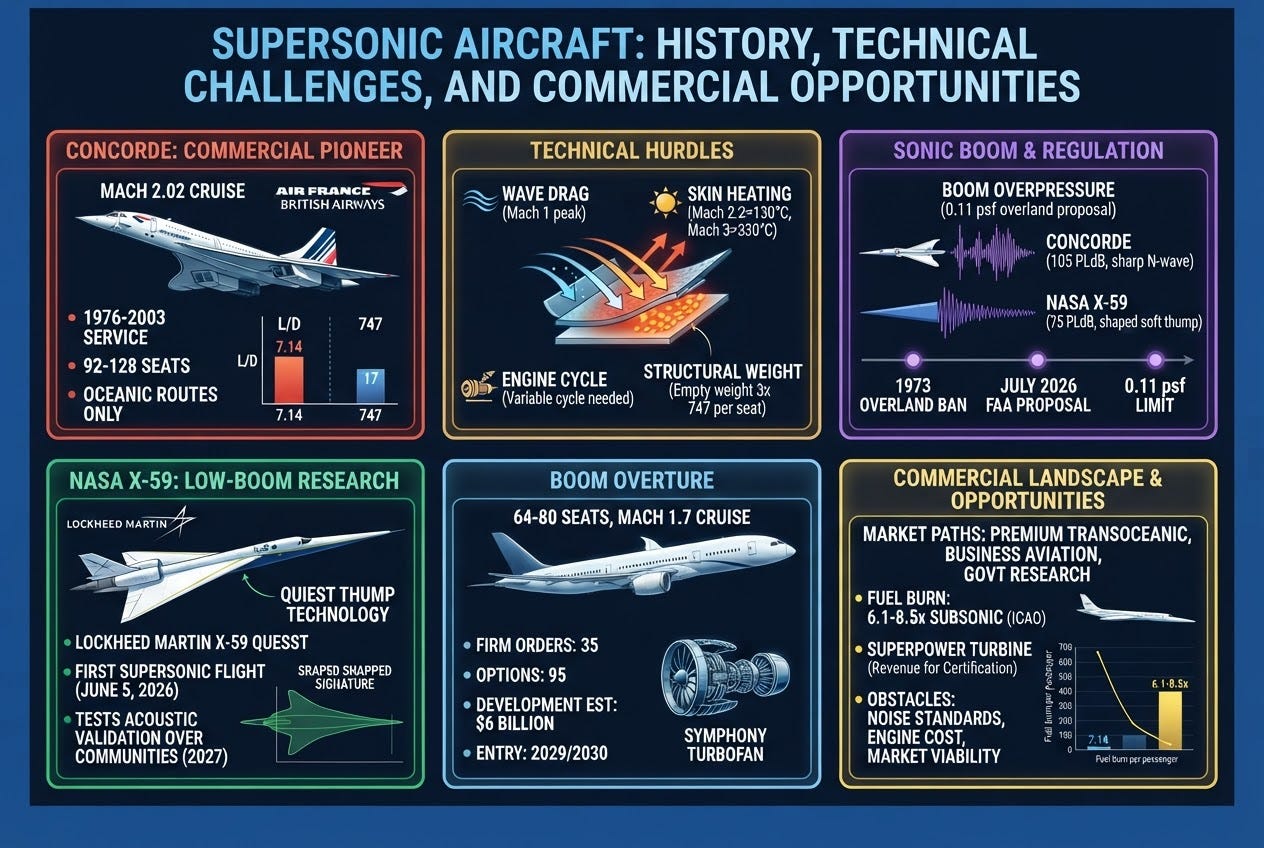
When Will Supersonic Passenger Flights Return After Concorde Retired
Description
Supersonic aircraft burn 6.1 to 8.5 times more fuel per passenger than twin aisle jets, and the FAA’s July 2, 2026 proposal addresses only sonic boom overpressure at 0.11 psf.
That gap shapes every business plan now being financed. Docket FAA-2026-6935 would repeal the speed based overland ban in 14 CFR 91.817, which dates to 1973, and the comment period closed on August 17, 2026. The proposal reserves landing and takeoff noise for a later Part 36 rule, and the FAA does not expect type certificate applications for supersonic airliners until that rule exists. Executive Order 14304 sets June 6, 2027 as the deadline for finalizing noise certification standards.
Concorde supplies the baseline. It entered service on January 21, 1976, cruised at Mach 2.02, and carried 92 to 128 passengers on 20 airframes built in total. At full load it delivered 15.8 passenger miles per gallon, and a Boeing 747 delivered 46.4. The 1973 oil crisis raised fuel costs, and the aircraft stayed on oceanic routes because its sonic boom made overland flight impossible without public complaints. Air France Flight 4590 crashed on July 25, 2000, the fleet returned on November 7, 2001 with Kevlar lined fuel tanks, and both airlines retired it in 2003 citing maintenance costs, low passenger numbers, and the air travel slump after September 11, 2001.
Two other programs ended earlier. The House voted 215 to 204 on May 20, 1971 to end funding for the Boeing 2707, with 115 unfilled orders from 25 airlines and no prototype finished. The Tu-144 flew passengers from November 1, 1977 and made its last scheduled flight on June 1, 1978. Each program met the same constraints in fuel burn, noise, and boom, and all of them remain.
The physics explains why. Wave drag near Mach 1 runs about four times subsonic drag, and at about Mach 2 the lift to drag ratio roughly halves, with Concorde at about 7.14 against about 17 for a 747. Skin temperature reaches about 130 degrees Celsius at Mach 2.2, and aluminum loses strength above roughly 127 degrees Celsius. As a nuclear trained submarine officer, I learned that a system lives or dies by where its heat goes. A fast airframe has the same accounting problem, and Concorde’s Mach 2.02 cruise was chosen to extend airframe life.
NASA’s X-59 addresses the boom. It flew supersonic for the first time on June 5, 2026, reaching about Mach 1.1 at 43,400 feet, and NASA stated that Mach 1.4 comes next. The design target is about 75 PLdB, against a nominal 105 PLdB for Concorde. NASA plans to fly over select U.S. communities and survey residents, with results due to the FAA and ICAO in 2027. An ICAO en route low boom standard is not expected until 2031.
Boom Supersonic carries the commercial weight. Its XB-1 demonstrator reached Mach 1.122 on January 28, 2025, and the Overture airliner is specified at Mach 1.7 with 64 to 80 seats and 4,250 nautical miles of range. Boom reports 35 firm orders and 95 options from United, American, and Japan Airlines, a $6 billion development estimate, and entry into service in 2029 or 2030. No FAA type certificate exists for Overture, and a Symphony engine core test is planned for 2026. In December 2025 Boom closed a $300 million round and introduced Superpower, a 42 megawatt natural gas turbine, with Crusoe ordering 29 units.
In three decades of counseling technology companies in Silicon Valley, I have read many financing documents in which a hardware milestone releases the next tranche of capital. Selling turbines before certifying an airframe changes the order of those milestones. The turbine revenue arrives from customers buying a power specification, and the airliner’s certification risk stays with the company. Both risks sit inside the same company.
Aerion shows what happens when the money stops. Its AS2 business jet had a $2.4 billion firm order from Flexjet in 2015 and purchase rights for 20 more aircraft by NetJets in 2021, and the development estimate had