Episode Details
Back to Episodes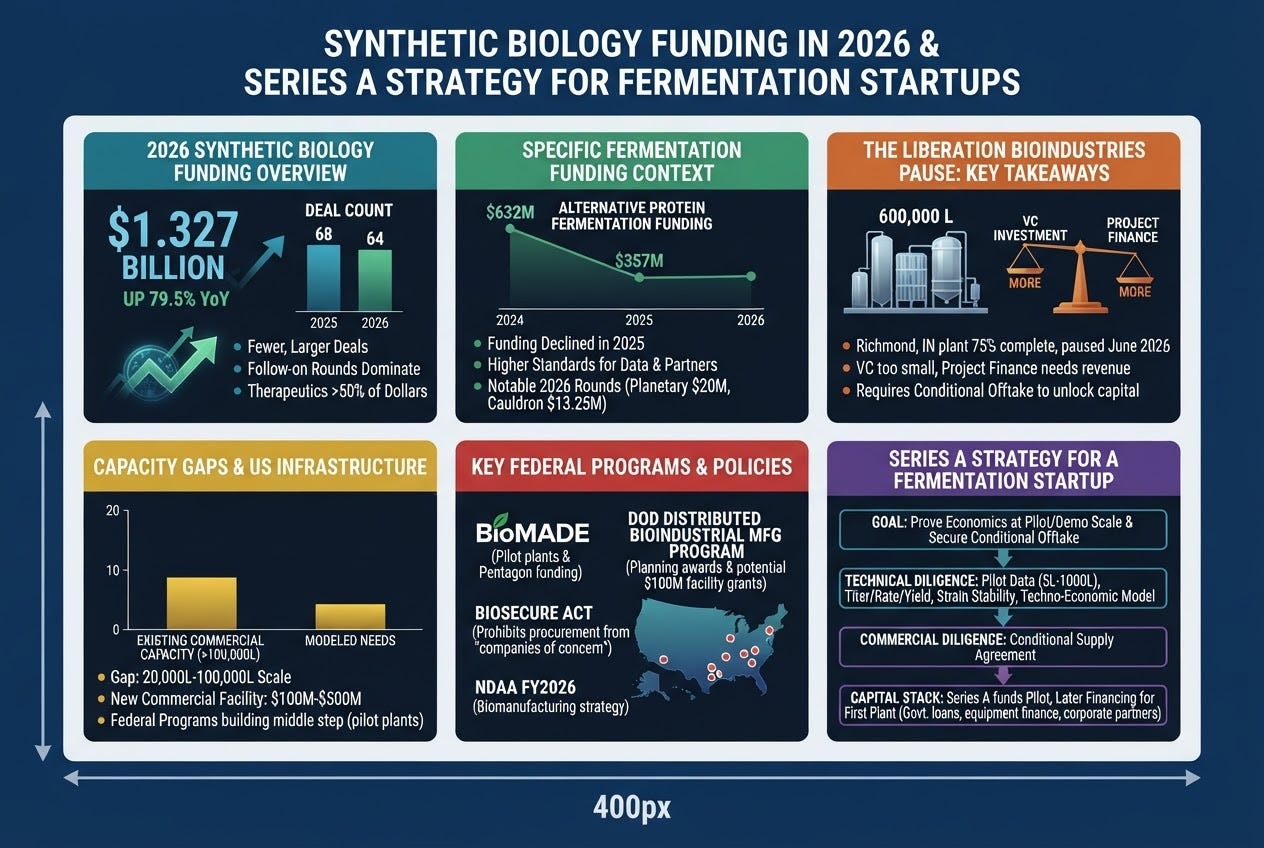
How Should a Fermentation Startup Raise a Series A
Description
A fermentation startup raising a Series A in 2026 needs pilot data and conditional offtake, because Liberation Bioindustries stopped building its 600,000 liter Indiana plant in June 2026 without them.
Synthetic biology investors put $1.327 billion into 64 deals through September 22, 2026, up 79.5% from the prior year. Series A deals rose from 17.6% to 32.8% of all deals, and the median disclosed round reached $13.52 million. The stage is open, and investors are using it to demand proof of production economics.
Liberation’s plant is about 75% complete. The company has raised $70 million to $80 million in equity, assembled a large equipment financing package and secured a $25 million USDA loan guarantee. It reports qualified interest for well over 200% of the plant’s capacity. Construction stopped anyway. Customers want a firm operating date before they sign, and capital providers want signed customers before they lend. The chief executive calls the project too capital intensive for venture capital and too early in revenue for project finance.
That stalemate is the central problem a Series A must solve. A fermentation company that reaches the plant stage without conditional customers will wait, and waiting burns cash. The round has to be sized and timed so the company never needs to finance a plant before customers commit.
The 79.5% rise in dollars needs a second look. Excluding rounds above $50 million, 2026 funding is about 34.8% ahead of 2025. Deal count fell from 68 to 64. Therapeutics account for fewer than one in five deals and more than half of the dollars. Follow on rounds supplied roughly $1.211 billion, and seed deals dropped from almost 40% of activity to below 30%. Money is moving to companies that already have data.
Fermentation shows the same pattern with a sharper edge. Funding for alternative protein fermentation startups fell about 44%, from $632 million in 2024 to $357 million in 2025, after several high profile failures reset what investors expect on timelines and scale. Planetary then announced a Series A of about $20 million in April 2026, led by Radikal Capital and Oetker Ventures, alongside roughly $7.5 million in credit. Cauldron Ferm announced a $13.25 million Series A2 in March 2026, led by Main Sequence. Both rounds sit near or above the $13.52 million median. A raise of $13 million to $20 million cannot build a plant that costs $100 million to $500 million, so the round must buy something else.
What the round should buy is a cost curve. Modeling shows that doubling titer cuts cost of goods about in half, while doubling plant size cuts it about 1.4 times. A startup that shows strain stability across more than ten generations, higher titer and strong downstream recovery at 1,000 to 10,000 liters has shown the variable that matters most. Investors in this market ask for exactly that, along with a techno economic model that tests titer sensitivity.
The federal government is building the pilot step that startups lacked. BioMADE plans a Hayward, California plant with about 4,000 liters for spring 2027, and plants for 2028 in Ames, Iowa, with 10,000 liters, and in Minneapolis. A demonstration plant in Maple Grove, Minnesota, with two 25,000 liter fermenters, carries at least $132 million from BioMADE and the Pentagon. The stated reason is national security: American companies often seek facilities overseas, which raises cost and risks loss of intellectual property.
The Pentagon also made 34 planning awards totaling $60.2 million under its Distributed Bioindustrial Manufacturing Program, with follow on awards giving access to up to $100 million to build a facility. I found no public announcement of a facility award yet. A startup should treat that money as a later source of plant capital and not as a Series A assumption.
A compliance duty runs alongside the money. Section 851 of the fiscal year 2026 National Defense Authorization Act, the BIOSECURE Act,