Episode Details
Back to Episodes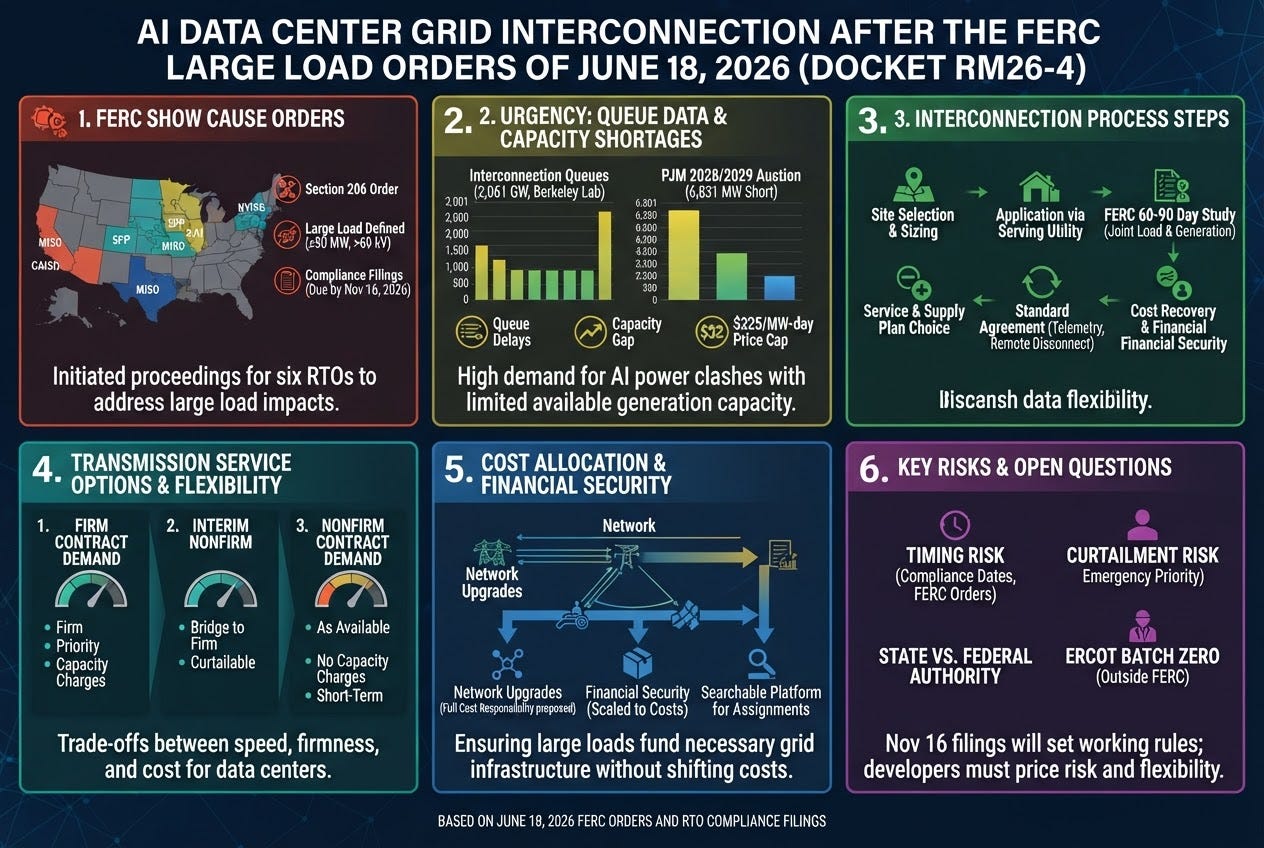
FERC Load Orders Reshape AI Data Center Hookups
Description
An AI data center gets interconnected quickly after the FERC large load orders of June 18, 2026 only by accepting curtailment or bringing its own power supply. PJM’s capacity auction on July 14, 2026 cleared 6,831 megawatts short of the reliability requirement, and PJM’s August 13 filing names the new data center without its own capacity as the first customer to be switched off in an emergency. Developers who read the June orders as a promise of faster connections are reading half of the record.
The June orders are real and they matter. In docket RM26-4, FERC began with a directive from the Secretary of Energy dated October 23, 2025, which proposed a national rule covering loads above 20 megawatts, studies in 60 days for curtailable loads, and full payment of network upgrades by the load. FERC then declined to write that rule. It issued six show cause orders instead, one for each regional grid operator, and told each to justify its tariff or reform it by August 17, 2026.
The headlines stopped there. The orders contain no connection date for anyone. They propose a definition of a large load, a site of 50 megawatts or more connecting above 69 kilovolts, and a study goal of 60 to 90 days. They ask for deposits that rise as a project gets closer to construction, a cost recovery agreement with financial security, and new transmission services for loads willing to limit their draw. The tariff filings that answer these orders are due from the operators on November 16, 2026, and FERC will rule after the comment period.
The mechanism explains why speed and firmness trade against each other. Transmission service today requires the customer to show resources, and resources need network upgrades that take years. Berkeley Lab counted 2,061 gigawatts of generation and storage in queues at the end of 2025, and only 13 percent of the capacity requested from 2000 to 2020 reached operation. A data center that waits for a firm path waits in the same line. The operators therefore built service that skips the line by giving something up.
SPP is furthest along. Its Conditional High Impact Large Load Service, accepted by FERC on June 5, 2026, gives a large load up to seven years of nonfirm transmission while firm service is built, and SPP may cut that service during constraints or emergencies. MISO proposed 90 day reviews for generation that serves a load at the same substation, capped at the size of the load, with no network upgrades beyond the substation. PJM proposed to put new loads without their own capacity first in the curtailment order starting June 1, 2027, with relief for loads that bring new capacity and commit it to the market for 10 delivery years.
The price tag is concrete. At the July auction cap of $325 per megawatt day, a 100 megawatt load faces about $11.9 million a year in capacity cost on gross demand. A new generator that wants PJM’s expedited track posts $500,000 plus $15,000 per megawatt, which comes to $4.25 million for 250 megawatts. These figures change who can afford to be early.
The unexpected implication is that the scarce asset is no longer the megawatt. It is verified flexibility. A load that can prove, through telemetry and a remote disconnect, that it will drop to a stated level within a stated number of minutes can buy service that a load without that proof cannot. SPP’s tariff already asks for real time telemetry, remote disconnect, and a ramp limit of 20 megawatts per minute. PJM would keep a registry of every large load, its backup generation, and its fuel. Duke University researchers estimated that 76 gigawatts of new load fits on the existing U.S. grid at 0.25 percent average annual curtailment, and 126 gigawatts at 1.0 percent, though that work did not model local congestion.
On a nuclear submarine, I learned that every electrical load has a place on a shed list and that the watch team knows the order before anything fails. Utilities are now asking data centers for