Episode Details
Back to Episodes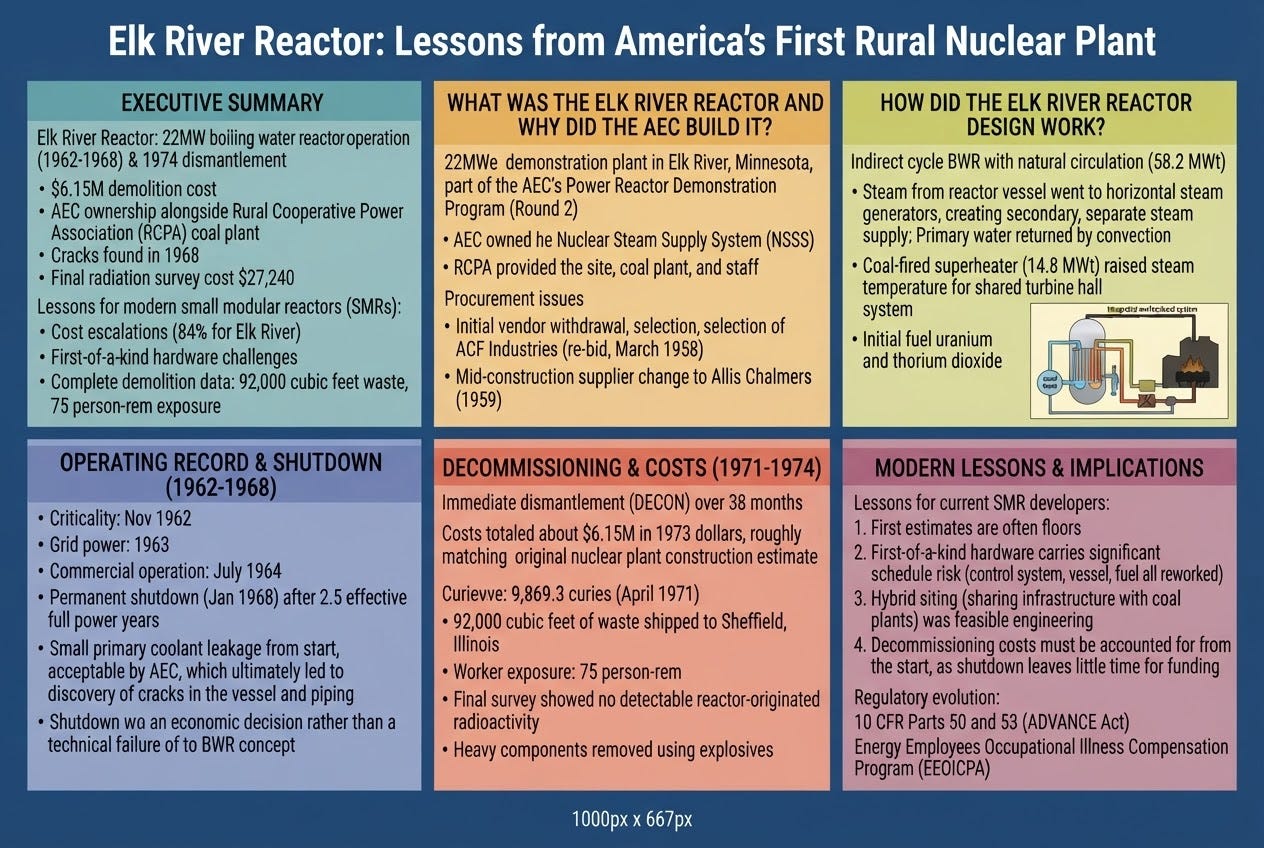
Elk River Nuclear Reactor in Minnesota
Description
The Elk River nuclear reactor in Minnesota ended operation in January 1968 after vessel cracks appeared, and the Atomic Energy Commission spent about $6.15 million to dismantle it by 1974. The plant had run for about 2.5 effective full power years. The repair bill was larger than anyone would pay for a demonstration plant. Its decommissioning record is one of the earliest complete cost datasets for a small power reactor in the United States, and developers of microreactors are about to pay for the lessons it contains.
The plant was a 22 megawatt boiling water reactor about 30 miles northwest of Minneapolis. A rural electric cooperative owned the coal fired plant next door, and the federal government owned the reactor. The two shared a turbine hall. A coal fired superheater, rated at 14.8 megawatts thermal, lifted the temperature of the nuclear steam before it reached the turbine, because steam from a 58.2 megawatt thermal boiling reactor was cooler and wetter than the turbine wanted. That hybrid looks odd for the 1960s. It looks familiar in 2026, when developers pitch small reactors at retiring fossil plants and industrial sites.
Why Did the Elk River Estimate Rise by 84 Percent?
Hardware that had never run drove the increase. The estimate for the nuclear plant started near $6.2 million and reached about $11.4 million before the plant made power. The first instrumentation and control system, a single channel design, had to be replaced with a multichannel system. The vessel needed rework, and the fuel elements had defects. The supplier changed in the middle of construction when Allis Chalmers bought the nuclear business of the original contractor in 1959.
The Utah small reactor project followed the same arithmetic. A six module, 462 megawatt plant carried a target price of $55 per megawatt hour, and the target reached $89 before the sponsors cancelled the project in November 2023, a 62 percent increase. Both numbers come from first of a kind hardware and first of a kind supply chains. Investors who underwrite a microreactor at a published price are underwriting a number that Elk River and Utah both moved by more than half.
What Did Elk River Teach About Leaks and Cracks?
A small leak that starts on day one can end a reactor’s run. Elk River had small primary coolant leakage from startup. The Atomic Energy Commission graded it within specification, and operation continued. During my years as a nuclear trained officer aboard USS William H. Bates, primary coolant leakage was a number the plant tracked to a tenth of a gallon per minute. An upward trend set the maintenance schedule before anyone from outside arrived. At Elk River the leak turned out to be the visible symptom of cracks in the vessel and piping, found during an inspection outage that ended on January 31, 1968, as the last time the plant ran.
The reactor sat idle until all fuel left the site on September 16, 1969. In March 1971 the Atomic Energy Commission decided to dismantle it. Demolition began in June 1972, and the project closed in September 1974.
How Much Does It Cost to Dismantle a Small Reactor?
Dismantling Elk River cost about $6.15 million in 1973 dollars, ran 38 months at roughly $162,000 per month, produced about 92,000 cubic feet of waste carrying about 10,000 curies, and exposed workers to 75 person rem. The bill is close to the original $6.2 million construction target. The final survey in June and July 1974 found no radiation above normal background.
A developer who prices the back end of a microreactor on the first day of the project will find this dataset useful, and a lender will ask for it. Current rules require decommissioning funding assurance under 10 CFR 50.75, completion within 60 years under 10 CFR 50.82, and release of the site at 25 millirem per year under 10 CFR 20.1402. The new 10 CFR Part 53, published on March 30, 2026 and effective April 29, 2026, adds a decommissioning subp