Episode Details
Back to Episodes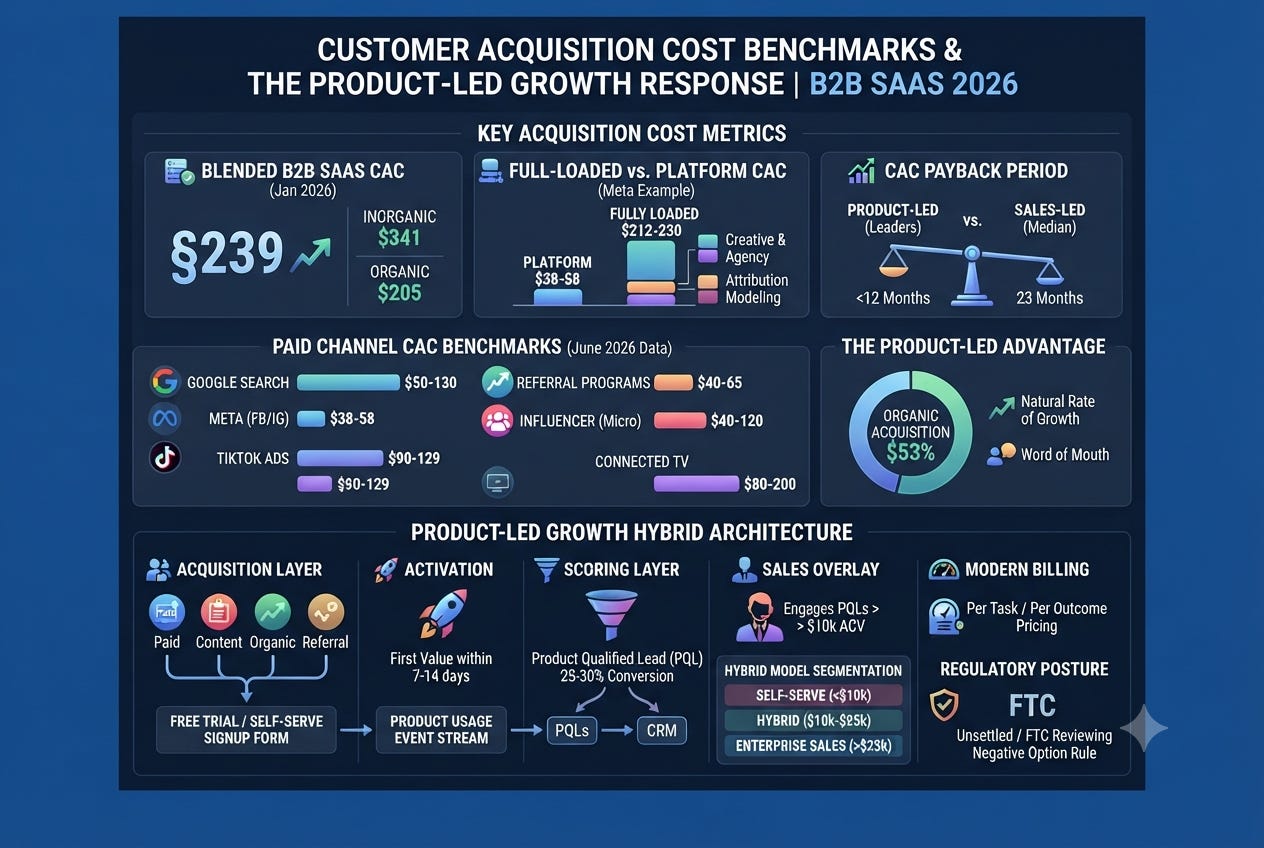
Customer Acquisition Cost Benchmarks By Channel
Description
Cursor added its first enterprise sales representative only after crossing 200 million dollars in annual recurring revenue. Before that point, an artificial intelligence coding company that eventually reached 500 million dollars in revenue in under 24 months closed every dollar of it without a single salesperson picking up a phone. That fact alone should worry any founder who just approved a 2026 marketing budget built around the assumption that paid advertising is still the cheapest way to add a customer, because the channel level data says otherwise, and the gap between what a platform reports and what a customer actually costs is wider than most board decks currently admit.
Customer acquisition cost is simply total sales and marketing spend divided by new customers won, an arithmetic identity nobody disputes. What is disputed, or at least poorly understood inside most 2026 marketing organizations, is which number belongs in the numerator. A platform’s own dashboard reports only the media dollars it can see and credits a conversion to whichever ad it tracked last, and that produces the flattering figures every advertising sales team quotes: 38 to 58 dollars to acquire a customer on Meta, 50 to 130 dollars on Google Search, 90 to 129 dollars on TikTok, based on channel data collected through June 2026. Add the agency fees, the creative production budget, and a cross channel attribution model that redistributes credit to the several touchpoints a buyer actually saw before converting, and Meta’s own fully loaded figure climbs to 212 to 230 dollars, nearly four times its platform reported number.
That inflation is not evenly distributed. A January 2026 industry benchmark study covering client analytics data from 2022 through 2025 found business to business software companies paying a blended 239 dollars per customer, built from 205 dollars for organic acquisition and 341 dollars for inorganic. Cybersecurity companies paid more across both channels, 345 dollars organic and 512 dollars inorganic, reflecting a buyer who researches longer and converts more slowly regardless of which channel first reached them. In nearly every industry the same study measured, organic acquisition beat paid acquisition, sometimes by a wide margin, a pattern that explains why the growth teams posting the best 2026 numbers have stopped treating organic channels as a nice complement to paid spend and started treating them as the primary channel paid spend is meant to support.
In thirty years of counseling technology companies, I have watched more than one board meeting where a marketing dashboard’s reported cost per click stood in for the truth, while the fully loaded figure that actually determined whether the current funding round would last another eighteen months sat one tab away, unopened. Product led growth is the industry’s answer to that problem, not a marketing trend but a redesign of where the acquisition work actually happens. A product qualified lead, an account whose in product usage, a feature used a defined number of times, a seat count crossed, predicts a high probability of paying, converts at 25 to 30 percent, against 5 to 10 percent for a marketing qualified lead generated by a form fill. That gap exists because behavior is a better predictor than a declared interest, and 2022 measurement work still cited in 2026 industry summaries found that 53 percent of new product led customers arrive through organic channels rather than paid ones, a channel mix a sales led competitor spending on outbound alone cannot replicate.
The unit economics case is not subtle. Product led companies measured in 2025 growth benchmarking work spent 39 percent less on combined sales and marketing than sales led peers while growing revenue 50 percent faster over the same period, and their payback period on acquisition spend commonly closed inside 12 months against a median near 23 months for the broader software as a service category. N