Episode Details
Back to Episodes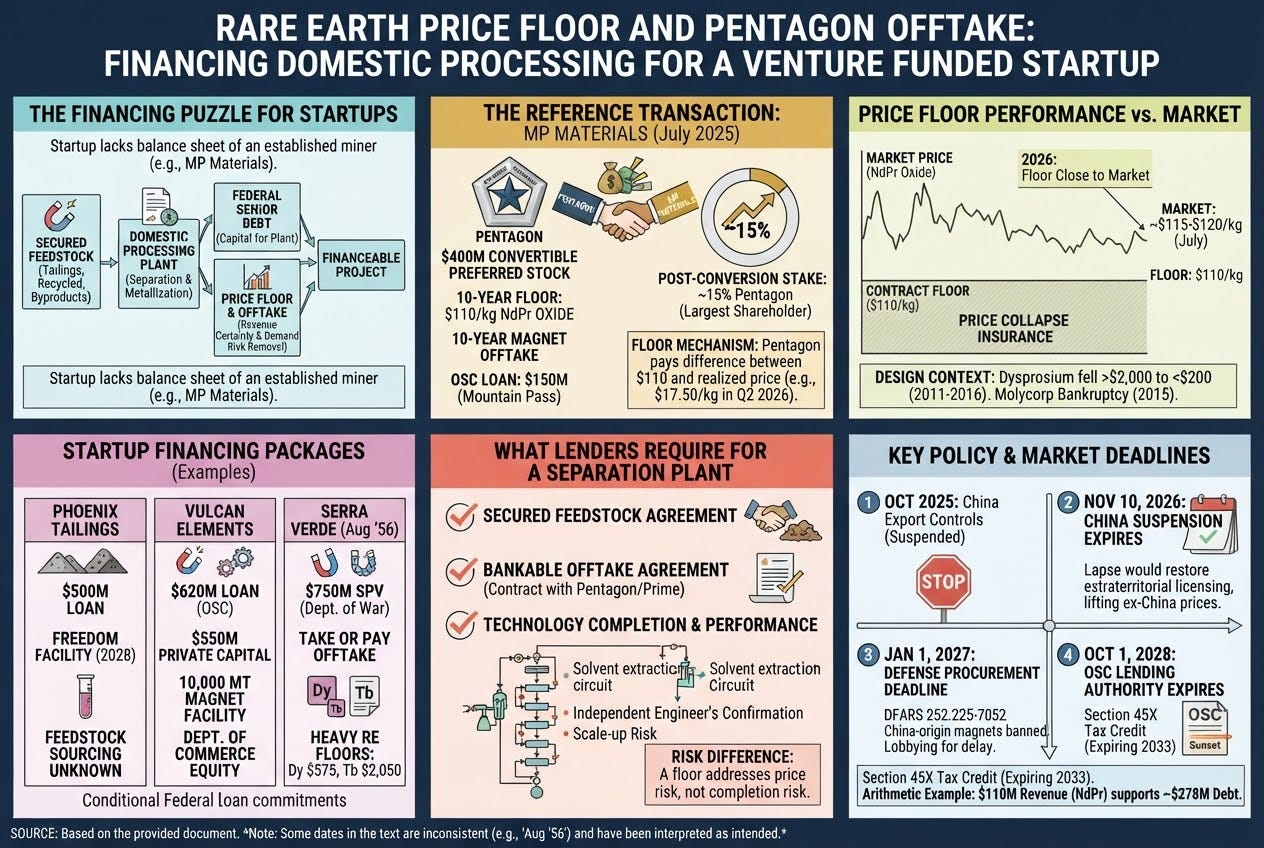
Rare Earth Price Floors
Description
Domestic rare earth processing becomes financeable for a venture funded startup when a price floor and Pentagon offtake arrive with federal debt, as the $500 million Phoenix Tailings commitment shows. The floor removes price risk. The offtake removes demand risk. A processing plant still costs several hundred million dollars before it ships a kilogram, and in 2026 the money that pays for it is coming from the government’s own lending office.
The reference deal is the July 10, 2025 agreement with MP Materials. The Pentagon bought $400 million of convertible preferred stock, took a warrant at $30.03 per share, guaranteed $110 per kilogram on NdPr oxide for ten years, and committed to buy the output of a new magnet plant. Some commentary calls the resulting stake 50 percent. The announced figure is about 15 percent on conversion and exercise.
The floor sits close to the market. NdPr oxide delivered to North America assessed at $115 per kilogram in July 2026, and traders reported sales below $110 in August. In the second quarter MP sold 1,006 metric tons for $94.4 million, which is about $94 per kilogram, and booked $17.6 million of price protection income, which adds about $17.50. The sum is about $111, so the mechanism topped realized revenue up to the floor. The arithmetic is mine and mixes oxide and metal volumes. It shows a floor working as insurance in a market that has stopped collapsing for the moment.
Lenders carry a specific memory. Dysprosium oxide traded above $2,300 per kilogram in 2011 and below $200 by 2016. Molycorp filed for bankruptcy in 2015 with $1.7 billion of debt and was sold for $20.5 million. A floor answers that memory. It does not answer the next question a lender asks.
I have sat across the table from lenders on hardware financings, and they ask for three documents before they discuss a term sheet: a feedstock agreement, an offtake with a counterparty they can underwrite, and an independent engineer’s report that the technology works at plant size. A price floor lives inside the second document. Phoenix Tailings, the startup that received the $500 million conditional commitment on June 16, 2026, had disclosed neither a site nor public feedstock agreements, and its separation technology was still in a demonstration phase. It had raised a $43 million Series B. The federal announcement mentioned no price floor.
The pattern repeats. Vulcan Elements received a $620 million loan from the Pentagon’s lending office in November 2025 alongside $550 million of private capital, and ReElement received $80 million. The Department of War takes warrants. Energy Fuels, a public company, received a conditional $725 million commitment on a 20 year tenor. In each case the federal instrument is senior debt, and each commitment is conditional on diligence. Venture capital pays for the pilot and the engineering. The government pays for the plant.
The most useful template for a startup came on August 24, 2026, when the Department of War raised its commitment to $750 million inside a $1.55 billion vehicle for the Serra Verde mine in Brazil. The vehicle pays at least $575 per kilogram for dysprosium, $2,050 for terbium and $110 for NdPr, each floor rising 2 percent a year. The producer keeps 70 percent of any price above the floor. The offtake is take or pay, the Defense Logistics Agency committed at least $300 million over five years, and a large bank committed a $500 million revolver for working capital. A startup should ask for these terms by name.
Heavy rare earths carry the economics. China has licensed exports of dysprosium and terbium since April 2025, and the dysprosium floor of $575 sits well above the sub $200 price of 2016. A public company, Energy Fuels, plans about $104 million of capital for up to 120 tonnes of dysprosium oxide and 20 tonnes of terbium oxide a year. At the Serra Verde floors that output would earn $69 million and $41 million, a total of $110 million of g