Episode Details
Back to Episodes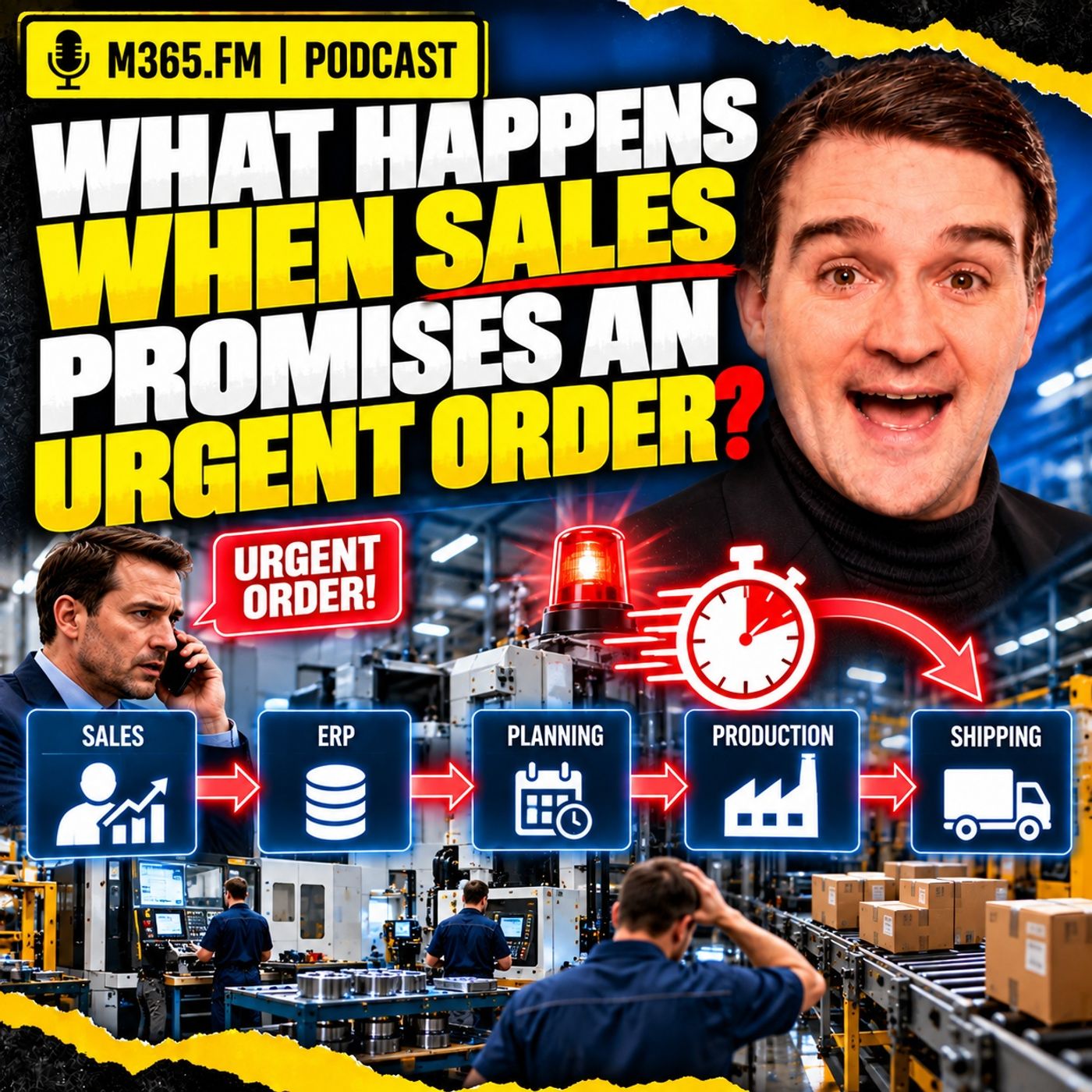
What Happens When Sales Promises an Urgent Order
Published 1 week, 4 days ago
Description
An urgent customer request sounds simple: sales promises a fast delivery date, marks the order as priority, and asks production to fit it in. But the new order does not enter an empty factory. It enters a schedule already filled with machine reservations, material allocations, setup plans, qualified people, inspection capacity, maintenance windows, and promises made to other customers. The real question is therefore not simply whether the urgent order can be produced, but which existing commitment absorbs the disruption when it moves forward.
A PROMISE IS NOT A PRODUCTION PLAN
A commercial promise tells the customer what the business intends to deliver. A feasible production date proves that there is actually a path through material, machining, assembly, inspection, packing, and shipping within the available time.
ERP can hold requested dates, promised dates, production orders, materials, and routing information, but a priority flag does not create capacity. A CNC machine still has limited hours, inspection still needs qualified people and equipment, and shipping still has carrier cutoffs. Urgency changes priority; it does not remove physical constraints.
FINITE CAPACITY EXPOSES THE REAL TRADE-OFF
Infinite-capacity planning can place several orders against the same resource and leave the collision for production to solve later. Finite-capacity scheduling forces that conflict into the open.
If the urgent order receives Tuesday morning on a CNC machine, another operation loses Tuesday morning. That displaced order may then miss assembly, inspection, or packing windows and lose far more time than the urgent order actually consumed.
The first scheduling move therefore creates a chain reaction through the remaining route.
MATERIAL DOESN'T OBEY PRIORITY FLAGS
Inventory showing as available does not always mean it is usable for the urgent order. Material may already be allocated to another customer order, still be waiting for quality release, require a specific batch or supplier, or have traceability and shelf-life restrictions.
Reallocating material can save the urgent customer while quietly creating a shortage somewhere else. The factory has not removed the constraint; it has transferred it.
The same applies to fixtures, gauges, special packaging, test equipment, and other physical resources that multiple orders may depend on.
MACHINE CAPACITY IS NOT USABLE CAPACITY
A machine can have an open calendar slot and still be unavailable for the work. The required setter may not be on shift, an operator may lack the necessary certification, the fixture may be installed somewhere else, or the CNC program may not be released for the current product revision.
Real capacity exists only when the machine, people, tools, material, process approvals, and time window come together.
That is why an alternate machine is not automatically an alternate production route. A proven alternate route needs approved tooling, programs, quality checks, realistic cycle times, and people who can actually run the work.
THE BOTTLENECK MOVES
An urgent order may initially look like a machining problem. Once machining finds a solution, the pressure can move immediately to assembly, inspection, testing, packing, or even one person responsible for an approval.
A bottleneck is not permanently attached to one machine. It is whichever constraint currently limits the flow of work toward shipment.
This is why high equipment utilization does not automatically mean good delivery performance. A plant can have efficient machines and still ship late because the wrong work is waiting at the wrong constraint at the wrong time.
THE SECOND-ORDER EFFECTS ARE WHERE THE DAMAGE SPREADS
The visible effect of an urgent order is easy to see: it moves forward.
The less visible effect is everything tha