Episode Details
Back to Episodes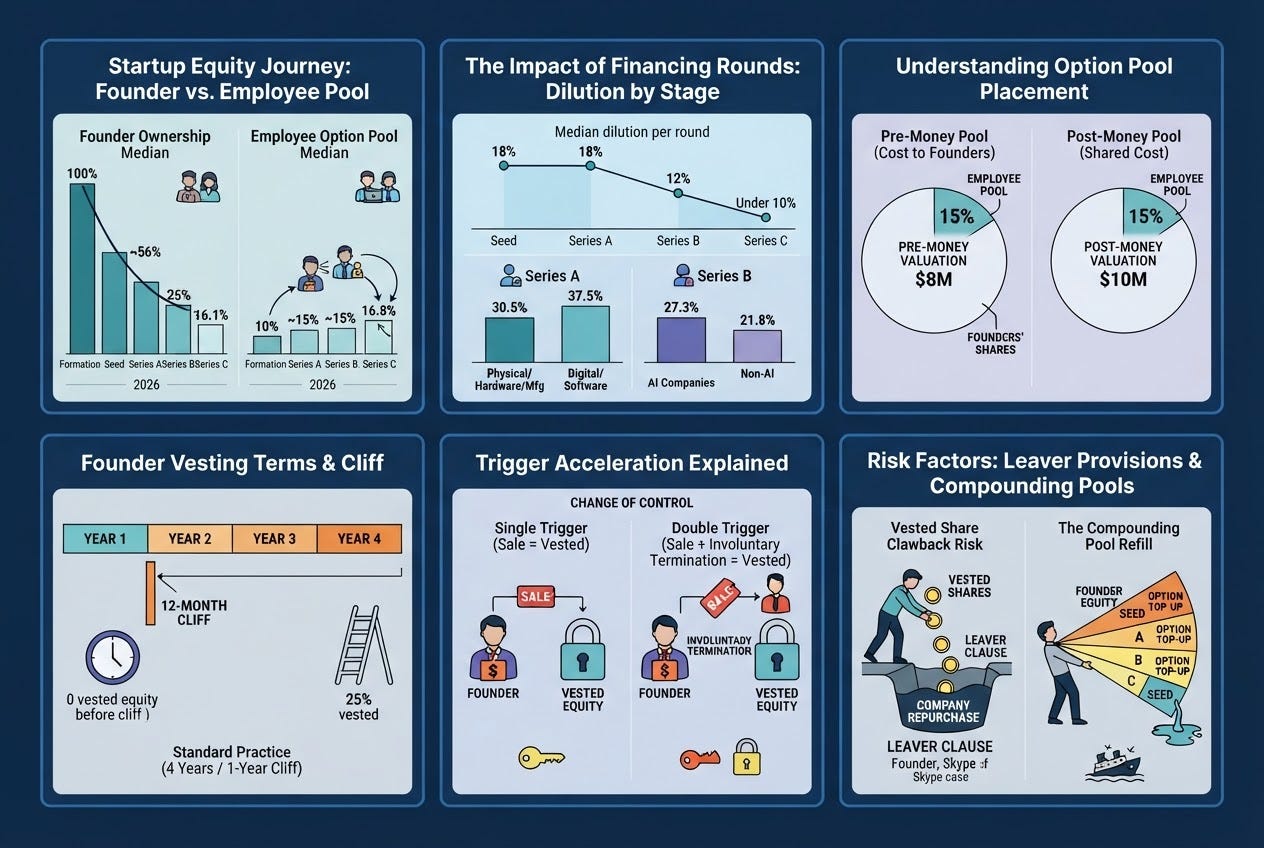
Founder Equity Dilution: Owning Less Than Your Option Pool
Description
Founder Equity Pool Size and Vesting Terms at Company Formation
A founder who accepts a ten to fifteen percent employee option pool at formation without negotiating its placement on a post money basis, and who signs a standard four year vesting schedule with no double trigger acceleration, risks reaching a Series C financing holding less equity than the pool created to hire the company’s own staff. Venture financings closed through 2026 show a median founder holding 16.1 percent of a venture backed company at the Series C stage against a median employee option pool of 16.8 percent of that same company. The gap opens earliest in the two decisions a founder controls completely at formation: the size and placement of the option pool, and the vesting and acceleration terms attached to the founder’s own stock.
Executive Summary
In 2026, the median startup founder holds 16.1 percent of a venture backed company whose own employee option pool holds 16.8 percent by the Series C round. A founder negotiating formation documents should fix the initial employee option pool at approximately 10 percent of fully diluted equity, sized against an eighteen month hiring plan, not an investor’s standard template, and should insist the pool sit on a post money basis so new investors share its cost. Founder vesting should run four years with a twelve month cliff, matching the term the venture industry’s own standard form documents recommend for every other option holder, paired with double trigger acceleration that vests the founder in full only if a change of control is followed by an involuntary termination or a material cut to title or pay.
Median founder ownership falls from approximately 56 percent after a seed round to 36 percent after a Series A round, then into the high twenties or low twenties by a Series B round, before reaching 16.1 percent at Series C. Each decline compounds two separate mechanics: the capital raised at each round, and the employee pool that investors require the company to create or refresh immediately before that round prices. A founder who negotiates pool size once, at formation, and then accepts whatever pool refresh a term sheet proposes at every later round, surrenders control over the second mechanic entirely. The practice described below, sizing the pool to an actual hiring plan, placing it on a post money basis, and fixing founder vesting on terms no worse than the employee pool itself receives, reflects established market practice rather than an aggressive founder position, and it is available to any founder willing to negotiate it before signing a term sheet.
Detailed Findings
Capital Structure and Pool Sizing at Formation
An employee option pool is almost always sized on a pre money basis at formation, which means the cost of creating it comes out of the founders’ side of the capitalization table before a new investor’s money is counted. A lead investor proposing a $2,000,000 seed investment on an $8,000,000 pre money valuation will routinely ask for a 15 percent pool to be added to that same pre money figure, so the investor’s ownership lands exactly where the term sheet states while the founders absorb the entire cost of the pool on top of the dilution the new money itself causes. Market practice through 2026 centers the initial pool between 10 and 15 percent of fully diluted equity, with 10 percent the single most common figure in seed stage financings, though a pool sized to an actual eighteen month hiring plan rather than to a generic percentage better protects a founder’s position than accepting whatever figure the term sheet proposes.
A stack of convertible instruments compounds the same mechanic before a priced round ever happens. Three stacked Simple Agreements for Future Equity of $500,000, $1,000,000, and $1,000,000 on progressively higher valuation caps commit roughly 20.1 percent of the company before a lead investor prices anything, a figure tha