Episode Details
Back to Episodes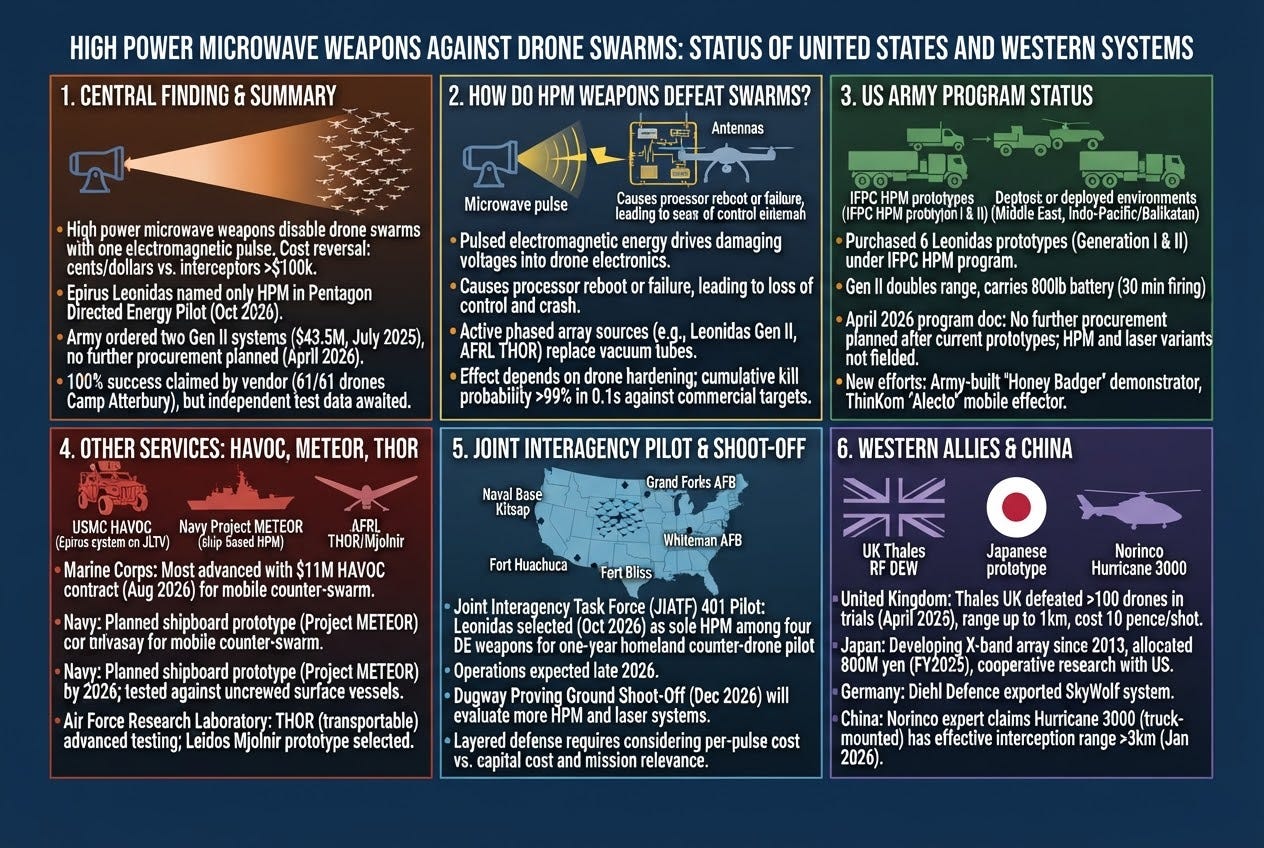
How High Power Microwave Weapons Stop Drone Swarms
Description
High power microwave weapons stop drone swarms with one electromagnetic pulse, and the Army paid Epirus $43,551,060 in July 2025 for two Generation II Leonidas systems. In October 2026 the Pentagon named Leonidas the only microwave weapon in a one year drone defense pilot at five bases, and the Army documented in April 2026 that it plans no further microwave purchases. The cost per shot runs in cents, the strongest test evidence comes from the vendor, and the range stops near one kilometer.
Cheap drones broke the cost logic of air defense. The Pentagon acquisition chief said in April 2024 that efforts to take out hostile drones exceed $100,000 per shot, and one published comparison sets a $2,000 drone against a $2 million interceptor missile. A microwave weapon spends electricity where a missile spends an interceptor, and that single fact explains why the Army, the Marine Corps, the Navy, the Air Force, and the defense ministries of Britain, Japan, and Singapore all work on it.
Why Does a Microwave Pulse Beat a Missile on Cost?
Epirus estimates about five cents per engagement for its Marine Corps system, and the British Army puts its radio frequency weapon at 10 pence, about 13 cents. Capital cost completes the arithmetic. The Army paid an average of $21,775,530 per Generation II system under its July 2025 contract, a figure that includes test events, support equipment, and spares. At $100,000 per interceptor that sum equals 218 interceptors, so the weapon pays back only where drone attacks are frequent enough to displace more than 200 of them.
A Generation II Leonidas draws on 800 pounds of lithium polymer batteries for up to 30 minutes of firing, and a 70 kilowatt generator supports continuous use, according to Epirus.
On a nuclear submarine every electrical load is budgeted against what the plant delivers, and I read this weapon first as a power budget. A 70 kilowatt load fits a diesel generator. The Army announced its Janus microreactor program on October 14, 2025 with a goal of a reactor at a domestic military base by September 30, 2028, and a reactor of that class produces multiple megawatts. It serves installation power. A single microwave weapon does not need one.
How Reliable Is the Test Evidence?
Epirus reported that Leonidas disabled 61 of 61 drones in five scenarios at Camp Atterbury, Indiana on August 28, 2025, including 49 quadcopters in one burst. Military observers and foreign delegations attended, and the company did not disclose drone types or distances. In January 2026 Epirus reported that a vehicle mounted system disabled a fiber optic guided FPV drone in a December 2025 live fire, a drone type that radio jammers cannot reach. Both results are company reports.
Published modeling of high power microwave weapons finds a per pulse kill probability below 1 percent against hardened electronics that fail at 0.1 joule, against about 0.4 for commercial electronics that fail at 0.01 joule.
The same model finds that distance matters more than weather. A drone that carries shielding changes the outcome, and the public record contains no independent test against one. Military hardening practice calls for 80 decibels of attenuation up to 1 gigahertz, a 10,000 fold reduction in voltage, so the technique is known and adversaries can add it at a cost in weight and money to every drone.
Where Does the Beam Stop?
Published ranges for Western systems cluster near one kilometer. The Army defines the layer Leonidas protects as an inner zone of about one kilometer, and the British weapon reached up to one kilometer. Norinco claims more than three kilometers for its Hurricane 3000 and published no test data.
Energy falls with the square of distance, so a claim of 2.5 times the range from 30 percent more power cannot come from power alone. Range grows with the square root of power, which gives about 14 percent. Epirus points to longer pulses, new polarizati