Episode Details
Back to Episodes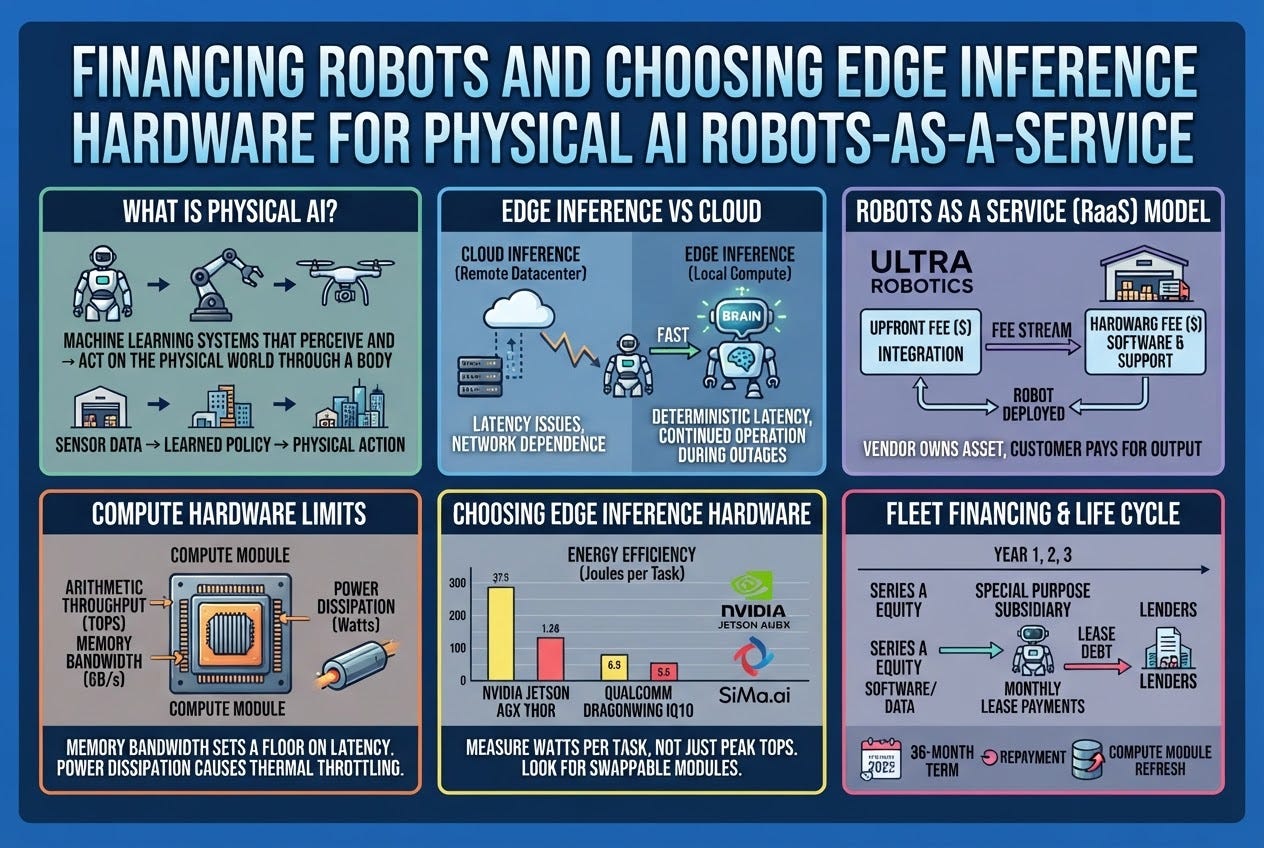
How a Robotics Startup can Finance Robots as a Service
Description
Ultra’s $62 million round on October 9, 2026 shows robots as a service depends on financing structure and edge inference choices, because chips age faster than robot arms.
Ultra, a Brooklyn company, raised a $50 million Series A led by Framework Ventures, with Y Combinator participating, on top of a $12 million seed. It leases packing robots to warehouses for an upfront integration fee and a monthly fee, and its robots have packed more than 500,000 orders. Consider a robot that costs $60,000 to build and earns $2,500 a month net: it pays for itself in 24 months, and the chip inside it may be obsolete in 36. Those two figures are my hypothetical illustration, since Ultra has not disclosed revenue or valuation.
The model looks like software as a service until the first invoice. A software vendor sells the same code to the ten thousandth customer at near zero marginal cost. A robot vendor builds a machine for each customer and keeps it on its own balance sheet, so every new customer consumes cash before it produces any. Equity can fund that for a while. A fleet of thousands needs debt.
Lenders lend against a serial numbered asset, a customer contract, a site where the asset can be found and a residual value. In financings of hardware companies I have seen lenders ask for serial numbers and landlord waivers before they asked a single question about the model. A robot in a third party logistics building the customer does not own can be hard to retrieve without a landlord waiver, and a security interest perfected under Article 9 of the Uniform Commercial Code means little if no one can reach the collateral.
Tax treatment adds a second reason to separate the robots from the startup. Section 168(k) allows 100 percent bonus depreciation for qualifying property acquired and placed in service after January 19, 2025, and Section 179 now allows a $2.5 million deduction. A startup with losses cannot use either. A taxable lessor can, and it can pass part of the benefit back as a lower monthly fee. Whoever owns the robot should be the party that can use the deduction.
Now the chip. Investors are paying for the layer above the metal: Physical Intelligence is valued at $5.6 billion, and XPeng’s robotics business raised more than $900 million on October 6, 2026 at a post money value above $6.3 billion. SiMa.ai raised $150 million on September 28, 2026 at $1.45 billion to sell the layer underneath. A founder choosing edge hardware sits between these two, and the vendor numbers do not line up.
NVIDIA’s Jetson AGX Thor is specified at 2,070 TFLOPS, but that figure is FP4 with structured sparsity; the dense figure is 1,035. Its power range runs from 40 to 130 watts, and the developer kit costs $3,499. Older modules quote INT8 TOPS, some accelerators quote INT4, and Qualcomm’s 700 TOPS IQ10 comes with no published power draw. SiMa.ai promises 1,000 dense TOPS for the first half of 2028 and has disclosed no watt figure. Dividing one by another produces a number, and the number means nothing until it is measured on your policy.
Memory bandwidth is the figure that deserves more attention. A transformer reads its weights on every forward pass. A 5 billion parameter model stored at 8 bit precision is 5 gigabytes, and Thor’s 273 GB/s bandwidth means the read alone takes at least 18 milliseconds. That is my arithmetic with no benchmark behind it, and it explains why a module with a vast TFLOPS rating and a narrow memory bus can lose to a smaller module on a real task. The right metric is joules per completed pick on the actual model.
Then there is the refresh cycle. NVIDIA claims Thor has 3.5 times the energy efficiency of its prior module. If the compute generation turns over every three years or so, a lease term of 36 months matches it, and a modular compute board lets the vendor swap the brain at renewal while the arm, cameras and chassis keep earning. That gives the lender a credible residual, and the r