Episode Details
Back to Episodes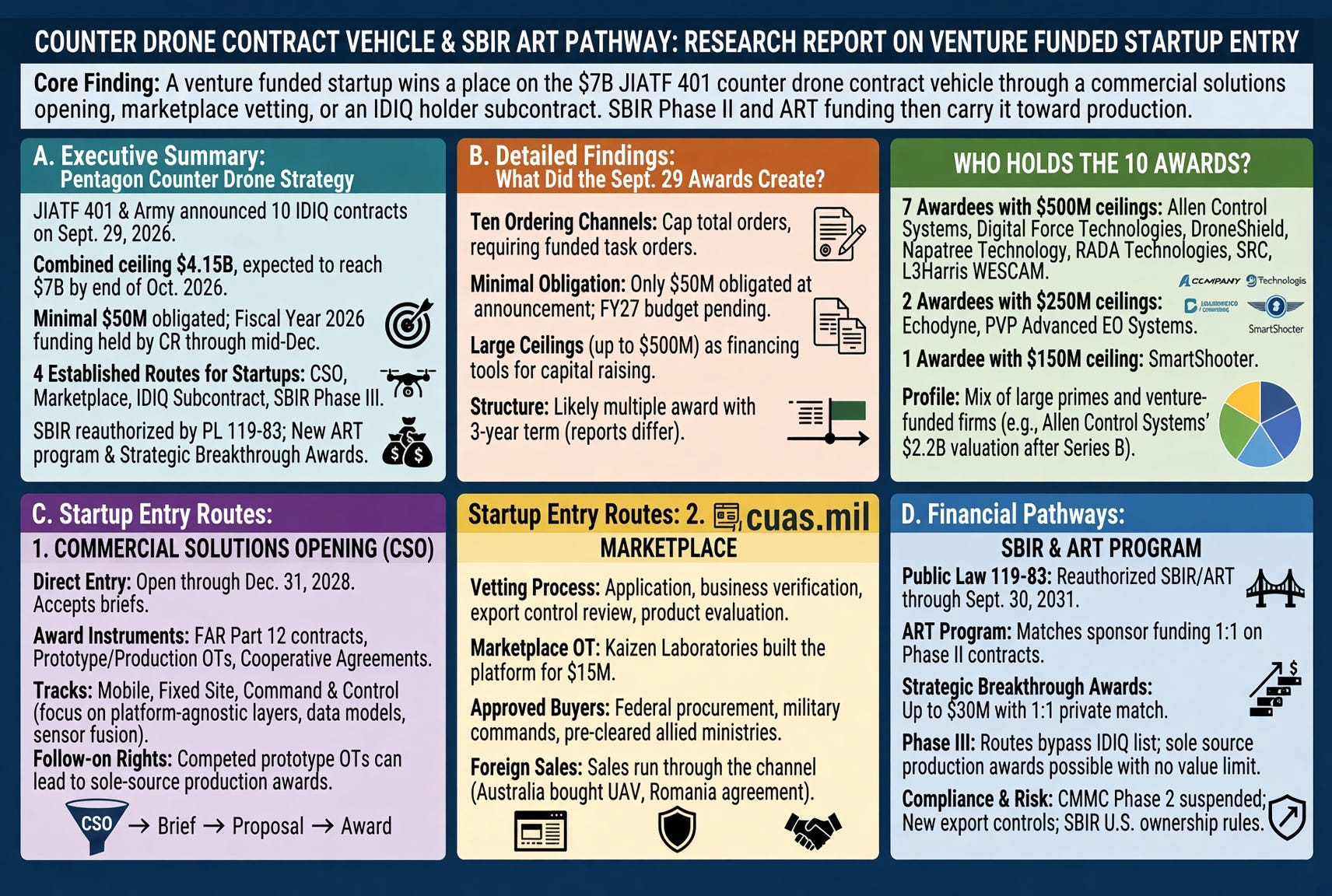
A $7 Billion Counter Drone Vehicle Opens Doors for Startups
Description
A venture funded startup can win a place on the $7 billion counter drone contract vehicle through JIATF 401 channels and SBIR Phase II funding. The ten IDIQs announced September 29, 2026 carry a $4.15 billion combined ceiling, and only $50 million had been obligated.
Start with that gap. Joint Interagency Task Force 401 and the Army announced ten indefinite delivery, indefinite quantity contracts on the last Tuesday of September, with ceilings of $500 million for seven awardees, $250 million for two, and $150 million for one. The task force expects the vehicle to reach $7 billion by the end of October. A continuing resolution holds fiscal year 2026 funding levels through mid December, and Congress has not passed a fiscal year 2027 defense appropriation. The ceiling is permission to order, and the money comes from appropriations.
That gap sets how a founder should read the list. Federal Acquisition Regulation 16.504(a)(1) requires an IDIQ to state a minimum quantity, and the minimum is usually a small fraction of the ceiling. Revenue arrives when a funded task order issues. In thirty years of counseling technology companies, I have seen ceiling figures quoted in board decks as if they were bookings, and the correction tends to arrive during diligence.
A ceiling caps total orders. Revenue starts only when a funded task order issues, so a startup should model obligated dollars, not ceiling dollars, in every financing plan.
The ten awardees include one company with a public venture history. Allen Control Systems raised a $12 million seed round in April 2024 and a $200 million Series B at a $2.2 billion valuation on June 9, 2026, about three months before its IDIQ. The task force director said that large IDIQs let companies raise capital to build inventory, because they can expect continued work. Capital followed the contract path, and the contract path followed demonstrated performance.
A startup outside the ten has four routes. The task force commercial solutions opening has been open since February 26, 2026, accepts briefs on a rolling basis through December 31, 2028, and can produce fixed price contracts or prototype and production other transactions under 10 U.S.C. 3458 and 4022. The fiscal year 2026 National Defense Authorization Act lets a production other transaction issue directly from that opening.
The second route is the cuas.mil marketplace. Vendors apply, and program staff verify the business, review export controls, and evaluate the product. Purchases reached $21 million by early August 2026. The amount is small next to the ceilings, and each sale creates test data and a reference customer.
The third route is a subcontract or integration agreement. The Army wants open architecture and interchangeable components, which gives a sensor, radar, effector, or software startup a way into a holder system. The fourth route runs through SBIR. A Phase III award under 15 U.S.C. 638(r) may be sole source, carries no value or duration limit, and follows Phase II work. It bypasses the IDIQ list.
Public Law 119 83, signed April 13, 2026, reauthorized SBIR and STTR through September 30, 2031. The Pentagon opened more than 90 topics on April 20, 2026 and launched the Accelerated Research for Transition program. ART needs a Pentagon sponsor with a funded requirement and a signed Technology Transition Agreement.
ART matches sponsor funds one to one on Phase II contracts, and the sponsor must be a Pentagon agency or component. A prime contractor cannot supply the match.
Strategic Breakthrough Awards sit beside ART. They reach $30 million over 48 months, and they require a prior Phase II, market research, a match equal to 100 percent of the award from new private capital or non SBIR federal funds, and for the Pentagon a program objective memorandum commitment. A venture round closed after the application can serve as the match, which ties the cap table to the contract.
Th