Episode Details
Back to Episodes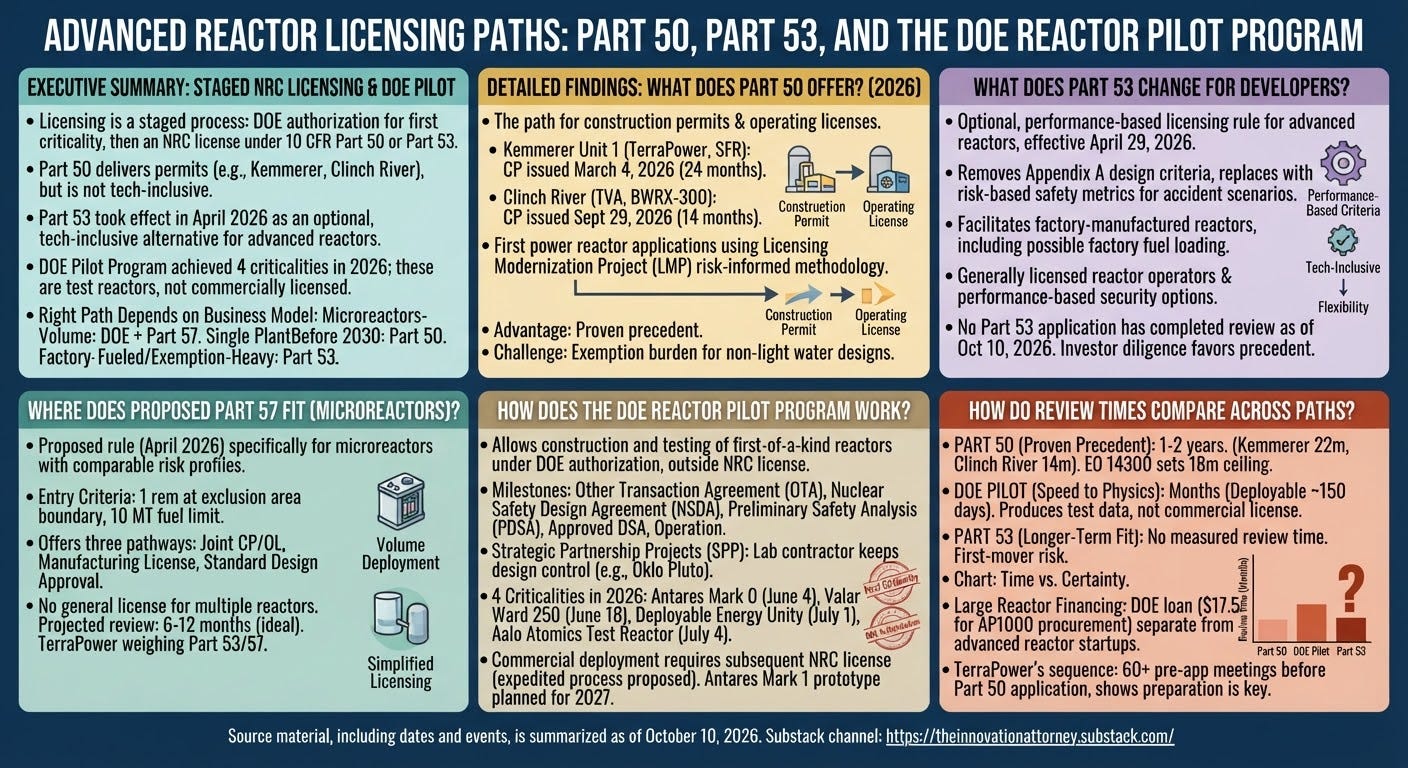
Advanced Nuclear Reactor Licensing
Description
Advanced reactor startups should reach first criticality under DOE authorization, then sell power under an NRC license issued through Part 50 or Part 53 in 2026. Four reactors reached criticality between June 4 and July 4, 2026 under DOE authorization, and none of them can be deployed commercially without the NRC. The two NRC construction permits issued this year, Kemmerer Unit 1 on March 4 and Clinch River on September 29, both came through 10 CFR Part 50. Part 53, effective April 29, 2026, has no completed review behind it.
The company holding the most advanced permit has not settled the question. At an NRC public meeting on July 22, 2026, TerraPower said it plans a Part 50 operating license application for Kemmerer Unit 1 by March 2028 while it weighs Part 53 and proposed Part 57. A developer with more than 60 preapplication meetings behind its first permit is keeping its options open, and a startup with a fraction of that budget has less room to guess.
What Did the July 4 Criticality Deadline Prove?
It proved that DOE authorization moves quickly. Executive Order 14301 set a goal of three reactors at criticality by July 4, 2026. Antares Nuclear reached zero power criticality on June 4 at Idaho National Laboratory, Valar Atomics followed on June 18 in Utah, Deployable Energy reached criticality on July 1 about 150 days after starting its project, and Aalo Atomics reached it at 12:20 a.m. Mountain time on July 4.
All four were zero power or very low power tests. Valar reached 10 kWt on June 22, and Deployable Energy plans full power testing by July 4, 2027. Radiant Industries, whose 1 MWe Kaleidos took its first fuel at the DOME test bed on July 1, did not reach criticality by the deadline and plans a 150 hour full power run later this year. The program produces physics data and a safety analysis. It does not produce a license to sell electricity.
Why Does Part 50 Still Win for a Utility Customer?
Part 50 has a record. The Tennessee Valley Authority filed for a 300 MWe BWRX 300 at Clinch River in May 2025 and the NRC issued the permit 14 months after formal review began, four months ahead of schedule. TerraPower waited about 24 months from its March 2024 filing for the Kemmerer permit, which used the risk informed Licensing Modernization Project methodology. Kairos Power received its Hermes 2 permits in November 2024 after a review of just over a year. Executive Order 14300 sets an 18 month ceiling for new reactor decisions, Kemmerer ran past that ceiling and Clinch River finished inside it.
I spent my early career on a submarine reactor plant, USS William H. Bates, where every procedure traced back to a safety basis that had been accepted before the ship went to sea. Nobody operated against a document the reviewer had not seen. Investors in deep technology companies carry the same instinct into diligence, and the first question they ask is which approval the revenue depends on and who issues it. Two permits in 2026 answer that question. A rule less than six months old does not yet.
When Does Part 53 Make Sense for a Startup?
Part 53 makes sense when the design fits poorly in rules written for light water reactors. The NRC published the final rule at 91 Fed. Reg. 15696 on March 30, 2026. It replaces the Appendix A general design criteria with plant level safety criteria in sections 53.210 and 53.220, permits factory loading of fuel in manufactured reactors, and allows generally licensed reactor operators. The NRC’s own analysis puts net averted costs at $152 million at a 7 percent discount rate, and the rule exists to reduce exemption requests under Parts 50 and 52.
The cost is first mover risk. The NRC staff has no completed Part 53 review to use as a template, and the agency issued nine guidance documents with the rule while promising more. Microreactor developers face a further variable. Proposed Part 57 would cover reactors under one rem at the exclusion area