Episode Details
Back to Episodes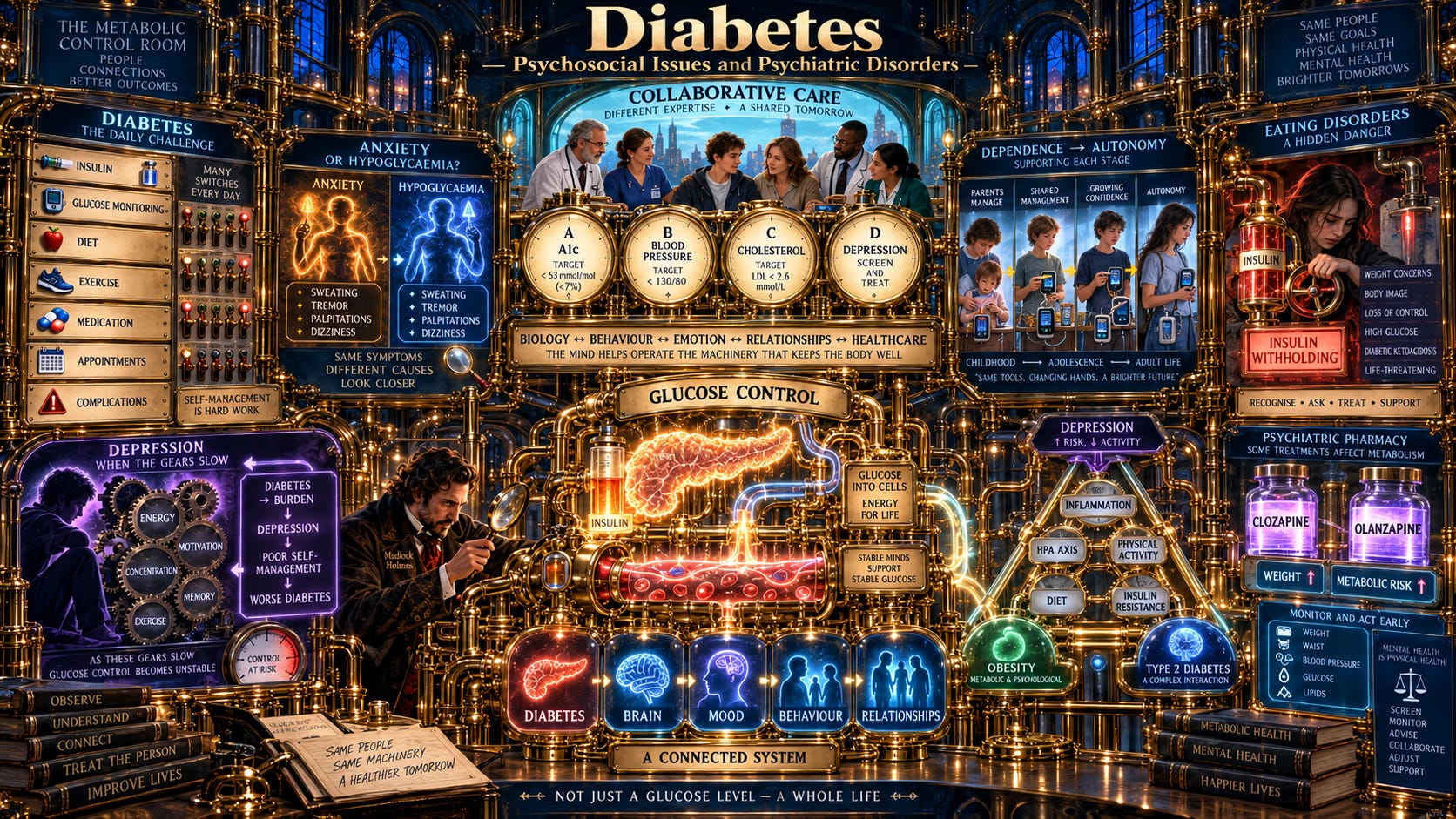
PSYCH 147: Diabetes - Psychosocial Issues and Psychiatric Disorders
Description
making mental health inseparable from metabolic health.
Episode Description
Medlock Holmes enters The Metabolic Control Room, an immense Neo-Victorian chamber built around a glowing bloodstream. At its centre sits a vast brass dial labelled GLUCOSE, connected to the pancreas, brain, heart, kidneys, eyes and peripheral nerves.
At first, the machinery seems straightforward.
In type 1 diabetes, autoimmune destruction of pancreatic β cells leaves the body producing little or no insulin.
In type 2 diabetes, insulin resistance dominates initially, often followed over time by declining insulin production.
But Holmes soon discovers that controlling diabetes requires something no machine can supply automatically: continuous human self-management. The chapter describes diabetes as an unusually complex chronic illness in which successful outcomes depend heavily on the patient’s own behaviour and supportive relationships.
Every day brings decisions about:
MEDICATION • FOOD • EXERCISE • GLUCOSE MONITORING • SMOKING • APPOINTMENTS • COMPLICATIONS
Then Holmes notices another mechanism connected directly to the glucose dial.
It is labelled:
DEPRESSION
When depression enters the system, energy falls. Motivation weakens. Concentration becomes harder. Exercise decreases. Diet may deteriorate. Prescriptions are missed. Appointments become harder to attend. Diabetes begins to feel impossible to control.
Worsening diabetes then creates more symptoms, complications, restrictions and distress.
The machine forms a loop:
DIABETES → BURDEN → DEPRESSION → POORER SELF-MANAGEMENT → WORSE DIABETES
But the relationship is not merely behavioural.
Hyperglycaemia, inflammation, vascular changes, stress systems and neuronal insulin signalling may contribute to the biological connection between diabetes and depression. The direction of causality therefore cannot simply be reduced to “the patient is depressed because they have diabetes.”
Holmes finds another clue.
Depression can change not only the disease but the experience of the disease.
A patient with depression may report substantially greater fatigue, pain and other diabetes-related symptoms even when objective measures such as HbA1c do not fully explain the difference.
This creates an important psychiatric distinction:
DISEASE BURDEN ≠ EXPERIENCED SYMPTOM BURDEN
Then comes anxiety.
Sweating. Trembling. Palpitations. Dizziness. Fear.
Is this:
ANXIETY?
or
HYPOGLYCAEMIA?
For someone using insulin, the distinction can become frighteningly difficult. Repeated false alarms may encourage catastrophising; repeated genuine hypoglycaemia may eventually lead someone to dismiss symptoms that require urgent action.
Holmes next enters the Family Chamber.
A young child with type 1 diabetes cannot independently manage repeated glucose checks, insulin, food and exercise. Parents become part of the treatment system.
But adolescence changes the equation.
The developmental drive towards independence can collide directly with parental anxiety and the demands of diabetes:
“CHECK YOUR GLUCOSE.”
“TAKE YOUR INSULIN.”
“WATCH WHAT YOU EAT.”
What appears medically as non-adherence may sometimes represent a developmental struggle over autonomy, identity and control.
Another corridor contains the eating disorders.
Here Holmes discovers an especially dangerous possibility in insulin-dependent diabetes: deliberately reducing or withholding insulin to influence weight.
Furthe