Episode Details
Back to Episodes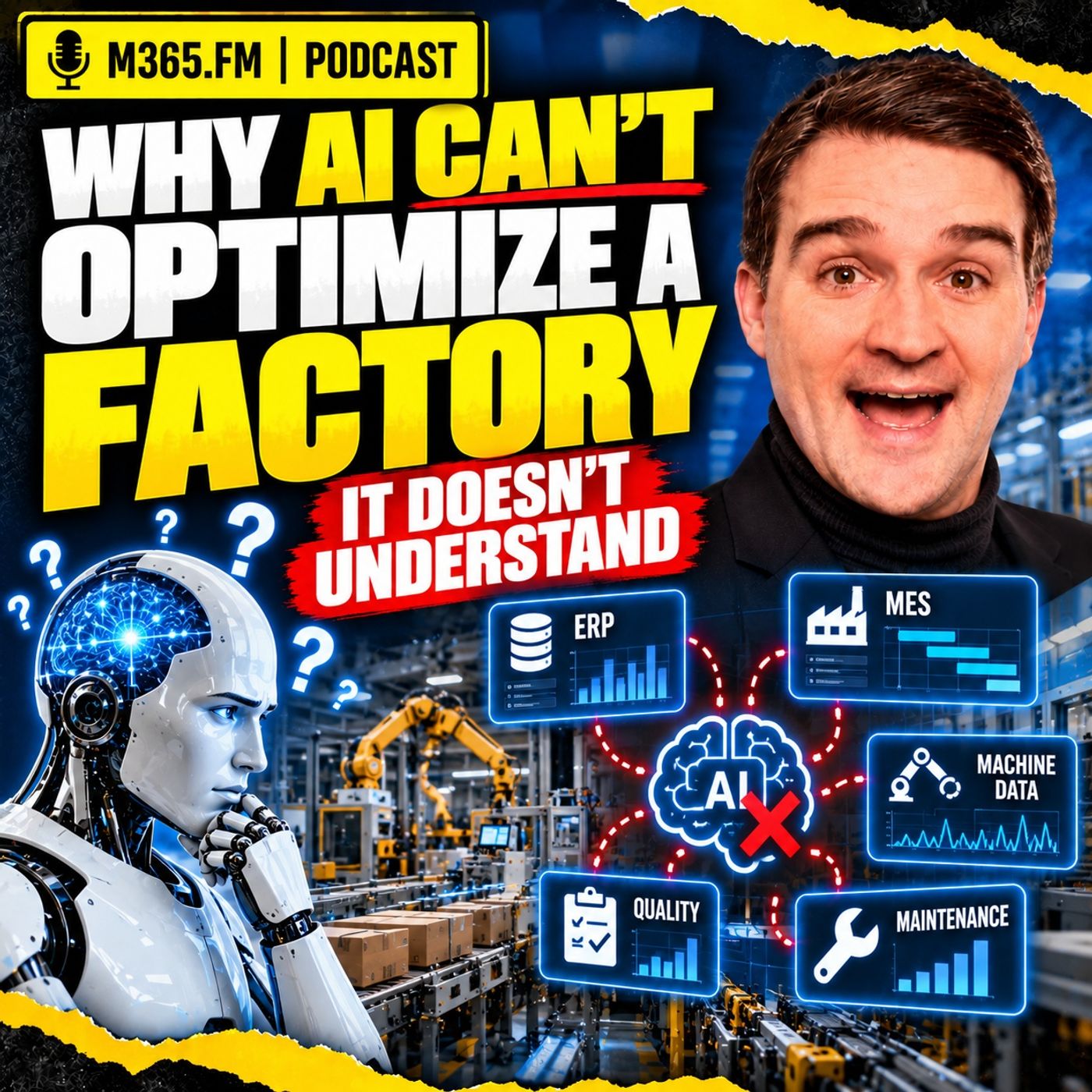
Why AI Can't Optimize a Factory It Doesn't Understand
Season 4
Published 1 week, 5 days ago
Description
A machine stops in the middle of production. ERP knows the customer orders and due dates, MES knows which operation stopped, maintenance knows the repair status, and the machine layer knows the fault code and exact timestamp. Then someone asks the obvious question: what should we do now?
AI can summarize the alarm, find patterns in historical downtime, and explain what probably happened. But unless it also understands which product was running, which orders depend on that operation, which machines are approved alternatives, which tools are available, which operators are qualified, and which quality or process rules apply, it cannot safely optimize the response.
That is not primarily an AI problem. It is a factory-context problem.
DATA IS NOT THE SAME AS CONTEXT
Factories already produce huge amounts of data. ERP, MES, maintenance, quality, historians, PLCs, IoT platforms, and spreadsheets all hold useful facts.
The problem is that those facts often remain disconnected.A machine stop code by itself does not tell you whether the event happened during production, changeover, maintenance, or a batch with a strict processing window. A machine can appear idle while still being unusable because the required fixture is unavailable or the qualified operator is not on shift.
Context connects the event to the operating situation around it.
That includes:
• Asset and resource identity
• Active operation and work order
• Product and revision
• Route and alternate routes
• Material and batch status
• Tooling and fixtures
• Skills and shift coverage
• Quality restrictions
• Maintenance status
• Capacity and downstream dependencies
• Customer commitments
WHY DASHBOARDS ARE NOT ENOUGH
Power BI and operational dashboards are excellent for showing what changed. They can expose downtime, growing queues, late orders, scrap, or available capacity.
But showing a problem is different from deciding what production should do next.
A dashboard may show that another machine is available. It does not automatically know whether that machine is approved for the current product revision, whether the fixture is already reserved, whether quality must approve the transfer, or whether moving the job creates a new bottleneck downstream.
Once reports start containing dozens of special-case calculations and planners still export the result to Excel to test alternatives, the missing piece is usually not another visualization. It is an explicit model of the factory rules behind the decision.
PREDICTION IS NOT OPTIMIZATIONPrediction can tell you that a machine is likely to fail or that an order has a high probability of being late.
That is useful, but it does not tell you what to do.
Optimization has a different job. It evaluates possible actions against the rules and constraints of the factory.
For example, after a machine failure, an optimizer might test whether affected work can remain on the original resource, move to an approved alternate machine, change sequence, or use overtime.
A feasible plan has to respect real conditions.
Safety limits, process approvals, material compatibility, operator certification, tooling, quality restrictions, maintenance windows, and sequence rules cannot simply disappear because another machine looks free.
AI, OPTIMIZATION, AND RULES HAVE DIFFERENT JOBS
Generative AI can help planners understand the situation, search connected information, compare alternatives, explain trade-offs, and create a useful handover.
Predictive models can estimate risk.
Optimization engines can search for feasible schedules.
Deterministic rules can verify that a proposed action respects known production conditions.
These components can work together, but they should not be confused with each other.
A language model can p