Episode Details
Back to Episodes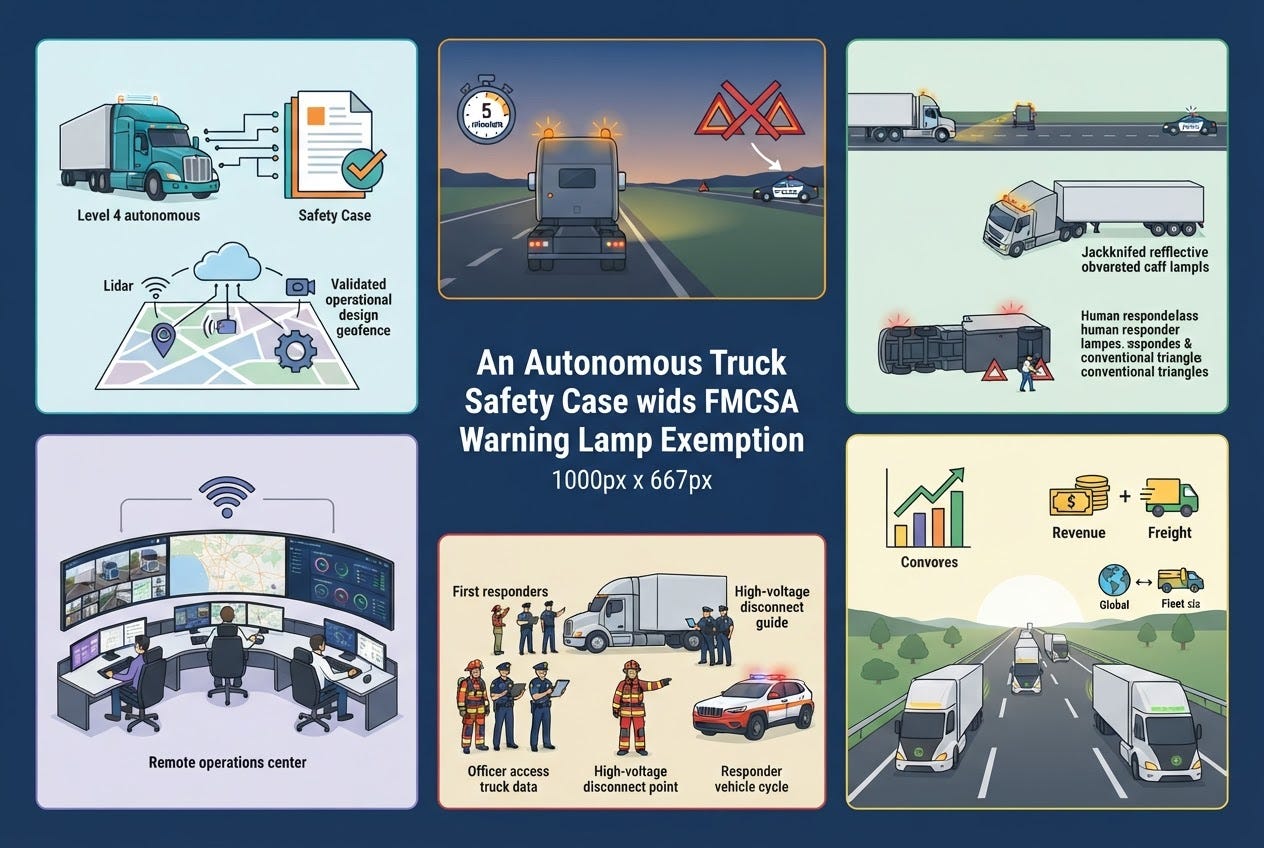
How Should a Driverless Truck Startup Build Its Safety Case
Description
A driverless truck startup should build its autonomous truck safety case around the FMCSA exemption effective October 7, 2026, which lets cab mounted warning lamps replace triangles for five years. Aurora’s lamps flashed for nearly 10 hours across more than 500,000 miles of testing under the earlier waiver. That is the entire activation record behind a five year federal exemption.
Aurora ran 34 trucks with the lamps from October 2025 to January 2026. FMCSA found no reported faults, no malfunctions, and no collision while a truck sat stopped with lamps on. Ten hours of real stops now supports a rule that covers any Level 4 carrier willing to certify compliance under penalty of perjury.
The common telling treats the grant as a victory that removes the last rule requiring a human at the truck. The record is narrower. The exemption relieves one duty, placing triangles within 10 minutes under 49 CFR 392.22(b). It leaves the duty to get a competent person to the truck. A stopped driverless truck still blocks a lane after a crash, still may leak fuel or battery electrolyte, and still needs someone with a radio and a reflective vest.
Opponents told FMCSA that a jackknifed trailer can hide cab mounted lights, that one electrical fault can darken them, and that the studies did not cover the full range of weather and lighting. One trade account reports that the agency acknowledged an overturned truck as a case where the lamps may not perform. A plaintiff’s lawyer will reconstruct exactly those scenes.
A safety case answers those scenes before they happen. UL 4600 asks for a structured argument supported by evidence, and the exemption supplies the boundary for that argument: the validated operational design domain. Inside it, the startup must show how fast the lamps activate, which is five minutes under the exemption as reported, how power redundancy was tested, and what the truck does when the lamps cannot do the job. Outside the domain, the exemption stops protecting the carrier.
In nuclear submarine service, I learned that a casualty procedure counts only if the watch team can execute it without opening the binder. A stopped plant gave the crew seconds. A stopped truck gives the company minutes, and the company is not standing on the shoulder. The remote operations center, the dispatcher, and the roadside responder have to work as one watch team, and the safety case should show how that team is drilled.
That makes remote operations a legal matter. Einride’s two cabless trucks in Marysville, Ohio, each have an off site remote operator who monitors the truck and can take over. Since its 2023 supplemental notice, FMCSA has asked whether remote assistants should face hours of service, drug testing, physical qualification, and commercial license rules, and it has not answered. A company that defines its remote role as advice to the truck builds a different liability profile from one that lets operators drive. Write that definition now, into contracts, training records, and system permissions.
Roadside procedures carry their own clocks. California finalized heavy duty rules on April 28, 2026, requiring a first responder interaction plan, a two minute response to an emergency geofencing message, and a 72 hour response to a notice of noncompliance. Texas began statewide enforcement of its authorization system on May 28, 2026, and requires certification that the Department of Public Safety holds the company’s emergency response interaction plan. The exemption adds a crash report within five calendar days. Four clocks run at once, and a startup with one on call engineer will miss one of them.
The unexpected consequence is financial. Aurora reported $2 million of revenue in the second quarter of 2026, an operating loss of $266 million, and about $1.2 billion in cash. An exemption lowers one hardware and procedure cost. It does nothing for a gap of that size. Startups that cannot fund a staffed re