Episode Details
Back to Episodes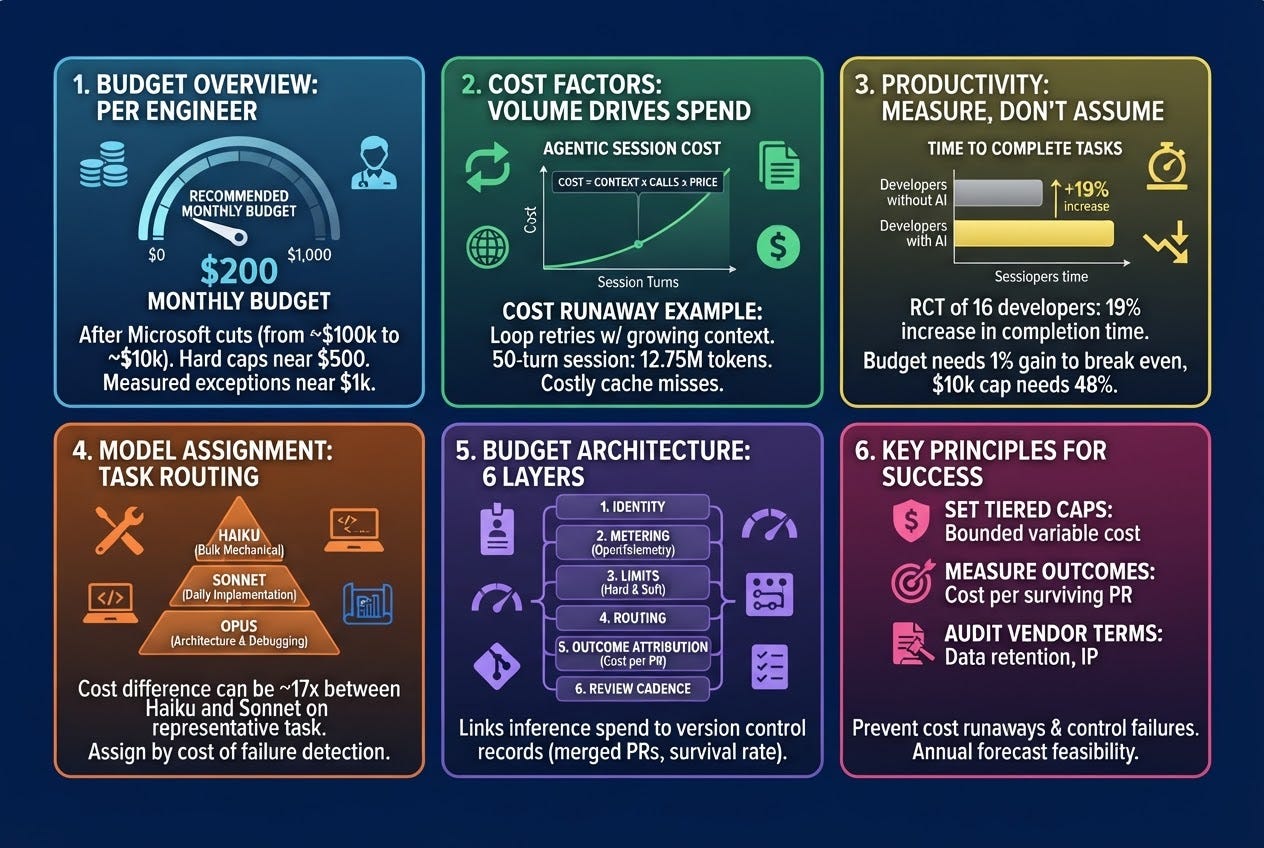
How Much Should a Startup Spend on AI Coding per Engineer
Description
A startup should set its AI coding budget per engineer near $200 per month after Microsoft cut most Cloud and AI division caps from $100,000 to about $10,000.
That cap is a ceiling with a hard limit near $500 and an exception tier near $1,000 for named experiments. The reasoning is arithmetic. At a $250,000 fully loaded annual cost, one percent of an engineer is about $208 per month, so a $200 budget pays for itself if the tools add one percent. Microsoft’s new $10,000 cap needs a 48 percent gain to break even, and the old $100,000 cap needed 480 percent.
Here is what was reported. Projected internal Microsoft spending on Anthropic fell by more than one third from an expected $1 billion per year, which implies a figure below roughly $670 million. Meta’s internal Claude Code users reportedly fell from about 60,000 to about 30,000. Both companies steer staff toward their own tools, and neither dropped Claude entirely. Neither report gave a single token volume, so no one outside those companies knows what the money bought.
What Does an Engineer Using AI Coding Tools Actually Cost?
Anthropic’s own enterprise numbers put the average near $13 per developer per active day, or $150 to $250 per month, with 90 percent of users under $30 per active day. Uber reported the same range, and up to $2,000 per month for its heaviest users, and then reportedly spent its entire 2026 AI coding budget in four months. Its chief operating officer said the link between that usage and better results was not there yet.
The bill grows faster than intuition suggests because every request resends the whole conversation. If each turn adds 10,000 tokens, a 50 turn session reads 12.75 million tokens in total. At Sonnet 5.5 list prices that is about $25.50 uncached and about $1.28 when the cache holds. Idle for five minutes on an API key, and the cache is gone.
How Do You Measure Token Cost Against Output?
Divide the dollars by something a third party recorded. My recommended denominator is a merged pull request that survives 14 days without a revert, joined to the cost of the sessions that produced it. Lines of code, accepted suggestions, and tokens consumed all reward the wrong behavior. An engineer who accepts every suggestion and rewrites it next week scores perfectly on acceptance rate.
Self reports fail for a documented reason. In a randomized trial of 16 experienced developers on 246 tasks, AI tools lengthened completion time by 19 percent. Before the study the developers predicted a 24 percent reduction, and afterward they still believed they had saved 20 percent. The developers reported what they felt. The task timer recorded a different number.
Aboard a nuclear submarine, every reading in the engineering log was recorded against a limit, and an operator who exceeded the limit explained why in writing. A spend number with no output number beside it works the same way a pressure reading with no limit does: it informs no one.
Which Model Should Handle Which Coding Task?
Assign by the cost of detecting failure. On one representative task that reads 2 million cached tokens and writes 60,000 output tokens, I computed $0.07 on Haiku 5.5, $1.20 on Sonnet 5.5, and $2.40 on Opus 5.5 at list prices. Sonnet costs about 17 times Haiku, and Opus costs twice Sonnet.
Price per attempt is not price per success, and an engineer hour at roughly $120 dwarfs all three. Ten minutes spent diagnosing a bad output costs $20, more than eight times the Opus token bill for that task. So send work a compiler or test suite can check to the cheap model: triage of logs, renaming, boilerplate, lint repair. Send daily implementation and bug fixes with reproducing tests to the middle model. Send architecture, cross module debugging, migrations, and ambiguous specifications to the strongest model, and put nightly bulk jobs through the batch interface at half price.
Why Did the Bill Rise While Token Prices