Episode Details
Back to Episodes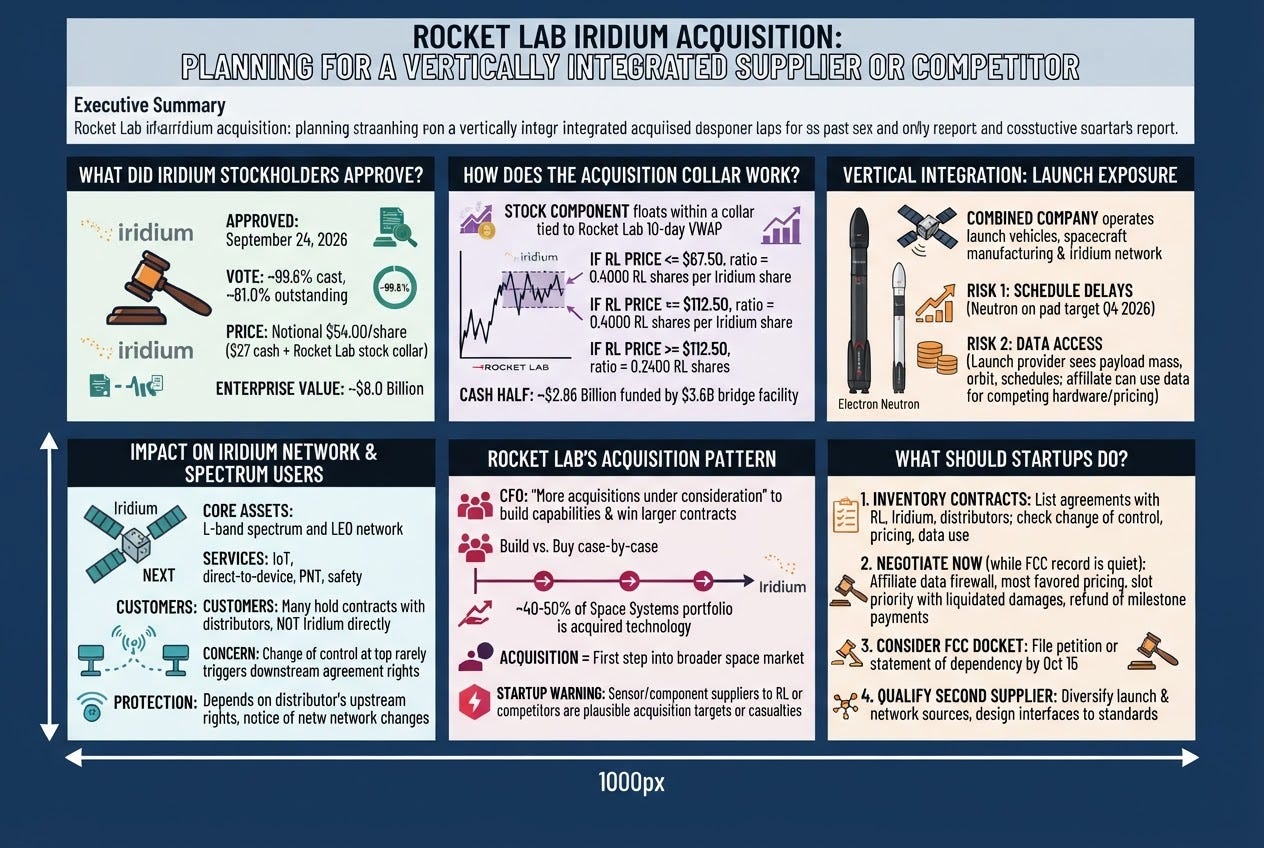
How Should Space Startups Plan for Rocket Lab Owning Iridium
Description
Space startups that depend on launch, spectrum, or network customers should secure neutrality, pricing, and change of control terms before Rocket Lab closes its Iridium acquisition in mid 2027. Iridium stockholders approved the $54.00 per share deal on September 24, 2026, with about 99.6% of votes cast. The FCC comment window under GN Docket No. 26 257 closes October 15, 2026, and replies are due November 9. After that, the Space Bureau decides whether to grant consent, and a startup that stayed silent has only its contracts to rely on.
Each Iridium share receives $27.00 in cash and Rocket Lab stock under a collar that fixes the stock value at $27.00 between Rocket Lab prices of $67.50 and $112.50. Rocket Lab is financing the cash with a $3.6 billion bridge loan, and Iridium carried $1.775 billion of term debt at June 30, 2026. The buyer reported a net loss of $198.2 million on $601.8 million of 2025 revenue, according to secondary reporting, while the target produced about $495 million of operational EBITDA on $871.7 million. A company that carries that much acquisition debt will look hard at every margin it controls.
Why Is a Vertically Integrated Launch Provider Different from a Neutral One?
A neutral launch provider sees your payload mass, orbit, frequency filings, and integration schedule, and has no business that competes with you. Rocket Lab will own launch vehicles, spacecraft manufacturing, and a global mobile satellite network, and its chief financial officer said on September 24 that the company is considering more acquisitions in Earth observation and sensors. In the filing with the FCC, the applicants themselves describe a better financed, vertically integrated operator.
In my practice, the clause that founders skip is the one governing what a launch provider may do with technical data collected during integration. Standard launch services agreements bind the two signatories to confidentiality and export control. They rarely restrict an affiliate that builds competing hardware. Anyone who has spent time in a semiconductor fab will recognize the pattern: a supplier that also makes a competing product learns your process from your purchase orders.
What Does Neutron Delay Do to a Startup’s Launch Plan?
Neutron is two years late and now targets the pad in the fourth quarter of 2026. Rocket Lab reports about $2.36 billion of backlog, 90 launch missions across Neutron and Electron, and a $397 million Space Force contract for Neutron. A startup holding Neutron capacity competes for manifest slots with a government customer that has priority and a parent company that needs the vehicle to replenish its own network. Varda, which closed a $251 million Series D at a $1.6 billion valuation at the end of September, scheduled its next two missions on SpaceX Transporter 18, which is what a funded startup with options does.
A seed stage company has fewer options and should buy protection with paper. Ask for slot priority with liquidated damages for delay, a refund of milestone payments if the vehicle has not flown by a stated date, and most favored pricing. Ask for a prohibition on affiliate use of payload and integration data, and for notice of any change in ownership of the network or spacecraft business that touches your mission.
What Happens If You Buy Network Capacity Through an Iridium Partner?
Most startups hold a contract with a distributor and none with Iridium, and Iridium describes more than 500 technology and distribution partners. A merger at the top rarely triggers anything in that downstream contract. Read the distributor agreement for price change notice, service plan changes, and termination assistance, because those are the terms a new owner with debt to service can change without anyone’s consent.
The merger agreement adds a wrinkle. It runs in two steps: Merger Sub I merges into Iridium, and, if conditions are met, Iridium merges into Merger Sub II.