Episode Details
Back to Episodes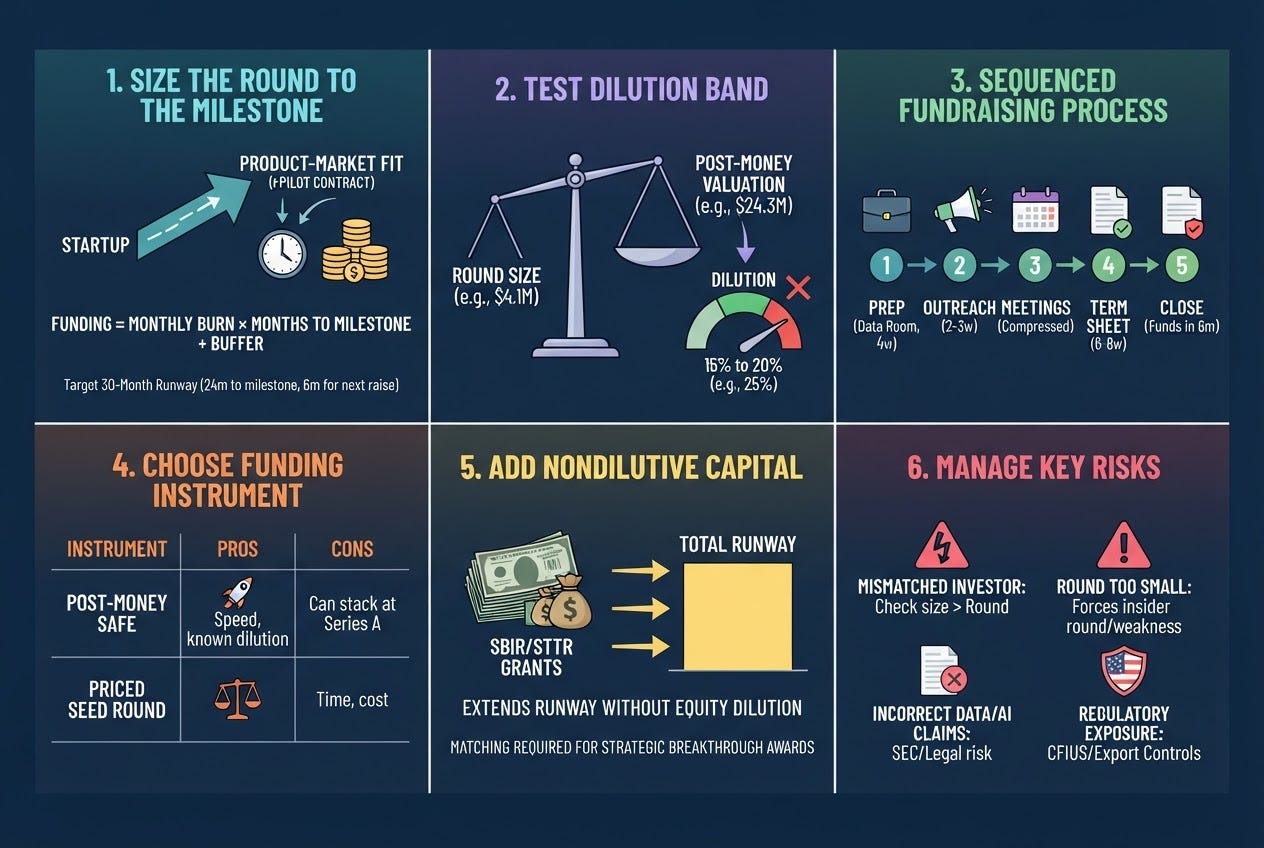
How Much Should a Startup Raise After Record 3Q2026 Megarounds
Description
Outside founders should size a round to the cash needed to reach the next milestone, because 27 rounds of $1 billion or more dominated the $159 billion Q3 2026 total. Take the median priced software seed round of $4.1 million, divide it by 30 months, and you get about $137,000 of monthly burn. That arithmetic decides how much you should ask for.
Most founders read the quarterly funding total as weather. The October 5, 2026 tally put global venture funding at $159 billion across about 6,000 startups, down 25% from the second quarter and up 53% from a year earlier. Artificial intelligence took $102 billion, or 64%. Databricks and Safe Superintelligence each raised $5 billion. A founder who sees those numbers can conclude that capital is abundant, and that reading fails when it meets the median round.
Here is the mechanic most teams overlook. The 27 rounds of $1 billion or more took roughly one third of the quarter, about $53 billion by my arithmetic. The remaining $106 billion or so went to roughly 5,970 companies, an average near $17.7 million that almost no company in the middle of the pack receives. Platform data for priced software rounds in the six months to July 2026 shows a median seed of $4.1 million at a $24.3 million post money valuation, and a median Series A of $14.4 million at $80 million. Dilution for both medians was 18%.
The time between those rounds is the number that should drive your plan. The median gap from seed to Series A was about 1.9 years for rounds raised in late 2025. Only about 17% of the 2022 seed cohort reached a Series A within two years, against 25% to 30% in a normal year. A founder who starts raising with six months of cash left, in a process that takes four to six months, has bet the company on the median.
A seed round sized to the median runway leaves no buffer. The practice rule I give clients is 30 months of burn: about 24 months to the milestone and about six months to run the next process. The milestone is a number and a date that the next investor will price: recurring revenue near $2 million to $3 million for a software company in the artificial intelligence era, or a certified prototype and a pilot contract for a hardware company.
Then run the dilution check. Divide the round by the post money valuation. If the milestone needs $6 million and the post money is $24.3 million, you are selling about 25%, above the 15% to 20% band that the medians support. You have four practical moves: cut burn, shorten the milestone, raise in two tranches tied to proof, or add nondilutive capital. Asking for a higher valuation is the fifth move, and it tends to fail, because the next investor prices your milestone and your comparable companies, and an inflated seed price shows up later as a stalled Series A.
Deep tech founders have a federal option that software founders lack. The Small Business Innovation and Economic Security Act of 2026, signed April 13, 2026, reauthorized SBIR and STTR through September 30, 2031 and created Strategic Breakthrough awards of up to $30 million. Applicants need a prior Phase I or Phase II award and a dollar for dollar match from new private capital or qualifying government funds. Your equity round becomes the match, so size it with that application in mind.
Two contract points belong in the plan before the term sheet. First, any foreign investor in a company that touches critical technology calls for a check under the Committee on Foreign Investment in the United States rules at 31 CFR Part 800, and the new SBIR security screening looks at foreign affiliations and investment ties. Second, review the vendor contracts that your product depends on. The quarter included reported acquisitions of infrastructure and tooling companies, including Nvidia’s bid for Hugging Face at $12.9 billion, and a new owner can change pricing and priorities. Change of control, assignment, and data use terms are easier to negotiate before the acquisiti