Episode Details
Back to Episodes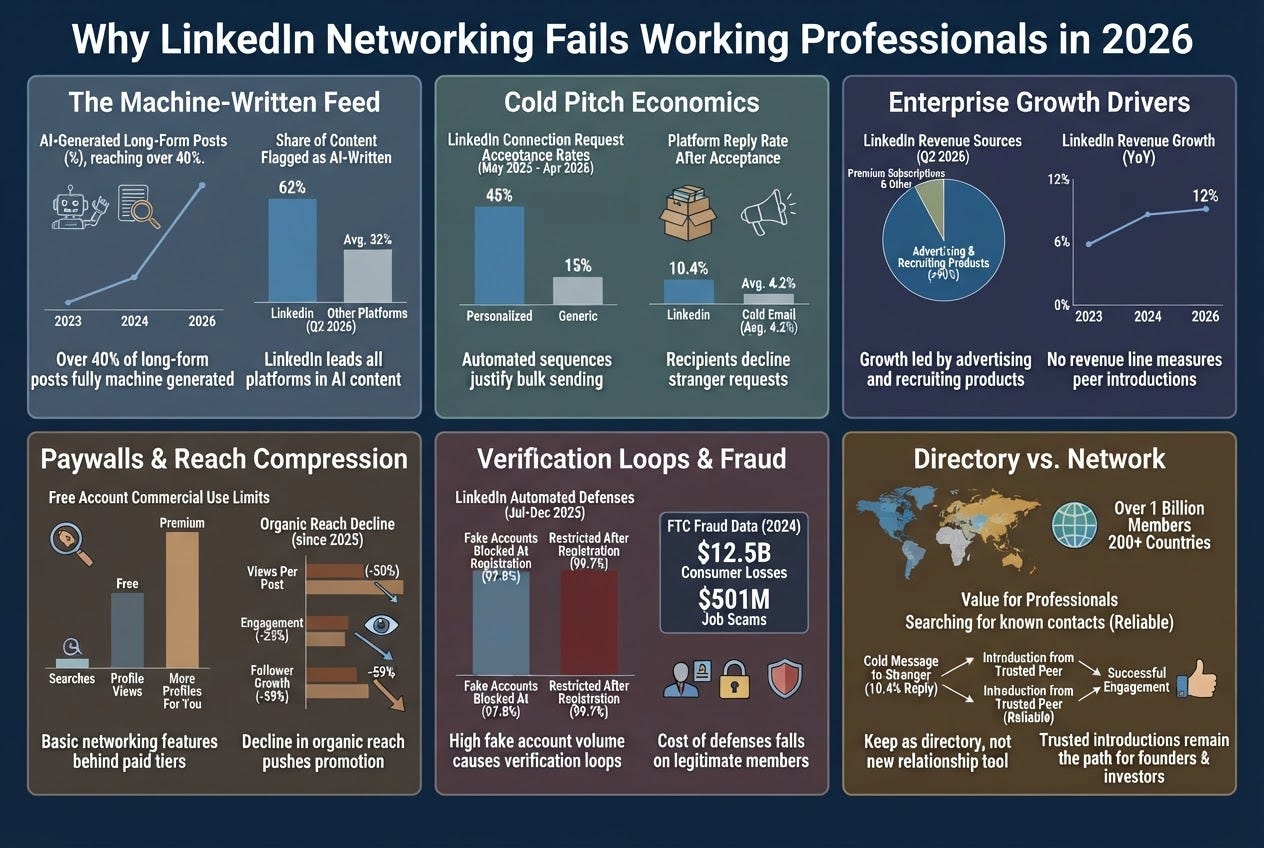
Why LinkedIn Networking Fails
Description
Executive Summary
LinkedIn networking in 2026 fails working professionals because over 40 percent of long posts are machine generated, cold pitches fill inboxes, and Microsoft’s growth is led by advertising. A July 2026 analysis of 1,002,627 posts found that LinkedIn supplied about one third of the content scanned and 62 percent of everything flagged as AI written. Outreach data covering 13.2 million connection requests shows that 28 to 30 percent are accepted and that 10.4 percent of messages sent after acceptance receive a reply. LinkedIn’s parent company reported 12 percent revenue growth for the quarter ended June 30, 2026.
This report examines ten reasons professionals give for abandoning LinkedIn as a networking tool: engagement bait, AI generated content, automated sales pitches, paid feature limits, humblebragging, message filters, an algorithm that favors frequency, identity verification loops, member lock in, and the weight of advertising and recruiting products in the business. Verified figures support the findings on AI content, outreach results, humblebragging, fraud, and revenue. The findings on message filters, reach changes, and verification burdens rest on practitioner reports, and the report labels each one that way.
LinkedIn keeps a place as a directory for checking people already met or introduced. Founders and investors seeking new relationships will find that introductions from people who know their work remain the reliable path.
Detailed Findings
Why do engagement bait posts dominate the LinkedIn feed?
Engagement bait dominates the feed because LinkedIn’s distribution rewards early reactions and comments, so authors write to produce them. Practitioner analyses of the ranking system describe the first 60 to 90 minutes after posting as the period that decides how far a post travels, and they describe dwell time as a weighted input. That mechanism pays an author for a poll that asks the reader to agree, or for an instruction to comment a single word in exchange for a guide delivered by direct message.
LinkedIn changed its ranking in 2025 to suppress engagement pods and generic comments, according to the same analyses, and a large language model began matching posts to member interests in August 2025. The reward for writing to the metric remained. A founder who wants a peer with experience in a Delaware preferred stock financing finds motivational stories ahead of that peer’s work. LinkedIn has not published its ranking weights, so every description of them comes from practitioners who test posts and compare results.
How much LinkedIn content is AI generated, and why does it matter?
Over 40 percent of long form LinkedIn posts in spring 2026 were classified as fully machine generated, roughly double the average across the other platforms examined. The analysis covered 1,002,627 posts of more than 50 words collected from April 24 through June 30, 2026, and it defined long form as posts above 250 words. LinkedIn represented about one third of the scanned content and 62 percent of the material flagged as AI written.
An earlier analysis of 8,795 public posts from January 2018 through October 2024 estimated that more than 54 percent of long English posts were likely AI written, and it found a 189 percent jump at the start of 2023, after the late 2022 release of ChatGPT. The two figures differ because the detectors and the definitions differ: one counted posts likely written by AI, and the other counted posts classified as fully machine generated. Both place the share near half. The 2026 analysis points to LinkedIn’s own Enhance Post feature and Microsoft Copilot integration, which place machine writing inside the composer.
When any member can produce a polished 300 word analysis in seconds, polish stops indicating knowledge. A reader must spend time to learn whether the author has done the work, and most readers decline to spend it.
Why do