Episode Details
Back to Episodes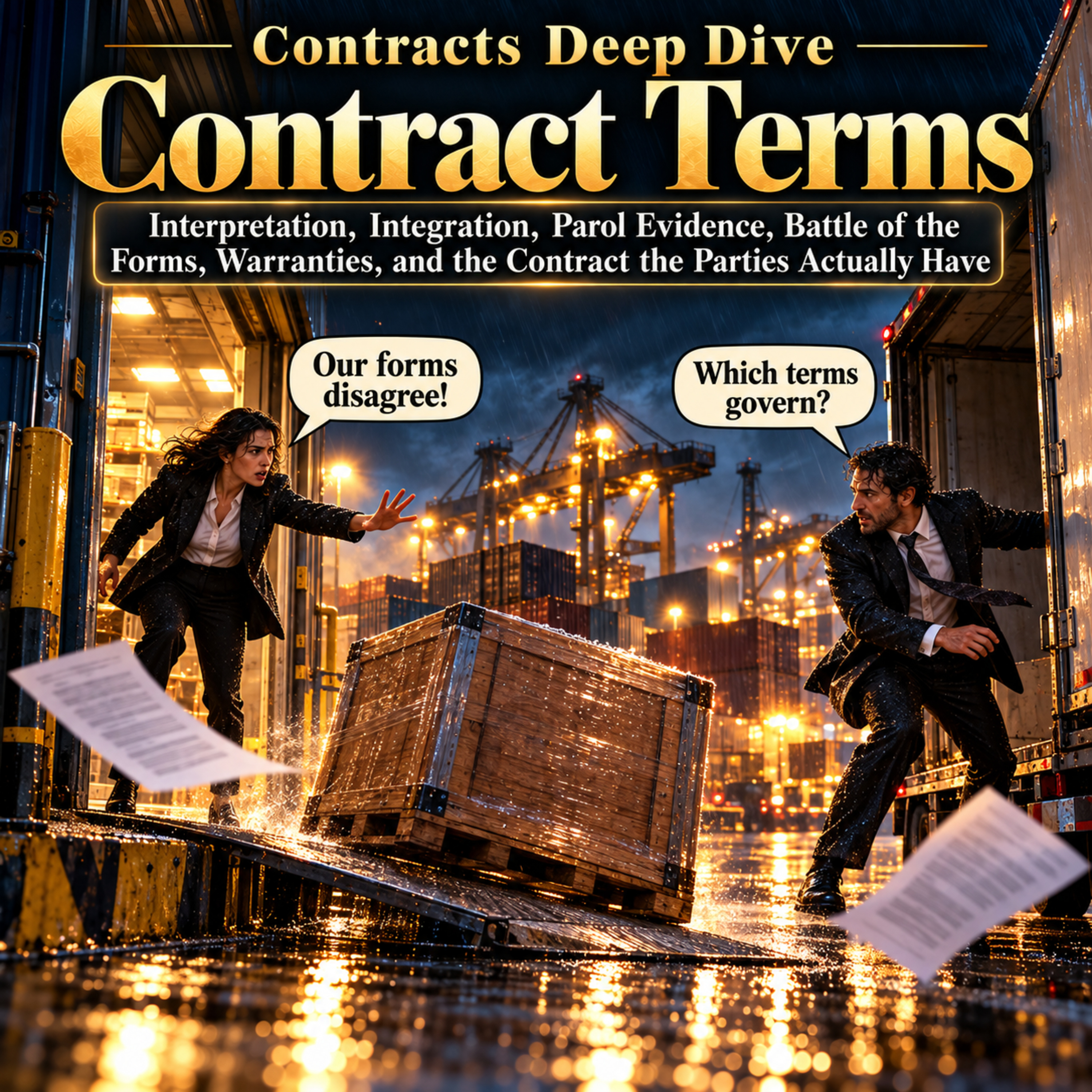
Contracts Deep Dive: UCC - Battle of the Forms, Warranties, and Risk of Loss
Description
⚖️ Hear the rules. Follow the stories. Connect the dots.⚖️
Five companion resources from The Law School of America.
🎬 THREE ILLUSTRATED GUIDES
👉 The Last Edition — Follow the case.
👉 The Price of a Promise — Trace the broken bargains.
👉 When the Lights Return — Step into the countdown.
📚 TWO TEXT GUIDES
📖 The Contracts Book — Deepen your understanding.
🎯 The Summary Guide — Sharpen your review.
See it. Study it. Review it.
Explore all three stories, build your foundation with the book, then pull it together with the summary guide.
🎧 EPISODE SUMMARY 🎧
Mastering Article 2 of the Uniform Commercial Code requires abandoning the rigid technicalities of the common law in favor of flexible commercial realities. Formation under Article 2 prioritizes the intent to contract, filling missing terms with statutory gap-fillers to validate the transaction.
When parties exchange conflicting commercial forms, Section 2-207 governs the battle of the forms, abolishing the mirror-image rule. A contract is formed on the writings despite additional or different terms, provided acceptance is not expressly conditional. Between merchants, additional terms enter the contract unless they materially alter the deal, while different terms knock each other out.
Warranties protect buyers regarding the quality of goods. Express warranties arise from affirmations of fact, descriptions, or models. The implied warranty of merchantability automatically guarantees that goods sold by a merchant are fit for their ordinary purposes, while the implied warranty of fitness for a particular purpose applies when any seller knows the buyer is relying on their expertise. Sellers may utilize disclaimers and limitation of remedies, but implied warranties can only be disclaimed through specific conspicuous language or phrases like "as is." However, "as is" clauses do not destroy express warranties, and unconscionability considerations prevent merchants from disclaiming liability for personal injuries caused by consumer goods.
Finally, Article 2 separates ownership/title questions from risk-of-loss questions. Title is a legal abstraction, while risk of loss dictates financial responsibility for destroyed goods. In shipment contracts, risk passes upon delivery to the carrier, whereas in destination contracts, risk passes upon arrival. For non-carrier pickups, merchant sellers retain the risk until physical receipt by the buyer, while nonmerchant sellers pass the risk upon tender of delivery. However, these baseline rules shift under breach effects: a party who delivers defective goods or wrongfully repudiates bears the risk of loss, penalizing the breaching party and protecting the innocent party's expectations.
ℹ️ INFORMATION, PRIVACY POLICY & TERMS OF USE ℹ️
The Podcast and Website Purpose
The Law School Podcast and 1L Study Aide webpage supplements law-school and Bar Exam study with strategies, condensed rules, quizzes, and flashcards.
Listen Now
Love PodBriefly?
If you like Podbriefly.com, please consider donating to support the ongoing development.
Support Us