Episode Details
Back to Episodes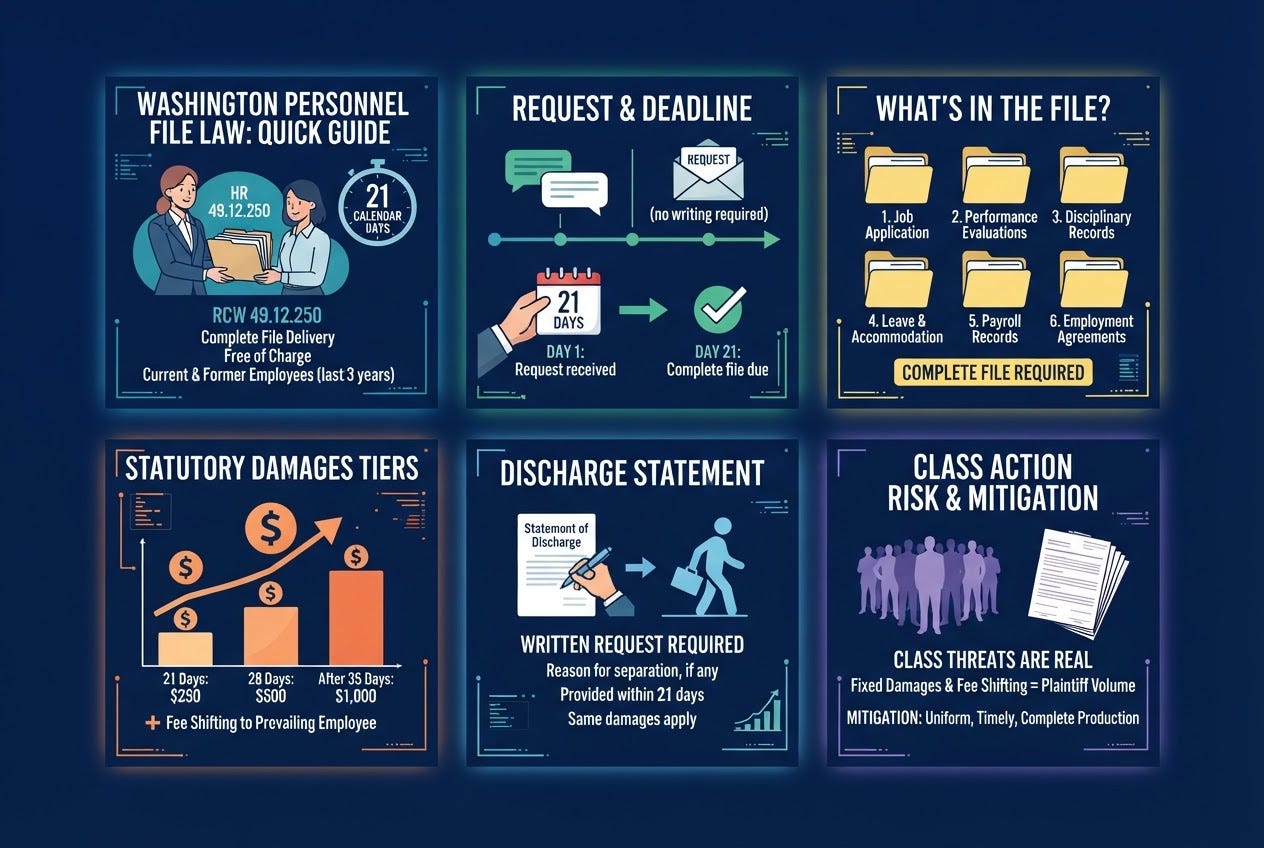
Can Employees Bring a Class Action Over Washington Personnel File Requests
Description
Washington employers who deliver a personnel file later than 35 calendar days owe $1,000 in statutory damages plus attorney fees under RCW 49.12.261. The deadline for production is 21 calendar days, the copy must be free, and the duty runs to current employees, former employees who left within three years, and their lawyers. A letter demanding the file can also carry the notice of intent to sue, which starts a five calendar day wait.
Substitute House Bill 1308 created that structure on July 27, 2025. Before it, the statute asked for inspection within a reasonable time, and L&I read that as about ten business days. Nothing in the old statute paid an employee for a late file. The new one pays $250 at day 21, $500 at day 28, and $1,000 after day 35, and it adds $500 for other violations.
Who collects the penalty, L&I or the employee?
The employee collects, and the statute names no fine payable to L&I. RCW 49.12.261 sends the claim to superior court and shifts attorney fees to the employer that loses. That choice was debated in 2025: business groups testified that a private action would generate income for lawyers and asked for agency enforcement. The legislature kept the private action.
The incentive follows from the arithmetic. A single late file produces a fixed number, the fees come on top, and no cure period lets the employer erase the tier it already reached. A lawyer can price the claim before sending the first letter.
Why do the letters mention a class?
The statute contains no class provision, yet the word appears in demand letters because Washington is in the middle of a class filing surge. Employment class actions numbered 54 in 2023 and 773 in 2025, and the first half of 2026 added 658. The pay transparency statute shows the mechanism. RCW 49.58.110 carried a $5,000 remedy per applicant, the Washington Supreme Court held in Branson v. Washington Fine Wine & Spirits in 2025 that a person who submits a resume qualifies as an applicant regardless of intent, and the legislature responded in 2025 with a five business day cure period and a graduated range of $100 to $5,000.
The Silenced No More Act, RCW 49.44.211, pairs $10,000 in statutory damages with fee shifting, and a court certified a class on December 10, 2024 in a handbook case. Fixed damages, fee shifting, and a document every employee received make a class easy to describe. RCW 49.12.261 has the first two. A class plaintiff needs the third.
In my practice advising technology companies for roughly 30 years, the first notice of an employment dispute has often arrived as a records request addressed to a founder or an office manager, who forwarded it to counsel after a week or more. Under this statute, ten days of delay consumes nearly half of the 21 day period.
Can a personnel file class action actually succeed?
No court has ruled on the question as of October 6, 2026, and the legal standards point toward limited success. Each damages tier turns on the date of one person’s request and the date of one production, and each person must have given or been covered by a notice of intent to sue. Rule 23 predominance and commonality therefore require a shared employer practice, such as a standard packet that omits payroll records or a vendor that always delivers on day 30.
Plaintiffs hold one advantage. Fixed damages avoid the damages model problem addressed in Comcast Corp. v. Behrend in 2013. Employers hold several. Fee shifting lets an individual sue alone, which weakens superiority. Arbitration agreements with class waivers are enforceable under the Federal Arbitration Act, as Epic Systems Corp. v. Lewis held in 2018. Federal court is a long way off, because the Class Action Fairness Act requires more than $5,000,000 in controversy, which means roughly 5,000 members at the top tier before fees, and TransUnion LLC v. Ramirez in 2021 requires concrete harm from each member seeking damages.
What