Episode Details
Back to Episodes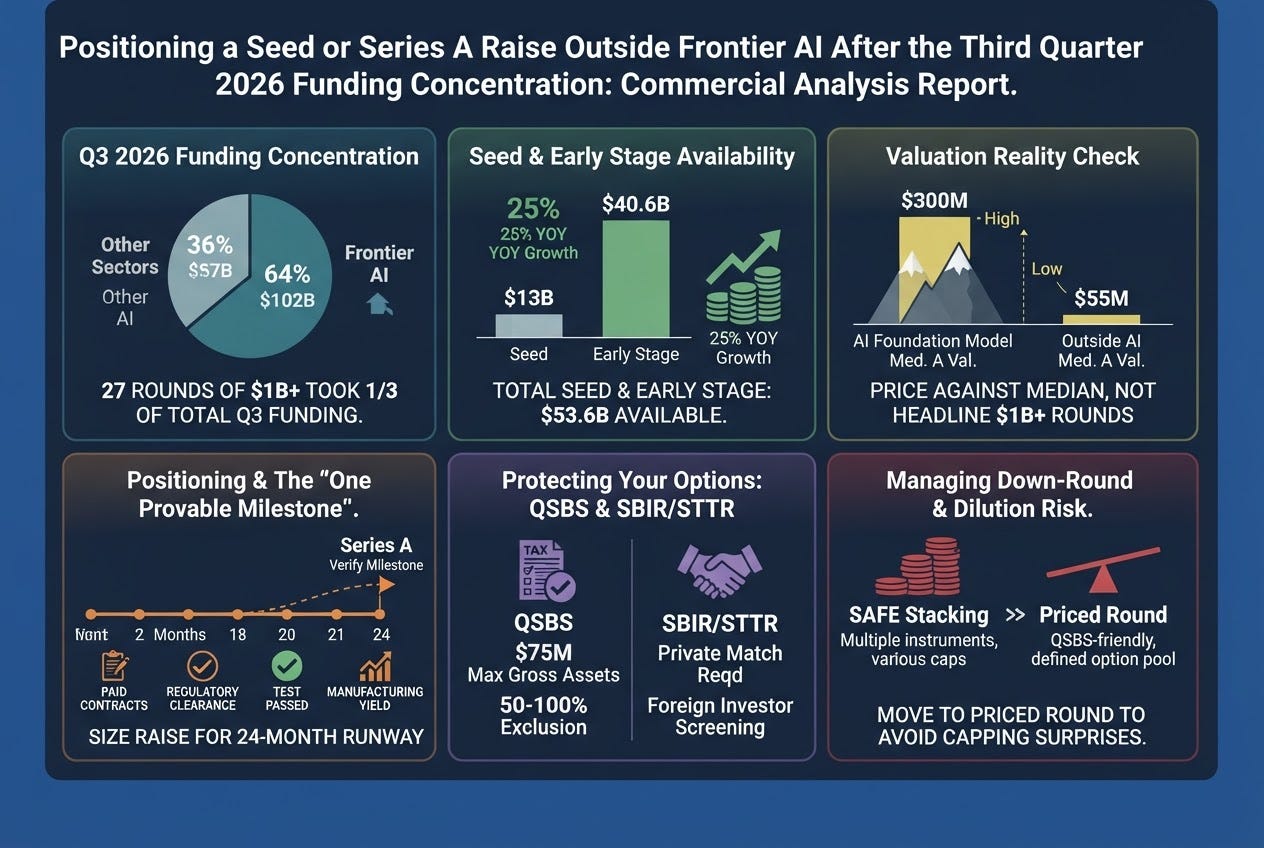
How To Raise a Seed or Series A Round Outside Frontier AI
Description
Founders outside frontier AI should size a seed or Series A to one verifiable milestone, because 27 rounds of $1 billion or more took a third of Q3 2026 funding. The qualified small business stock exclusion, the SBIR matching rule, and the next investor’s valuation test all depend on how large the round is.
A company that raises a $90 million seed round has just disqualified every share it issued from the qualified small business stock exclusion, and none of the investors who wrote the check will mention it. Section 1202 of the Internal Revenue Code, as amended in July 2025, measures gross assets immediately after issuance, so the cash from the round counts. A cash raise the size of the $480 million seed round Humans& closed this year would exceed the $75 million limit more than six times over.
Under Section 1202 of the Internal Revenue Code, as amended in July 2025, stock issued by a company with more than $75 million in gross assets immediately after issuance does not qualify for the exclusion.
Most founders outside frontier AI never see a round that large, and that is the point. The quarter that produced Databricks and Safe Superintelligence at $5 billion each also produced $13 billion of seed funding and $40.6 billion of early stage funding, up 25 percent from a year earlier. Artificial intelligence companies took $102 billion, 64 percent of the total, which leaves about $57 billion for everyone else. Seed and early stage together came to about $53.6 billion, nearly the same as the 27 giant rounds.
Capital is available at seed, and prices vary by a wide margin. The 95th percentile seed valuation hit $200 million in the second quarter, up from $72.2 million a year earlier, and the median Series A for a foundation model company sat near $300 million after the money went in while companies outside AI sat near $55 million. A typical software Series A in the six months to July raised $14.4 million and sold about 18 percent of the company. If you price your seed against the top percentile, you will need a Series A that a spreadsheet can defend about 1.9 years later, which is the median gap between the two rounds. Valuations in the second quarter passed their 2021 highs at every stage, and the down round rate was 11.4 percent in the first quarter.
On a nuclear submarine the length of a patrol is set by what you load before leaving the pier and how carefully you ration it. A seed round works the same way. Raise enough for roughly 24 months and one milestone that someone outside your company can verify: paid contracts, a passed qualification test, a regulatory clearance, a manufacturing yield. Then stop adding dilution.
The next mechanic is the federal money, and it changes the math on the size of the round. Congress let SBIR and STTR lapse for six months before the Small Business Innovation and Economic Security Act restored them on April 13, 2026, through September 30, 2031.
The Small Business Innovation and Economic Security Act, signed April 13, 2026, authorizes Strategic Breakthrough awards of up to $30 million over 48 months, and generally requires private capital matching the award dollar for dollar.
A seed or Series A that closes before the proposal is filed can supply that match. The same act orders agencies to screen applicants against federal watchlists for foreign ties and to disclose the basis for a denial, so every investor on the cap table, and every side letter, becomes part of the application. A company that learns this after the solicitation opens has already lost weeks.
Then there is the pitch itself. Investors screen for AI because AI companies took 49 percent of pre seed dollars in the first half of 2026 and 64 percent of all third quarter funding. The temptation to relabel a physical or services business is strong, and the Securities and Exchange Commission has shown what it costs. In April 2025 it sued Albert Saniger in the Southern District of New York