Episode Details
Back to Episodes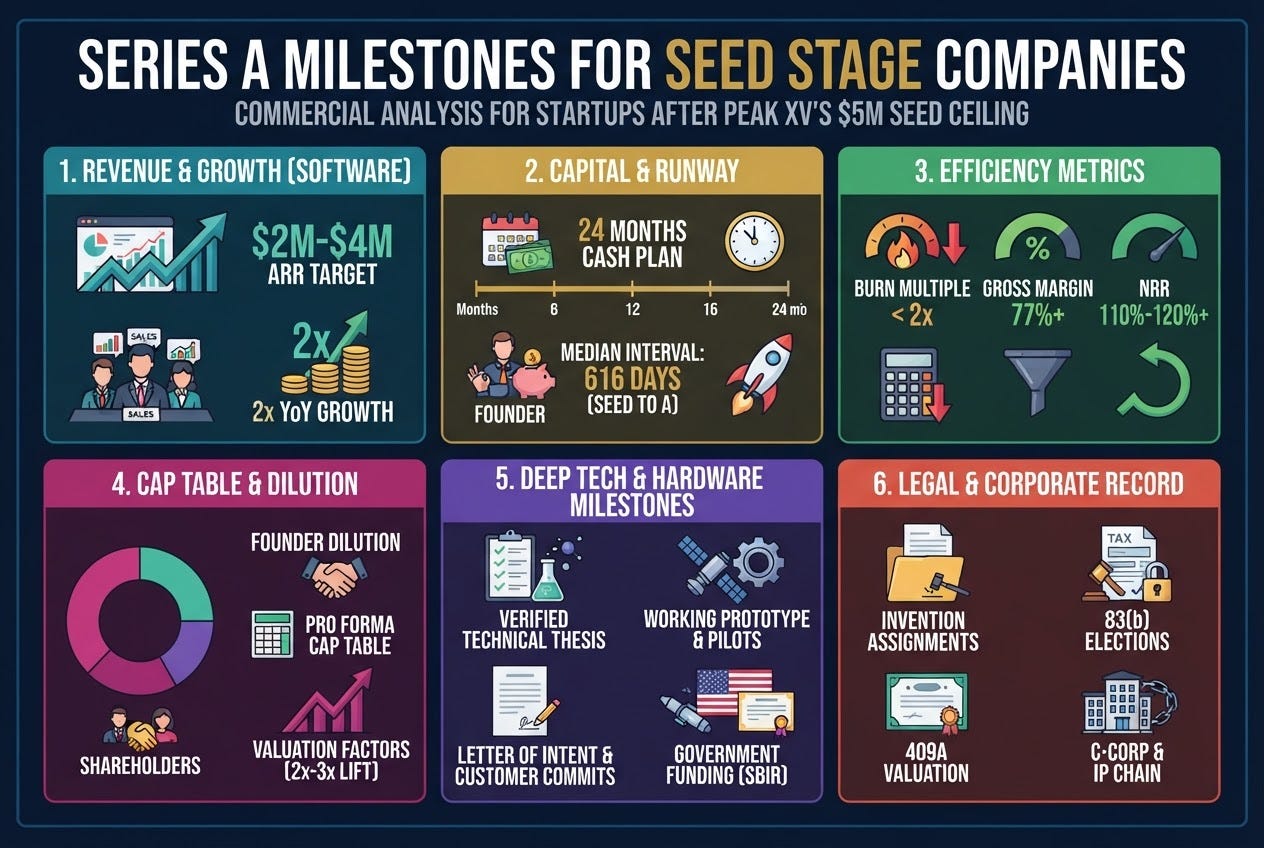
Peak XV Lifts Seed Checks to $5 Million as Series A Bar Rises
Description
A seed stage company in 2026 needs about $2 million to $4 million in annual recurring revenue and at least 2x year over year growth before a Series A lead will commit. On September 28, 2026, Peak XV raised its seed ceiling from $3 million to $5 million, and managing director Rajan Anandan said the bar to raise a Series A has gone up pretty significantly.
Start with the instrument most founders treat as a formality. A founder raising a $5 million seed round on SAFEs is writing a set of conversion promises, each with its own valuation cap, and the Series A lead will convert every one of them into shares before deciding what to pay. In the second quarter of 2026, large pre seed deals commonly stacked ten or more instruments, and SAFEs above $2.5 million at the 90th percentile carried valuation caps of $100 million. That number follows the company into the Series A room.
The money is moving toward bigger checks and fewer of them. Peak XV put more than $50 million into 18 companies in its twelfth Surge cohort, and those companies raised more than $90 million in seed capital together, close to $5 million each. Across the whole U.S. market in the second quarter of 2026, $3.19 billion went into more than 11,500 pre seed instruments, against $3.22 billion into 14,825 a year earlier. The dollars held flat while the instrument count fell about 22%, and the average check reached a record $276,000, up 27%.
A bigger check changes what the company owes its next investor. The median interval between seed and Series A is now 616 days, and reported graduation rates for seed cohorts run from about 20% to 27%, with the 2024 cohort at 24% so far. A company that plans on 12 to 18 months of runway will be raising from a position of weakness.
Runway arithmetic is the first thing to fix. A Series A process takes six to eight weeks from term sheet to close, and a sensible company starts the process with six months of cash in the bank. A $5 million seed round therefore supports about 18 months of building at roughly $278,000 a month. A $3 million round supports the same 18 months at about $167,000 a month. The $111,000 monthly difference is the practical meaning of Peak XV’s new ceiling for a founder.
Seed stage companies should plan on 24 months of cash, because the median interval from seed to Series A exceeds 600 days and the largest share of seed cohorts does not graduate on time.
Then the milestones. For a software company, published benchmarks put annual recurring revenue at term sheet near $3 million, with competitive ranges from $2 million to $5 million. Growth of at least 2x a year is the entry requirement, net revenue retention of 110% to 120% is competitive, and a burn multiple under 2x is acceptable. Median gross margin for companies in the $1 million to $5 million range is 77%, and median customer acquisition payback is 8 months. Founders should pull these figures from their own books before an investor does.
Deep technology companies cannot use those measures, and Peak XV’s managing director said capital intensive deep tech is one reason seed rounds are growing. The substitute is dated, third party proof: a prototype tested against a written specification, a paying pilot, a letter of intent stating quantity and price. A Small Business Innovation Research Phase II award, which carries a 20 year protection period for technical data under the 2019 policy directive, supplies that proof without dilution. If a foreign fund is writing the seed check, the company should also confirm whether its technology is critical technology under 31 CFR Part 800 before closing, because a mandatory declaration to the Committee on Foreign Investment in the United States delays a closing.
Artificial intelligence companies sit under a steeper standard. They took 49% of pre seed dollars in the first half of 2026, and their median growth rate between $1 million and $5 million in annual recurring revenue has been rep