Episode Details
Back to Episodes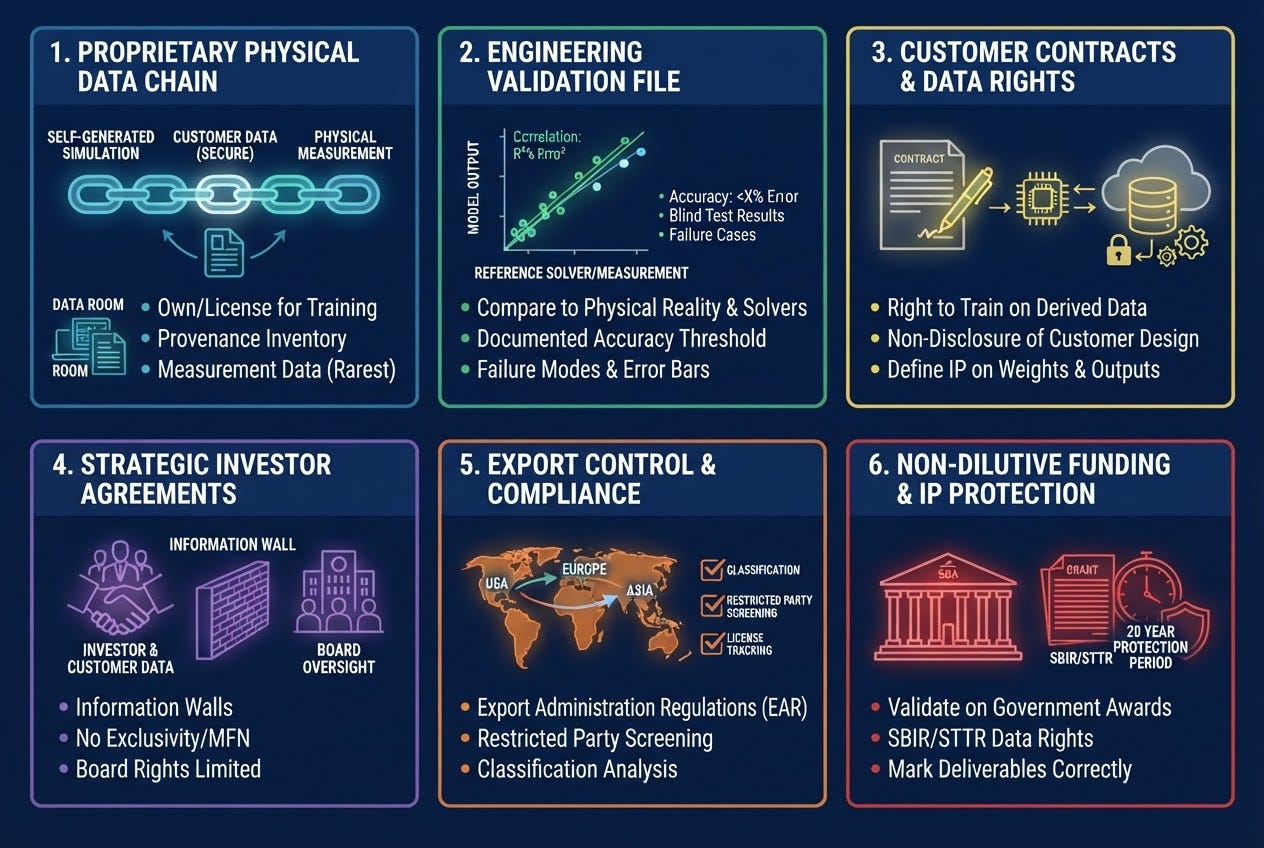
Vinci’s $250 Million Round
Description
A specialized artificial intelligence company raising a large round, as Vinci did with $250 million at a $1.5 billion valuation on October 6, 2026, must prove its model matches physical reality and that it owns the data behind it.
The mechanic most founders overlook sits in a clause nobody reads until diligence. Every commercial simulation license says something about benchmarking, publication of comparisons and use of outputs. A founder who generated a training set by running a licensed solver ten thousand times believes the data is proprietary. The solver vendor’s lawyer may read the same agreement and conclude the outputs cannot be used to build a competing product. That is a title problem, and it surfaces in the first week of a data room review.
Vinci builds artificial intelligence for physics simulation in semiconductor design. Its announcement says the platform analyzes designs from hundreds of millions to more than 15 billion degrees of freedom in minutes, works zero shot without customer specific training, and covers thermal analysis, thermo mechanical warpage and convective fluid behavior. Advent, Temasek and Xora led the round. AMD Ventures, Eclipse, Khosla Ventures and Madrona participated. The company had disclosed $46 million raised when it left stealth in December 2025.
What the announcement leaves out teaches as much. No customer is named, no revenue is disclosed, and the chief executive described a move from a handful of production pilots toward broader deployment. The accuracy claims are the company’s own. A founder should notice that the investors apparently decided on evidence the public has not seen, and should prepare to show the same kind of evidence privately.
Why does engineering validation set the price?
Engineering validation sets the price because the buyer is an engineer who signs off on a design that costs millions to manufacture, and that engineer trusts measurement before trusting a model.
In thirty years of counseling technology companies, the document request that most often stalls a diligence process is the correlation plot: model prediction against physical measurement, on designs the model never saw. Thermal junction temperature against on die sensor readings. Package warpage against shadow moire measurements across a reflow profile. A founder who has these plots, with stated error, the reference solver used and the conditions where the model fails, has a different conversation than a founder with a demonstration.
The competitor’s record raises the standard. Synopsys completed its roughly $35 billion acquisition of Ansys on July 17, 2025, and with it acquired a solver that customers have correlated against measurement for decades. A new entrant asks engineers to move from a tool with that history to a model with a pilot. The correlation file is the only credible answer.
Who owns the data a physics model learns from?
The company owns only the data it can trace, and chain of title for every training source is the first thing a later buyer or round’s counsel will request.
Three kinds of data matter. Self generated simulation data is only as clean as the license of the solver that labeled it. Customer design data, such as a package layout or a floorplan, belongs among the most confidential assets a chip company holds, and the contract must say whether the vendor may train on derived features and whether weights that encode patterns from many customers belong to the vendor. Measurement data from instrumented test vehicles is the rarest and the hardest for an incumbent to copy.
The price of a weak answer was visible in Bartz v. Anthropic, where the company agreed to a $1.5 billion settlement over books taken from pirated sources and the court gave final approval in 2026. Thermal fields differ from books, and the buyer’s question is the same: where did each example come from.
How should founders handle strategic investors an