Episode Details
Back to Episodes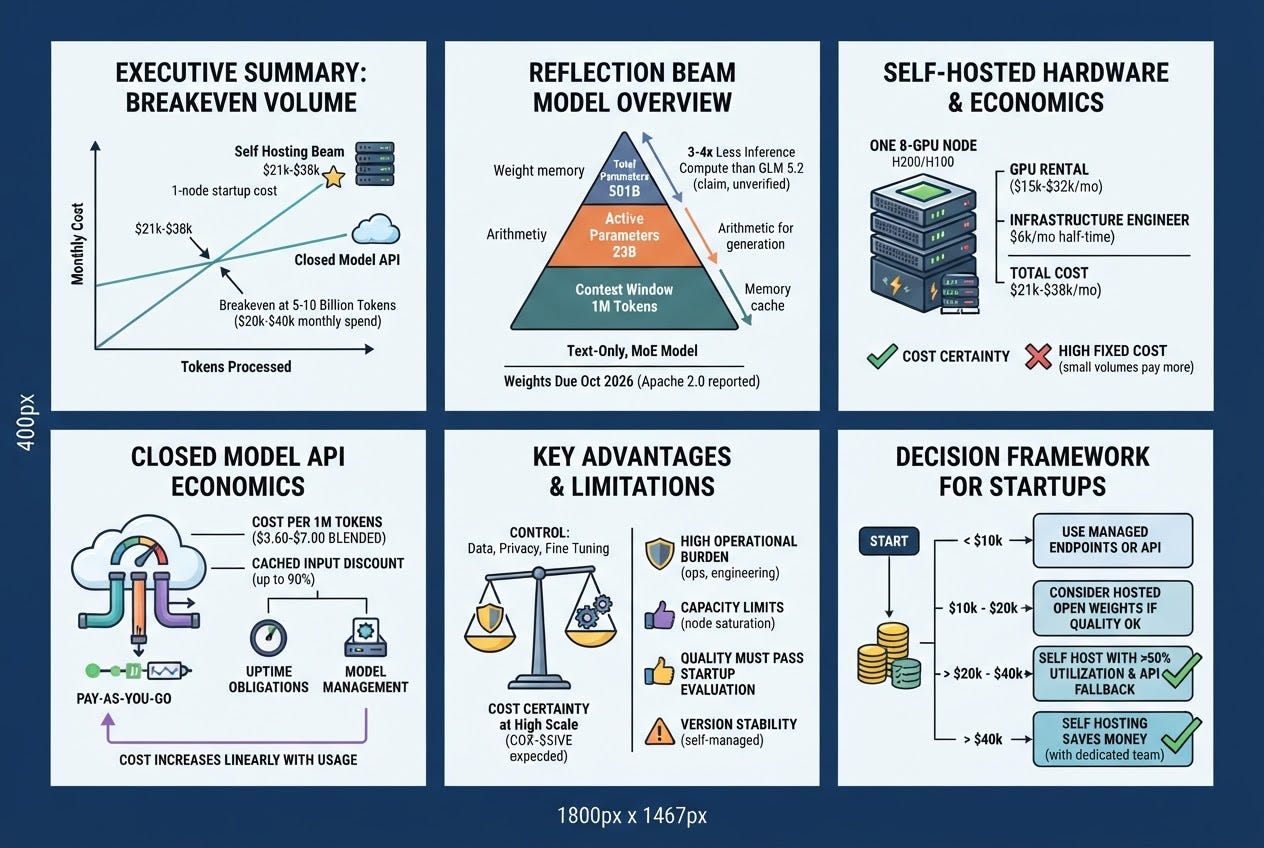
When Should A Startup Self Host an Open Weight Model
Description
Startups should self host an open weight model like Reflection Beam once closed API spend reaches $20,000 to $40,000 monthly, about 5 to 10 billion tokens. That holds only with sustained utilization above 50 percent. Below that line, a rented eight GPU node costs more per token than any closed API charges.
The 3 to 4 times efficiency claim in the Beam announcement of October 5, 2026 does not move that line as far as the headlines suggest. Reflection describes a 501 billion parameter mixture of experts model with 23 billion active parameters and a 1 million token context window. It says Beam matches GLM 5.2 on reasoning with 3 to 4 times less inference compute. Reflection also states that the estimate rests on active parameters and token counts and leaves out prompt processing and serving overhead, and no outside party has tested it. The weights are due later this month.
Why does a 501 billion parameter model need a full node
Every expert must sit in GPU memory even though only 23 billion parameters fire for each token. At 8 bit precision Beam needs about 501 gigabytes for weights. That fits on eight H100 GPUs with 139 gigabytes left for the cache, on eight H200 GPUs with about 627 gigabytes left, or on four B200 GPUs. It does not fit on one GPU, so the fixed cost begins at the price of a node.
That price in October 2026 runs from about $15,200 a month for H100 capacity at neocloud rates to $31,800 for eight H200 GPUs on demand, with a hyperscaler instance at $35,820. A half time infrastructure engineer adds roughly $6,000. One node therefore costs between $21,000 and $38,000 a month whether it serves one billion tokens or fifteen billion.
Smaller breakeven studies circulate widely, with figures like 160 million tokens a month or $4,200 of API spend. Those studies price a 70 billion parameter model on a single GPU. A founder who applies them to Beam understates the threshold by a factor of ten to fifty.
Where is the breakeven against closed model prices
Divide the monthly node cost by the blended API price per million tokens. At an 80 percent input and 20 percent output mix, GPT 5.5 costs $4.00, Claude Sonnet 5 costs $3.60 and Claude Opus 4.8 costs $7.00 before caching. A $37,800 node breaks even at 9.5 billion tokens against GPT 5.5, 10.5 billion against Sonnet 5 and 5.4 billion against Opus 4.8. The cheaper $21,200 node breaks even at 5.3, 5.9 and 3.0 billion.
Utilization is the multiplier that founders forget. A rented GPU costs the same idle or busy. At an assumed 6,900 tokens per second of capacity, the $37,800 node delivers tokens at $21.13 per million at 10 percent utilization, $8.45 at 25 percent and $4.23 at 50 percent. A startup whose traffic peaks during business hours and sleeps at night will not reach 50 percent without batch work to fill the gaps. The capacity figure is my estimate, since nobody has measured Beam yet.
Redundancy raises the bar again. A single node has no failover, and a redundant pair at H200 rates costs about $69,600 a month. The cheapest redundancy is an API fallback that charges nothing when idle, and I advise every client that self hosts to keep one wired in.
What does the 3 to 4 times claim actually change
Arithmetic splits the claim. Beam activates 23 billion parameters against 40 billion for GLM 5.2, a 1.7 times reduction. The rest must come from fewer reasoning tokens per task, which independent evaluators can measure within weeks of release. Where it holds, the larger gain is memory: Beam weights are 33 percent smaller than GLM 5.2 weights, which moves the model onto cheaper hardware. A 753 billion parameter model leaves only 375 gigabytes of cache on eight H200 GPUs. Beam leaves 627.
The reference model is also a moving target. GLM 5.2 now carries a deprecation notice from its own developer, who recommends GLM 5.3, and Beam trails GLM 5.3 and Kimi K3 on Terminal Bench v2.1 at 80.1 against 88.2 and 88.3 on the vend