Episode Details
Back to Episodes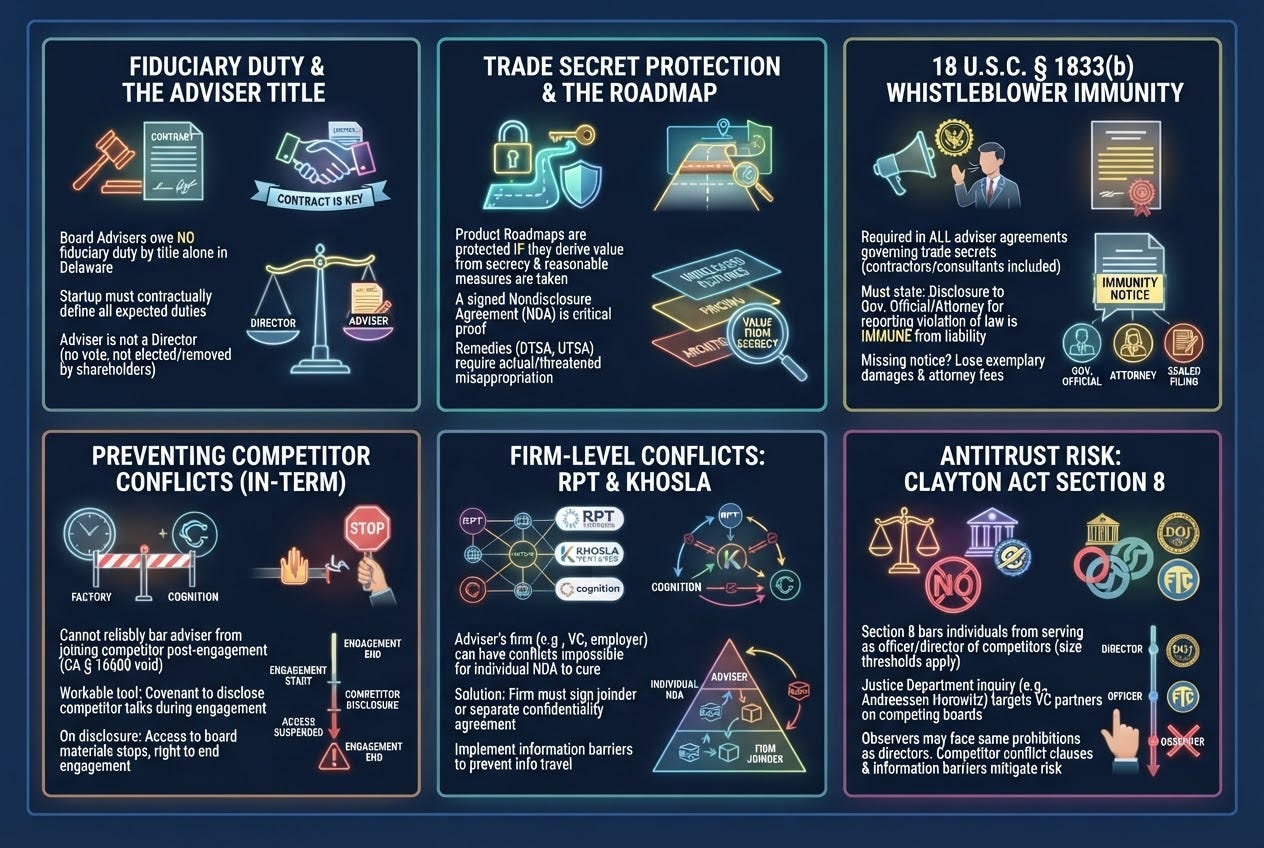
IP Dispute Shows Board Adviser Agreements Need Conflict Terms
Description
Matan Grinberg’s September 30, 2026 allegation against Chris Degnan shows a board adviser agreement needs a confidentiality clause and a competitor conflict covenant before any roadmap is shared. Degnan held the title of board adviser at Factory, and I found no Delaware decision that attaches fiduciary duties to that title. Whatever protection a startup has comes from what the adviser signed, and from trade secret law that depends on that paper.
Here is what has been alleged, and only alleged. Grinberg, Factory’s chief executive, posted on X on September 30 that Degnan shared confidential information with Cognition, the competitor Degnan joined as chief revenue officer. Degnan says he resigned on September 28 and shared nothing. Grinberg says he fired him on September 29, and he ties his concern to Degnan’s questions about Factory’s roadmap. No lawsuit has been reported. Factory raised $200 million at a $5 billion valuation this month, Cognition raised $2 billion at a $48 billion valuation, and Khosla Ventures invests in both.
Start with what the law gives a startup that has no signed terms. The Defend Trade Secrets Act, 18 U.S.C. § 1836(b), protects a roadmap only if it has value from secrecy and the company took reasonable measures to keep it secret. A signed nondisclosure clause is the cleanest proof of those measures, and it is also what creates the duty of secrecy whose breach makes later use a misappropriation. Delaware’s statute and California’s Civil Code § 3426.1 follow the same structure. An adviser who sat through a roadmap session on a handshake leaves the company arguing from habit.
Next comes a trap that catches careful companies. Under 18 U.S.C. § 1833(b), any contract with an employee, contractor, or consultant that governs trade secrets must carry the whistleblower immunity notice. Without it, the company cannot recover exemplary damages or attorney fees against that individual. An equity compensated adviser is a consultant under the statute. The notice takes two sentences to write, and the penalty for omitting it removes the two remedies that give a trade secret claim its force.
Founders then ask for a noncompete, and in California the request fails. Business and Professions Code § 16600 voids contracts that restrain anyone from a lawful profession or business, the California Supreme Court rejected a narrow restraint exception in Edwards v. Arthur Andersen in 2008, and the court of appeal rejected inevitable disclosure in Whyte v. Schlage Lock in 2002. Since January 1, 2024, § 16600.5 gives employees a private claim for the attempt itself, with attorney fees. The federal statute adds its own limit: a court cannot enjoin someone from taking a job, and any condition on employment needs evidence of threatened misappropriation. Knowing the roadmap is not enough.
So the contract has to do its work during the engagement. Define confidential information by category: unreleased features, architecture, benchmark evaluations, pricing, customer pipeline, and the competitive gap analyses a startup shows only to people it trusts. Restrict use to advising the company, and bar use for the adviser’s employer, fund, or any other engagement. Require written notice within two business days of any substantive talk about a job, an engagement, or an investment with a named competitor, and make access to board materials stop automatically on that notice. A California court has enforced a comparable in term restriction against an employee, in Techno Lite v. Emcod in 2020, though no decision I found covers an adviser.
The dispute shows why that notice needs a date. Degnan says his last board meeting came weeks before he first spoke with Cognition. Grinberg says Degnan described only a casual conversation. Cognition’s chief executive did not deny that talks occurred before the resignation. Each account may be sincere, and none can be tested without a record that says when the conflict arose and w