Episode Details
Back to Episodes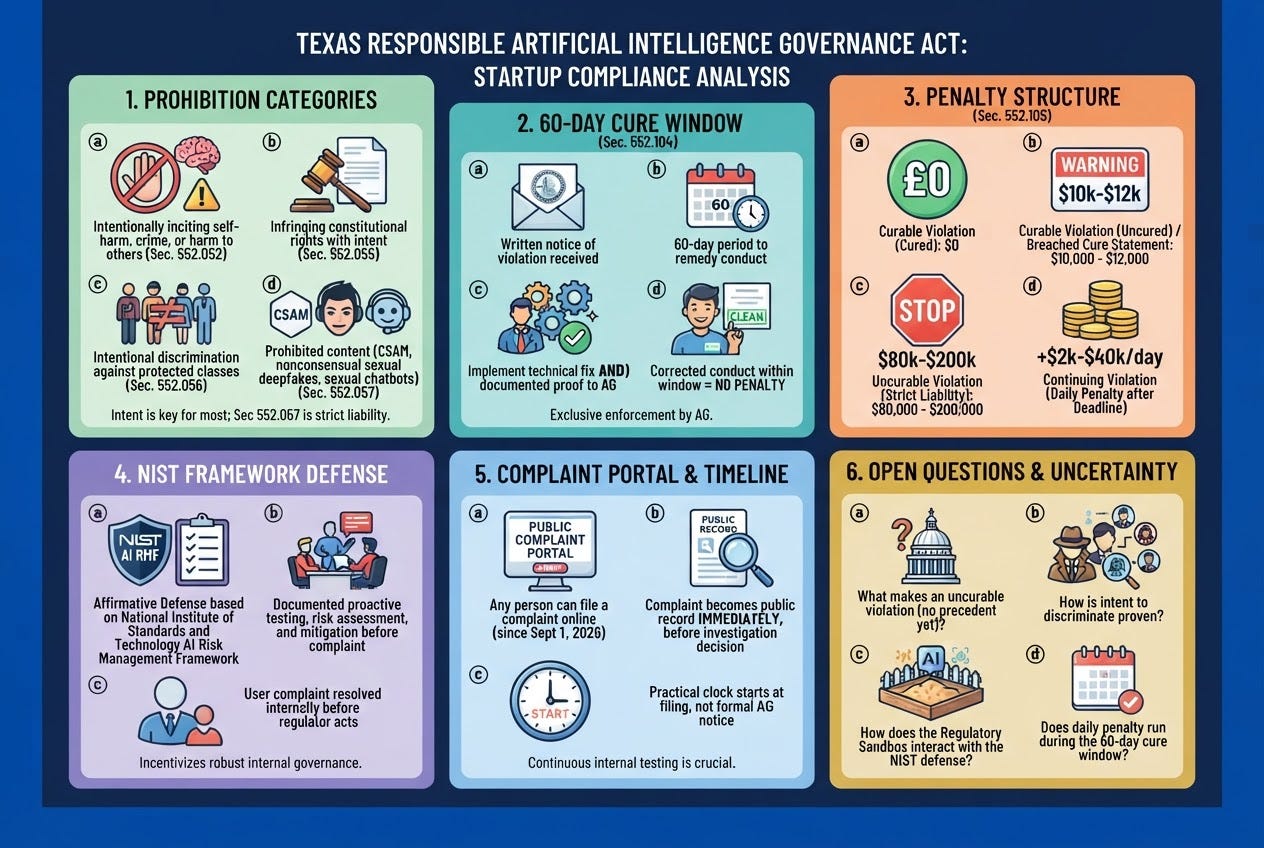
AI Law Gives Startups Sixty Days To Fix A Six Figure Risk
Description
Texas House Bill 149, the Responsible Artificial Intelligence Governance Act, took effect January 1, 2026, and gives a startup exactly sixty days from the Attorney General’s written notice to fix a cited violation before the penalty climbs from a few thousand dollars to as much as $200,000. The Attorney General holds exclusive authority to enforce the statute, so the notice a founder actually has to answer comes from one office in Austin, not from a competitor’s lawsuit or a class action filed in federal court. A company that documents its fix inside that window under Section 552.104 of the Business and Commerce Code owes nothing at all. A company that misses the window, or whose cure later turns out to be incomplete, owes between $10,000 and $12,000 for that violation alone, and a violation the statute treats as incapable of correction carries $80,000 to $200,000 regardless of anything fixed afterward.
The six categories of prohibited conduct read like a list a product team would assume applies only to someone else. Section 552.052 bars building a system with the intent to push a person toward self harm, harm to another person, or a criminal act. Section 552.055 bars a system built with the sole intent to infringe a constitutional right. Section 552.056 bars developing or deploying a system with intent to discriminate against a protected class, and the statute is explicit that unequal outcomes alone, without that intent, do not establish a violation. Section 552.057 bars producing or distributing child sexual abuse material generated by artificial intelligence, nonconsensual sexual deepfakes, and chatbots built to simulate sexual conduct with a minor. Two more sections, 552.053 and 552.054, reach only government agencies, restricting social scoring and nonconsensual biometric identification, so a startup selling software into state government should settle by contract which party answers for those two sections rather than assume the restriction stops at the agency’s door.
The sixty day window is not a grace period for quietly ignoring the problem. Section 552.104 requires the Attorney General’s notice to name the specific provision at issue, and it requires the company to submit a written statement documenting what it fixed and how, not merely to stop the behavior and hope nobody checks again. A cure statement that later proves false exposes the company to the same $10,000 to $12,000 penalty as never curing at all. In thirty years of counseling companies that build emerging technology, the pattern that actually produces one of these letters is rarely a decision anyone made on purpose. It is a product team that ships a capability, watches it work, and never returns to ask whether a regulator could later read intent into the choices embedded in the training data or the system prompt.
What the statute does not do is tell a founder, in advance, which of the six categories count as curable and which do not. Section 552.105 sets the three dollar tiers, curable, uncurable, and continuing, but the line between the first two is left to the Attorney General’s notice and, if a company contests it, to a Texas court applying a new statute with no decisions behind it yet. Read against Section 552.057, the uncurable tier points most directly at child sexual abuse material and nonconsensual sexual deepfakes, since content already generated and distributed cannot be taken back by a later patch the way a discriminatory scoring model can be retrained. A startup that removes the offending behavior, retrains the model that produced it, and documents the correction is building the strongest record it can for treating its violation as curable rather than arguing after the fact that the harm simply stopped.
The statute also hands a company an affirmative defense if it can show it found the problem itself, through its own red teaming or through alignment with the National Institute of Standards and Technology’s AI Ri