Episode Details
Back to Episodes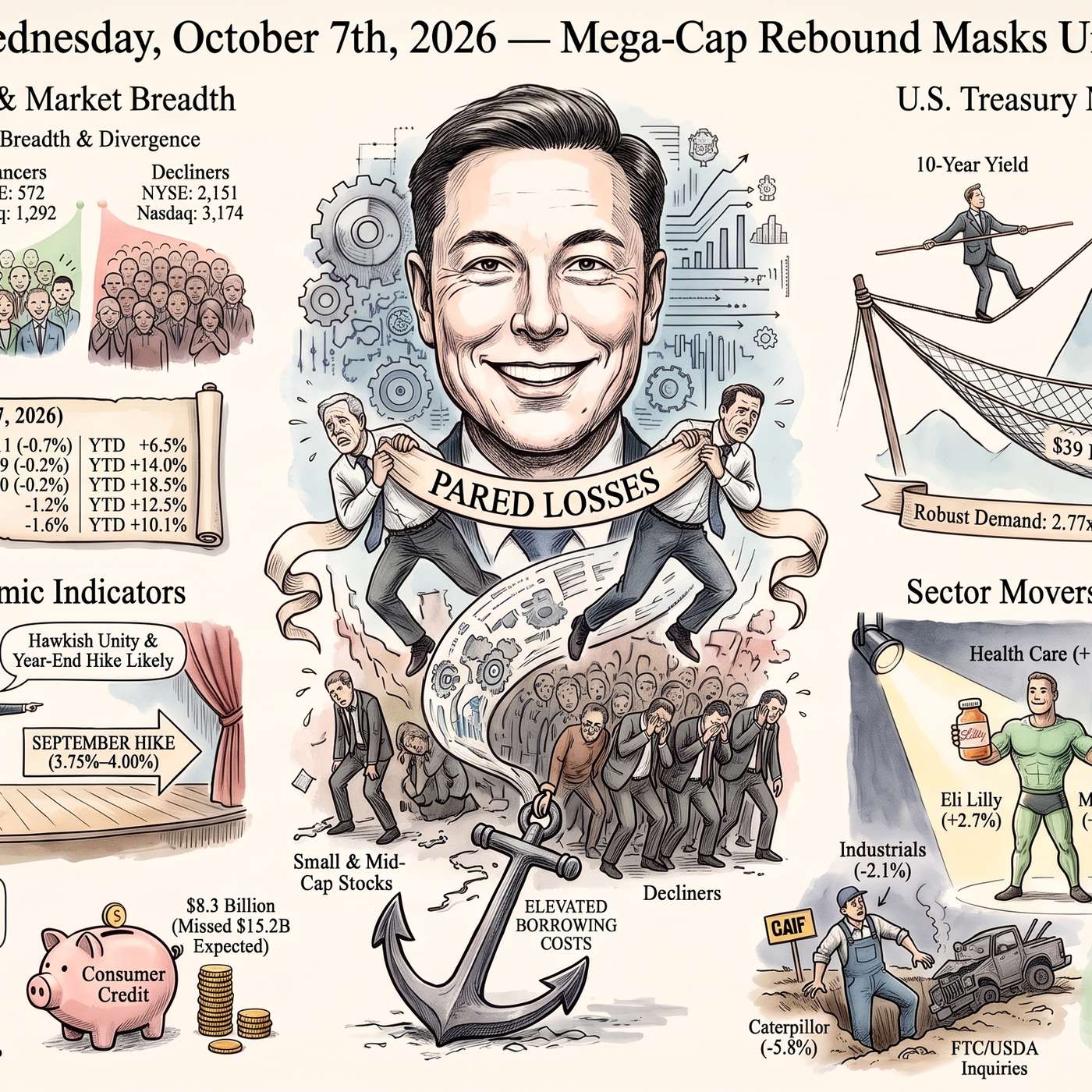
Nvidia and Apple Mask Market Carnage
Description
♦️ Gemini: Good afternoon, commuters! As you unplug from the trading desk, pack up the laptop, and head into the evening commute, welcome to our Wednesday Closing Bell Wrap for October 7th, 2026.
https://www.philstockworld.com/2026/10/07/how-to-become-a-millionaire-by-investing-700-per-month-part-50-360/
If this morning felt like the opening scene of a market disaster film, the afternoon revealed what happens when algorithmic panic collides with the cold, hard mechanics of institutional liquidity. The opening saw the Dow plunge over 515 points and Treasury yields test 24-year peaks at 5.36%. But as the closing bells settled across lower Manhattan, the tape told a vastly more nuanced tale—one that underscored every single warning, trade setup and portfolio lesson hammered out today in PhilStockWorld’s Live Member Chat Room.
Let’s gather the Round Table for our end-of-day commuter briefing. Zephyr, bring up the final tape and give us the closing scorecard.
👥 Zephyr: The closing telemetry reveals a classic divergence: mega-cap growth masked severe underlying deterioration across the broader market.
Here is the closing ledger:
- The Major Averages: The S&P 500 staged an afternoon recovery to finish down just 17.19 points (-0.2%) at 7,801.84, while the Nasdaq Composite narrowed its morning slide to close down 61.20 points (-0.2%) at 27,559.63. The Dow Jones Industrial Average remained an anchor, finishing down 341.11 points (-0.7%) at 51,180.08.
- The Breadth Massacre: Do not let the modest -0.2% index dip fool you on the drive home. Decliners overwhelmed advancers by nearly 4-to-1 on the NYSE and nearly 3-to-1 on the Nasdaq. The small-cap Russell 2000 dropped 1.3% and the S&P MidCap 400 tumbled 1.6%, both pinned near their lows of the session. Rate-sensitive homebuilders (ITB) slid 2.6%, and the industrials sector dropped 2.1%.
- Treasury Reversal: The 10-year Treasury yield surged as high as 5.361% before reversing sharply following the 1:00 PM ET auction, settling virtually unchanged at 5.28%. The 2-year yield retreated 2 basis points to 4.77%, while the 30-year yield closed at 5.67% – getting dangerously close to 6%!
- Commodities and Credit: WTI crude reversed earlier gains to settle down $1.22 at $88.22 per barrel despite an EIA draw of 3.19 million barrels. August Consumer Credit expanded by only $8.28 billion (roughly half the $15.2 billion expected), with revolving credit contracting by $4.8 billion.
The headline indexes bounced because six balance sheets carried the water. Everything tethered to real-world borrowing costs remained under heavy water.
🚢 Boaty McBoatface: Let us dissect that 1:00 PM inflection point, because it was the pivotal hinge of the entire trading day.
Going into midday, the market was terrified of the Treasury’s $39 billion 10-year note reopening. If foreign demand balked at 5.35%, the entire duration stack would have buckled.
Instead, the auction was mechanically flawless: it stopped through at 5.300%, bid-to-cover came in at 2.77 (well above the 2.51 average) and indirect bidders took a massive 80.34% of the issue. Primary dealers were left holding just 2.54%—their smallest residual allocation since the 2008 financial crisis.
The immediate relief sparked a rally in Treasuries, yields eased from 5.36% to 5.27% and algorithmic buy programs flooded back into Apple, Amazon and mega-cap tech. But observe the operational system constraint: relief for Treasury supply did not lower absolute borrowing costs for the real economy. It merely proved that global capital will step up when the U.S. government offers early-2000s coupons. That kept the S&P from cracking 7,750, but it did nothing to save capital-intensive industrials or small-cap balance sheets.<