Episode Details
Back to Episodes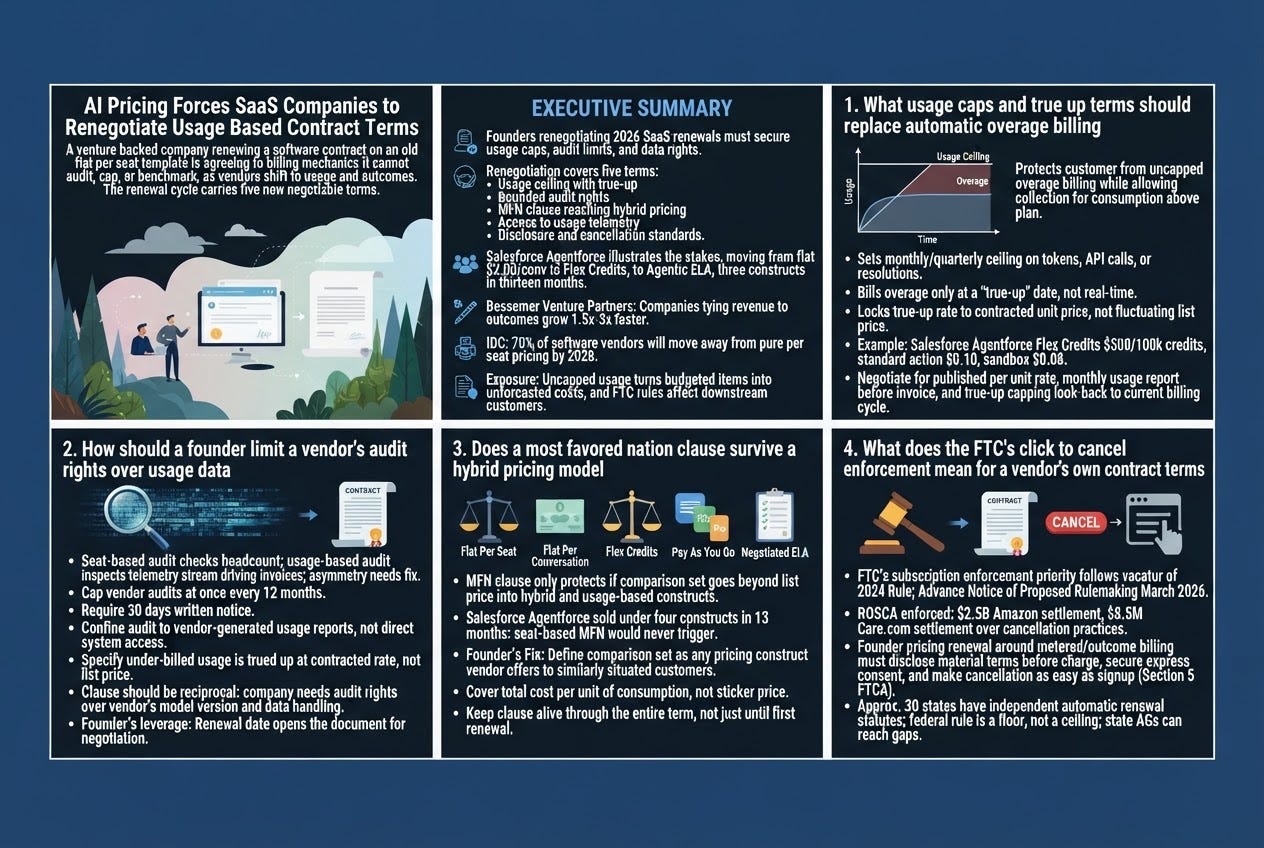
AI Usage Based Pricing Contract Renewal Terms
Description
A venture backed company that renews its software contracts on the old per seat template this year is agreeing to pricing mechanics it cannot audit, cap, or benchmark, because the vendor on the other side of the table has already rebuilt its own billing engine around usage and outcomes.
Salesforce sold its Agentforce product under a flat $2.00 per conversation fee at general availability on October 29, 2024. Seven months later, on May 15, 2025, it added Flex Credits, priced at $500.00 per 100,000 credits with a standard production action metered at $0.10. Three months after that, on August 19, 2025, it layered in pay as you go and pre commit payment options, and by October 2025 it was offering a negotiated Agentic Enterprise License Agreement to its largest accounts. Four billing constructs, inside thirteen months, from a single vendor. KeyBanc Capital Markets later reported that Agentforce deal volume grew 3.7 times over that stretch while the share of deals converting to paid usage actually fell, from roughly 60 percent to roughly 51 percent. A pricing engine that unstable is not a glitch: it is what PYMNTS described in February 2026 as the break between seat count and software revenue that artificial intelligence has opened across the industry, and it is the environment every SaaS customer is now renewing into.
The fix starts with the metering unit itself. A usage cap paired with a true up window, rather than real time overage billing, lets a customer see consumption against a contracted ceiling and settle the difference once, at the contracted rate, rather than watching an invoice move with every token processed. Salesforce priced Agentforce at $2.00 per conversation at general availability on October 29, 2024, then added Flex Credits at $500.00 per 100,000 credits on May 15, 2025: a founder negotiating a renewal should ask the vendor to publish the same kind of per unit rate before signature, not after the first invoice.
Audit rights need the same rebuild. A clause written for a flat license assumes the vendor is checking a headcount against a key. Usage based billing turns that clause into the vendor’s right to inspect the telemetry stream that generates its own invoice, so the customer should cap audits at once every twelve months, require thirty days of notice, and confine any audit to vendor furnished usage reports rather than direct system access. The same obligation runs in reverse for any company embedding a vendor’s AI feature into its own product: that company needs its own audit rights over the vendor’s model version and data handling, a protection most vendor paper omits entirely.
Most favored nation clauses need to widen too. A clause that only compares published per seat list price will never trigger against a vendor selling four different constructs to four different customer segments, the way Salesforce did between October 2024 and October 2025. The fix is to define the comparison set as any pricing construct offered to a similarly situated customer, measured by total cost per unit of consumption, not sticker price, and to keep the clause alive for the full term rather than letting it lapse at the first renewal.
The regulatory exposure runs through the company’s own downstream contracts as much as through the vendor’s. The United States Court of Appeals for the Eighth Circuit vacated the Federal Trade Commission’s 2024 Click to Cancel Rule in 2025 for skipping a required regulatory analysis, and the agency answered in March 2026 with an Advance Notice of Proposed Rulemaking to bring the rule back, with comments due April 13, 2026. In the meantime, the Federal Trade Commission has kept enforcing the Restore Online Shoppers Confidence Act directly, a statute that produced a $2.5 billion settlement against Amazon and an $8.5 million settlement against Care.com over cancellation and disclosure practices. A company that reprices its own customer subscriptions around a per resolut