Episode Details
Back to Episodes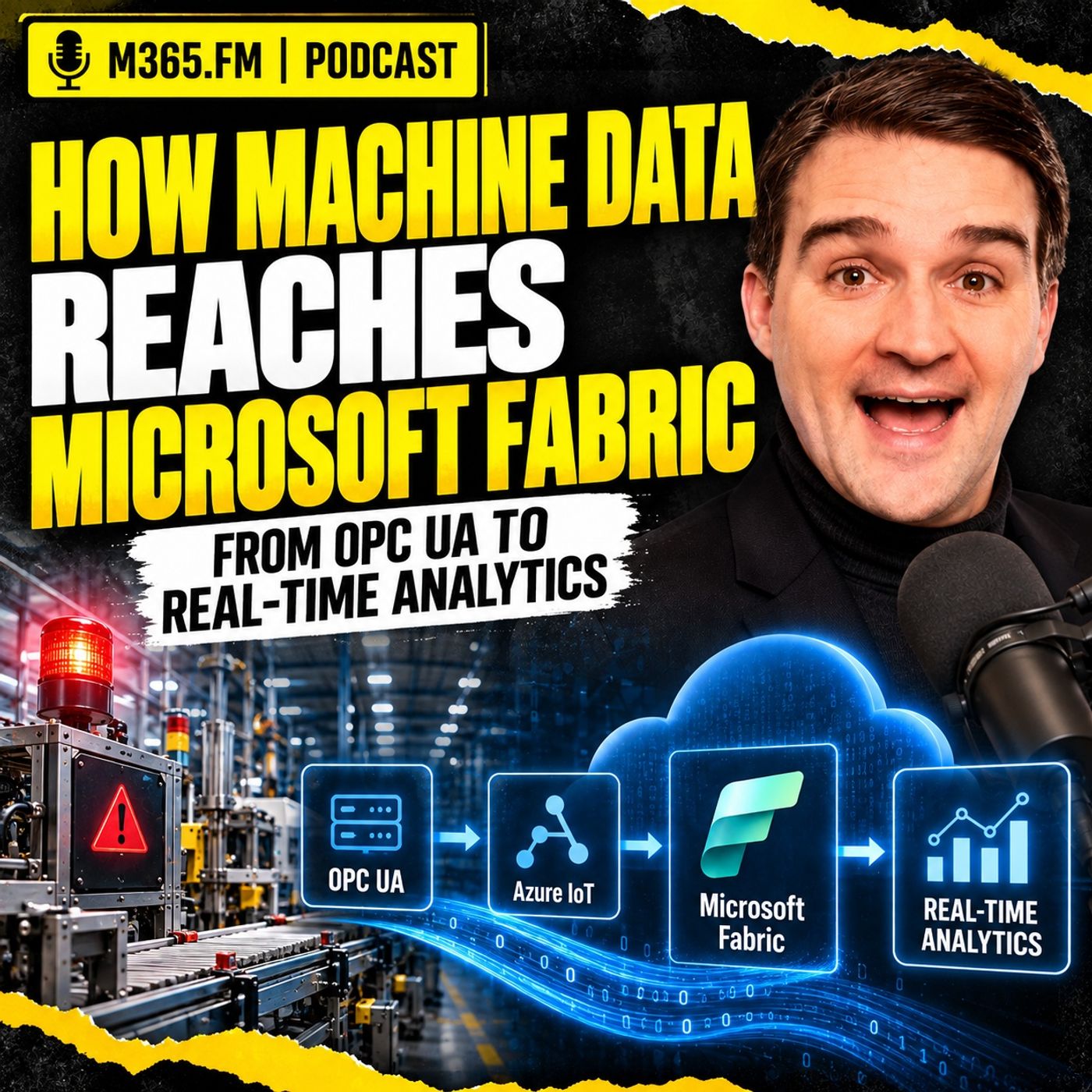
How Machine Data Reaches Microsoft Fabric - From OPC UA to Real-Time Analytics
Season 4
Published 2 weeks, 4 days ago
Description
Getting machine alarms, sensor values, production counters, and fault events into the cloud is easier than ever. OPC UA exposes the machine signal, an edge layer collects it, MQTT can distribute it locally, and Microsoft Fabric can ingest and analyze the resulting stream. The difficult part starts after the data arrives: how do you turn raw telemetry into enough production context to support an actual decision?
This episode follows one machine signal from the factory floor through the Microsoft industrial data stack. It starts with OPC UA, moves through the edge and MQTT, crosses securely into Azure and Microsoft Fabric, and then looks at how Eventstream, Eventhouse, KQL, Lakehouse, Power BI, MES, ERP, maintenance data, and production context fit together. The goal is not simply to show another telemetry pipeline. It is to explain what has to happen before machine data becomes useful for production, maintenance, quality, and planning.
FROM MACHINE STOPPAGE TO PRODUCTION CONSEQUENCE
A machine stoppage looks simple at the controller level. The state changes from running to faulted, a fault code appears, the part counter stops, and perhaps other values change around the same time. That information is useful, but production usually asks a different question: which work order is affected, how much quantity remains, can another machine take over, and does this delay threaten a delivery?
The machine understands its own condition, but it does not automatically understand the business consequence. MES may know the operation and work order. ERP may know the due date and demand. Maintenance may understand the equipment history. Quality may determine whether output can still be used. That is why a fast telemetry pipeline is only the beginning of the architecture.
OPC UA — WHERE THE SIGNAL ENTERS THE DATA PATH
OPC UA provides a standardized industrial interface for accessing information from equipment without requiring every cloud application to understand proprietary controller protocols. A server can expose variables, machine states, alarms, events, methods, timestamps, quality information, and sometimes structured equipment models.
That structure matters because a useful industrial event should carry more than a numeric value. Source timestamps, server timestamps, quality status, units, source identity, and the original OPC UA node information can all become important later when somebody asks where a number came from or why a production calculation looks wrong.
The episode also emphasizes that a tag name is not a data model. A field called “temperature” or “machine state” still needs context such as the asset, engineering unit, allowed range, state definition, and the production situation in which the signal was observed.
KEEP THE OT BOUNDARY CONTROLLED
Machine connectivity should not turn the production network into an extension of the corporate or cloud environment. Industrial networks need controlled boundaries, typically including segmentation and an industrial DMZ, so that approved edge systems can communicate with equipment without giving enterprise applications direct access to controllers.
The recommended pattern is generally outbound-oriented. The edge layer connects to approved OPC UA endpoints and then sends selected information toward cloud services through controlled destinations, ports, protocols, and identities. Analytics platforms should receive data without inheriting broad rights to browse or modify production systems.
Certificates, firewall rules, trust relationships, expiry handling, and ownership also need to be treated as operational processes rather than one-time configuration work.
THE EDGE SHOULD IMPROVE DATA — NOT INVENT BUSINESS MEANING
The edge layer sits between the machine environment and the wider data platform. Its first responsibility is connection, but it can also filter, no