Episode Details
Back to Episodes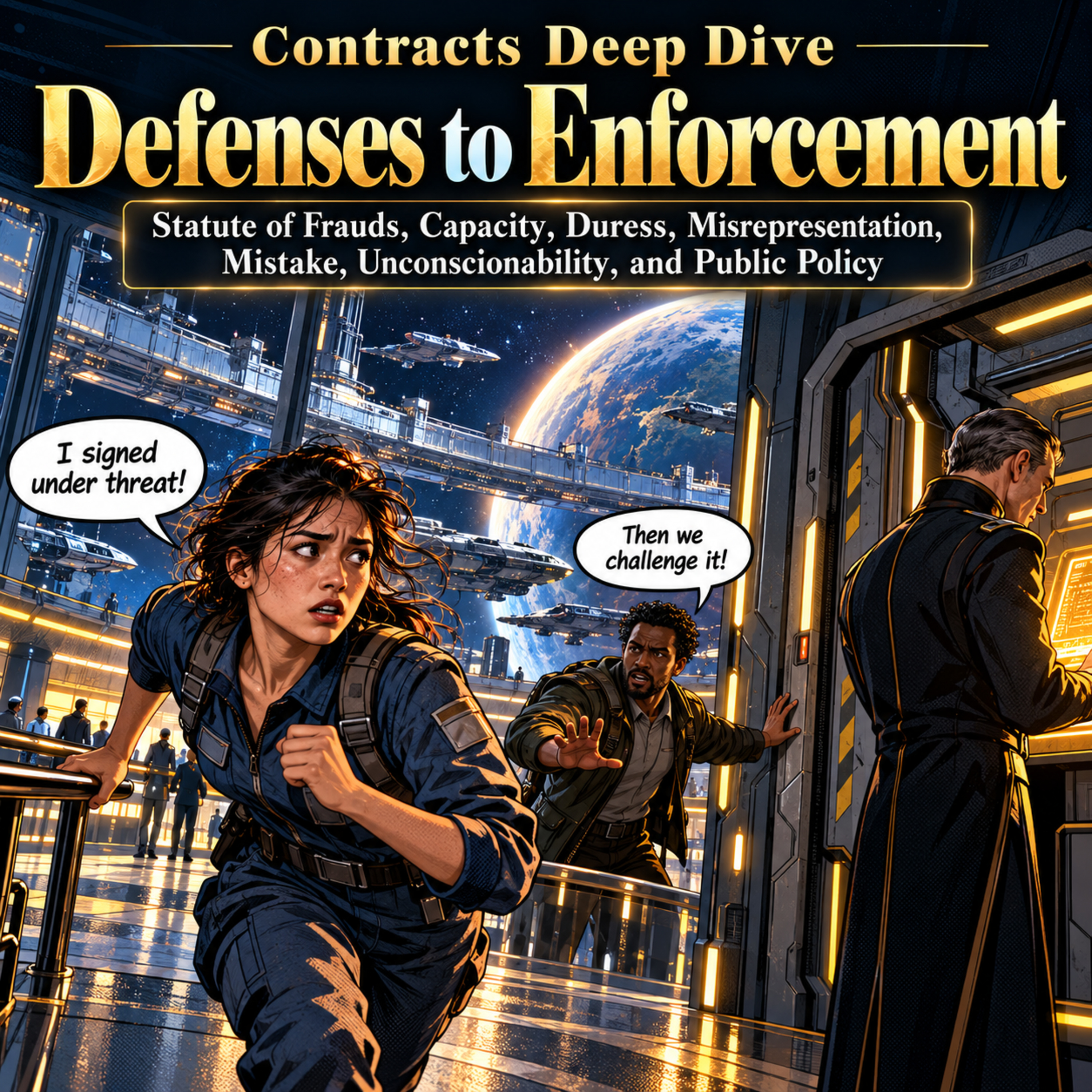
Contracts Deep Dive: Defenses, Statute of Frauds, and Parol Evidence
Description
⚖️ Hear the rules. Follow the stories. Connect the dots.⚖️
Five companion resources from The Law School of America.
🎬 THREE ILLUSTRATED GUIDES
👉 The Last Edition — Follow the case.
👉 The Price of a Promise — Trace the broken bargains.
👉 When the Lights Return — Step into the countdown.
📚 TWO TEXT GUIDES
📖 The Contracts Book — Deepen your understanding.
🎯 The Summary Guide — Sharpen your review.
See it. Study it. Review it.
Explore all three stories, build your foundation with the book, then pull it together with the summary guide.
🎧 EPISODE SUMMARY 🎧
A validly formed contract may still be unenforceable due to defenses, the Statute of Frauds, or the application of the parol evidence rule.
Formation defenses protect parties from unfairness and lack of genuine assent. Capacity defenses (infancy, mental incapacity, and intoxication) render a contract voidable. Assent defenses (duress and undue influence) protect parties from improper threats and unfair persuasion. A contract is voidable for misrepresentation if induced by fraud or a material misstatement, and nondisclosure can operate as a misrepresentation where legally significant. Mutual mistake regarding a basic assumption provides a defense unless the party bears the risk, while unilateral mistake generally requires a showing that the other party knew or caused the error. Illegality, public policy, and procedural and substantive unconscionability prevent the enforcement of contracts that offend justice or the law.
The Statute of Frauds determines whether an agreement must be evidenced by a writing. It applies to interests in land, agreements incapable of performance within one year from the date of contracting, suretyship, executor promises, and the sale of goods over $500. To satisfy the Statute, the writing must contain essential terms and be signed by the party to be charged, though exceptions like part performance or specially manufactured goods may excuse the writing requirement.
The parol evidence rule concerns how prior or contemporaneous agreements affect an integrated writing. If a writing is partially integrated, it cannot be contradicted by prior agreements but may be supplemented by consistent additional terms. If completely integrated, it can neither be contradicted nor supplemented. However, the rule never prevents the admission of evidence to explain ambiguities or to prove validity defenses such as fraud, duress, or mistake. Understanding these frameworks ensures a precise analysis of contract enforceability.
ℹ️ INFORMATION, PRIVACY POLICY & TERMS OF USE ℹ️
The Podcast and Website Purpose
The Law School Podcast and 1L Study Aide webpage supplements law-school and Bar Exam study with strategies, condensed rules, quizzes, and flashcards.
Educational Disclaimer
Content is for educational and informational purposes only. It is not legal advice, creates no attorney-client relationship, and does not gu