Episode Details
Back to Episodes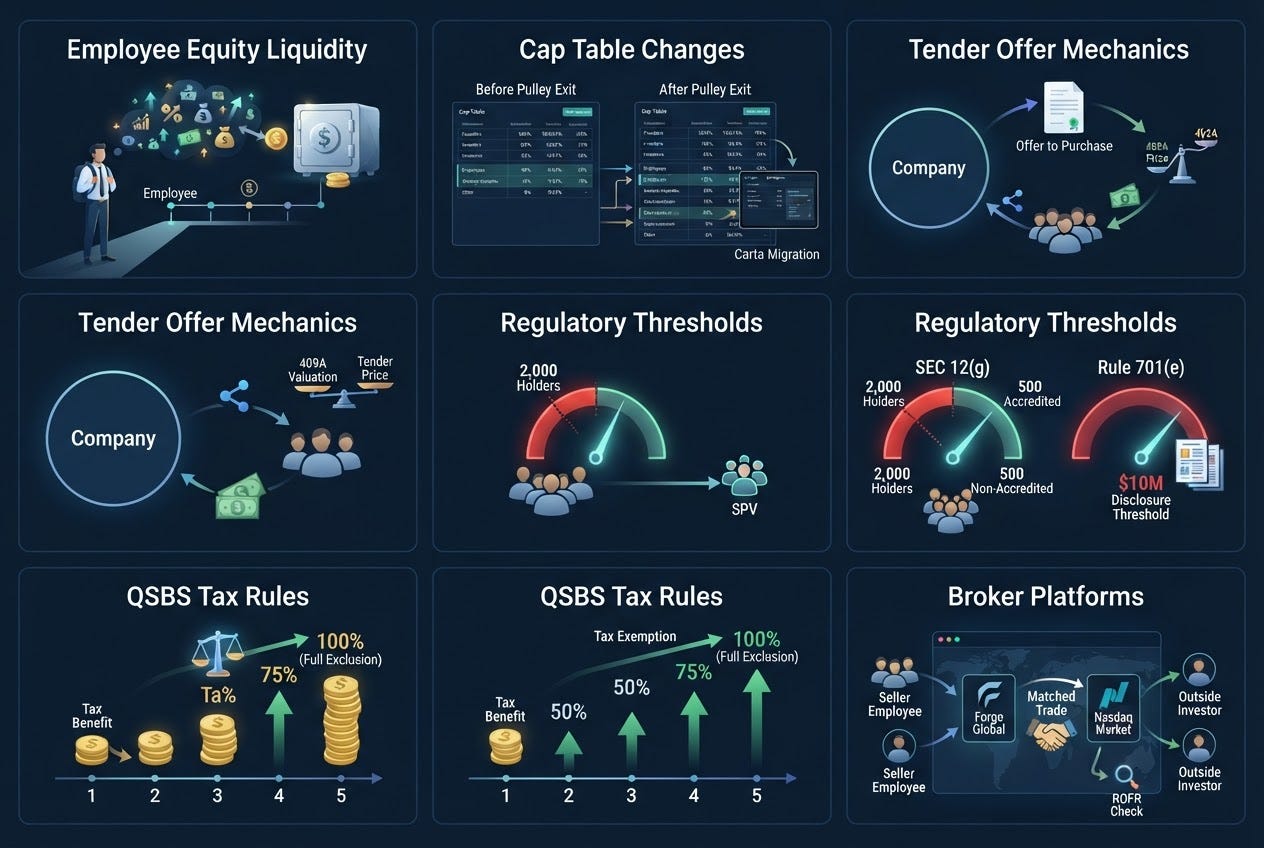
Employee Equity Liquidity After Carta And Pulley Exit Secondaries
Description
Startups now design employee equity liquidity through company sponsored tender offers, broker matched secondary sales, direct buybacks, or option financing, since Carta exited secondaries and Pulley closes December 8, 2026. Carta exited the secondary trading business on January 9, 2024, citing a conflict of interest it could not manage between holding customer cap table data and trading against it, and Pulley, the rival platform that built its business on being the alternative to Carta, will shut down entirely on December 8, 2026, sending its customers back to Carta for cap table administration only. The two platforms that employees and founders used to associate with liquidity have both stepped back from the part of the job that actually moves cash to a vested employee.
The mechanism most founders overlook is not the tax bill or the paperwork. It is that removing the platform does not remove the demand. Employees at any company approaching a meaningful valuation still want to convert years of vesting into a down payment on a house or a paid off student loan before the next round resets their strike price math, and if the company does not build a channel for that, employees build their own, informally, through a broker who calls without knowing whether the transfer requires board consent.
Four structures now have to be assembled deliberately, since neither platform still offers this as a feature to switch on. The first, and the one boards already recognize, is the company sponsored tender offer: a written offer to purchase vested shares, held open at least twenty business days under the Securities and Exchange Commission’s tender offer rule for unregistered securities, priced at a premium over the current 409A common valuation, and closed on a pro rata basis if oversubscribed. Databricks ran one alongside its $10 billion Series J round in April 2025 at a $62 billion valuation, and the pattern that emerges from deals like it is that the clearing price sits between the old 409A number and the new preferred price, and the 409A that gets recalculated afterward resets somewhere in between instead of jumping straight to the new figure.
The second structure routes around the company through a licensed broker platform. Nasdaq Private Market announced a partnership with the secondary investor G Squared on January 8, 2026, built on what it describes as nearly $70 billion in transaction volume across more than 875 company sponsored programs, a scale that suggests this channel is consolidating around a small number of platforms now that a major cap table incumbent has twice declined to compete for the business. A special purpose vehicle typically holds the purchased shares on behalf of multiple outside buyers and counts, for now, as a single record holder under Section 12(g) of the Exchange Act, which matters because a company that crosses 2,000 record holders has to begin filing with the Securities and Exchange Commission whether or not it wants to be a reporting company yet.
The third and fourth structures skip the outside buyer altogether. A direct buyback funded from the company’s own cash keeps the cap table simple but consumes runway dollar for dollar and asks incoming investors at the next round to trust that the balance sheet spent on cap table cleanup was not spent instead on the growth they are pricing. A nonrecourse financing arrangement takes the opposite path, advancing an employee the cost of exercising options and the associated tax liability in exchange for a share of eventual proceeds, so the employee owns shares without a sale ever happening and without writing a personal check, though the financing firm only gets paid back if the company eventually delivers a real liquidity event.
None of the four structures is free of the same clause that has killed secondary transactions since long before Carta or Pulley existed. Every venture financed company’s certificate of incorporation carr