Episode Details
Back to Episodes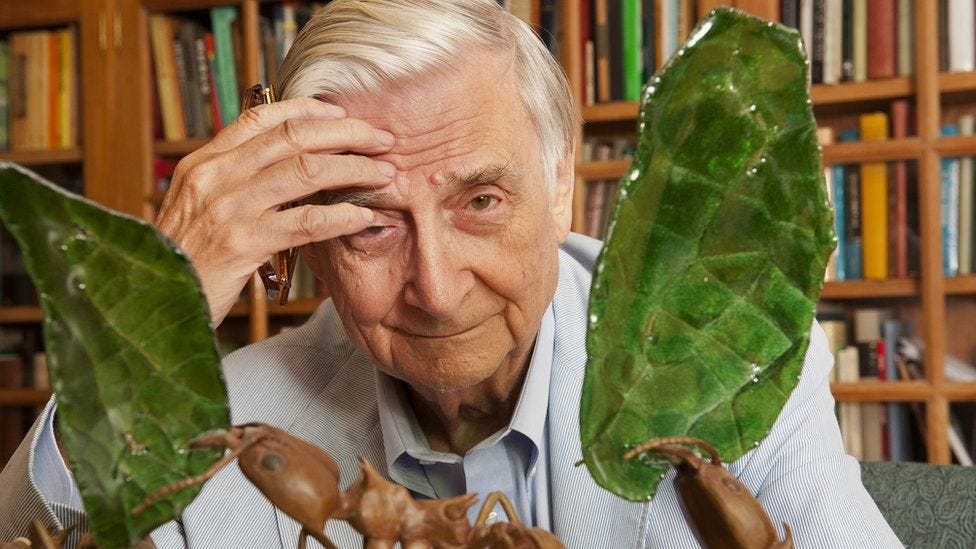
David Sloan Wilson and Charles C. Mann on E. O. Wilson's legacy
Description
The day after Christmas 2021, the great entomologist and evolutionary biologist E. O. Wilson died at the age of 92. Carl Zimmer in The New York Times wrote an obituary that highlighted his seminal early contributions to science, as well as his role as a public intellectual after the publication of 1975’s Sociobiology. Wilson also wrote an autobiography, Naturalist, telling the story of his life in science from his own perspective.
In the days after his passing, I wanted to touch base with those who knew him, collaborated with him, and even had disputes with him. The evolutionary biologist David Sloan Wilson (no genetic relation) has talked in his books about how he was influenced by the elder Wilson early in his career, and also how they eventually became colleagues and allies in scientific debates. Recently he published The Six Legacies of Edward O. Wilson as a reflection on E. O. Wilson’s career and influence. These six were his contributions to evolutionary biology, biodiversity, human sociobiology, the unification of knowledge, his encouraging stance toward young scientists and other learners, and finally, the frontier of ecosystems studies (his very last project).
I’ve talked to David before about his work on multi-level selection as well as his ambition toward utilizing evolutionary biological frameworks in the context of social science and policy, so I reached out to discuss the piece he wrote about E. O. Wilson’s life. Knowing that the elder Wilson had encouraged David's interest in group selection as a graduate student, I expected to focus on the late scientist’s great contributions. But in fact, we addressed the reality that the elder Wilson often had greater aspirations than concrete paths of execution. No one can deny E. O. Wilson’s original contributions to ecology and his mastery of entomology, but David Sloan Wilson points out that some of his recent books sketch out grand plans, but do not deliver any roadmap on how to achieve those ends. Rather than a hagiography, the conversation emphasizes that we shouldn’t make icons out of scientists, that science is a collective enterprise, and that too often it is depicted as the products of singular “Great Men.” Nevertheless, over the course of the discussion, David Sloan Wilson and I do discuss the late Wilson’s positive and important contributions to entomology and mentorship, as well as his last forays into scientific debates when he became involved in a controversy around the utility of W. D. Hamilton’s
Listen Now
Love PodBriefly?
If you like Podbriefly.com, please consider donating to support the ongoing development.
Support Us