Episode Details
Back to Episodes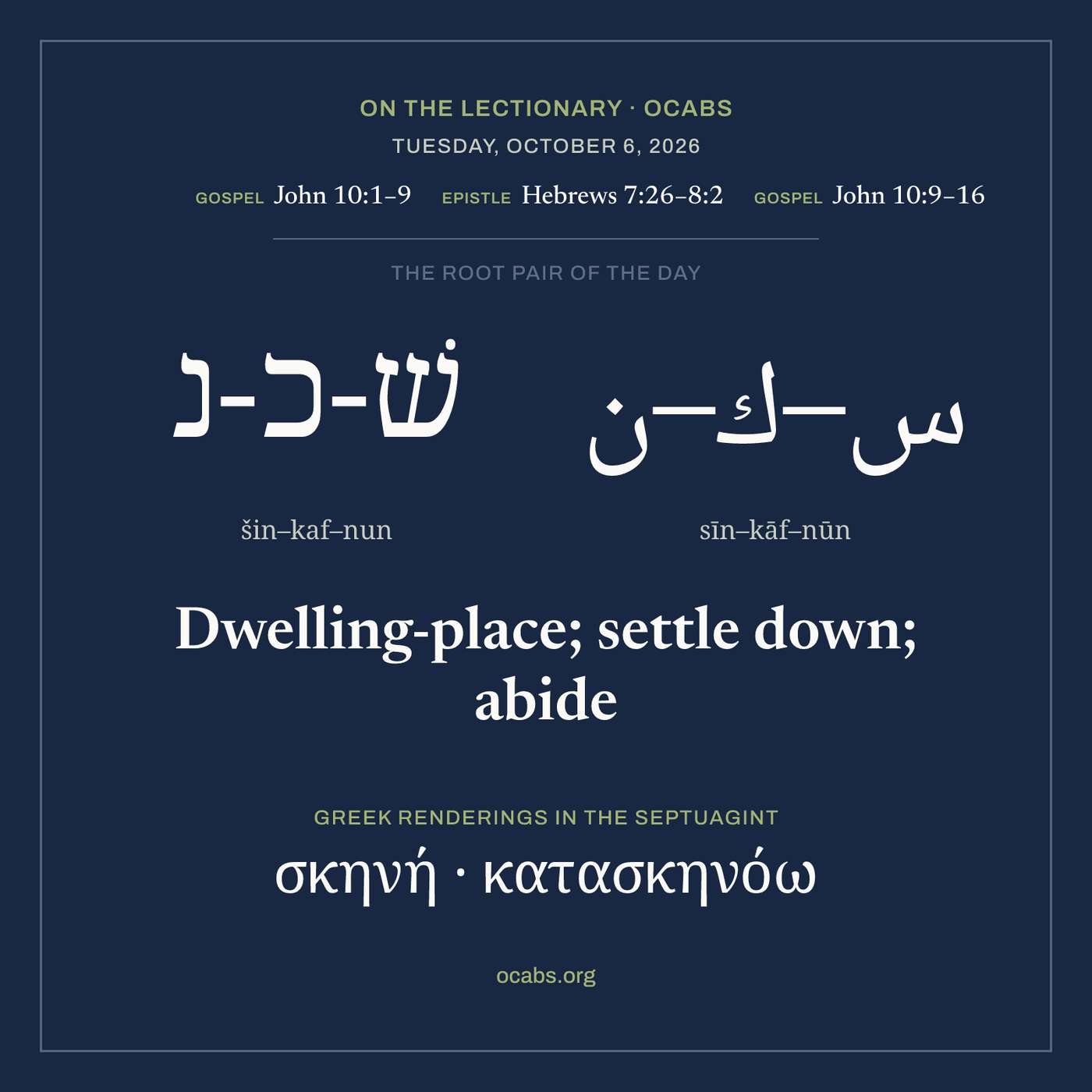
John 10:1-9 · Hebrews 7:26-8:2 · John 10:9-16 · Philippians 1:8-14 · Luke 6:37-45 — Tuesday, October 6, 2026
Description
A daily note from the team at OCABS.ORG, drawing on the published works of Fr. Paul Nadim Tarazi, with citations to his books and lectures.
Readings: John 10:1-9; Hebrews 7:26-8:2; John 10:9-16; Philippians 1:8-14; Luke 6:37-45.
The Gospel's imagery of the door and the shepherd comes from Ezekiel, where the Hebrew sha'ar (gate) becomes the Greek thyra that John uses for Jesus as "door." Fr. Paul traces several matching phrases between the two texts, including that the shepherd "calls his own sheep by name and leads them out." His lectures add that the story's pattern of going out and coming in is the pattern of exodus and of resurrection, and that "the shepherd's voice makes the flock"; without that voice the sheep only scatter.
Jesus names this teaching a paroimia, the same term the Septuagint uses for the Hebrew mashal, as in its title for the book of Solomon's proverbs, Paroimiai Salomontos - a story meant to be worked through rather than taken at face value. Those who came before him are called thieves, the same word for theft that returns when the Jewish leaders plot to kill Lazarus, confirming that "the thief comes only to steal and kill and destroy." The hired hand, misthotos, a word found nowhere else in the New Testament except tied to the sons of Zebedee, cares nothing for sheep he does not own. Against such figures the good shepherd lays down his life and gathers "other sheep which are not of this fold" into one flock, the joining of Jew and Gentile that Fr. Paul compares to Paul's teaching in Romans 11.
Fr. Paul's commentary on Hebrews reads the "such a high priest" as sinless, "separated from sinners, exalted above the heavens," set against Levitical priests who must sacrifice daily, first for their own sins and then for the people's. This priesthood rests not on the law's weakness but on God's own oath, appointing "a Son who has been made perfect for ever." The chapter's main point, he notes, is that this priest sits "at the right hand of the throne of the Majesty in heaven" and serves "the true tent which is set up not by man but by the Lord," the heavenly reality of which the earthly cult was only copy and shadow.
The root pair of the day · שׁ-כ-נ šin–kaf–nun, מִשְׁכָּן miškan · س–ك–ن sīn–kāf–nūn, مِسْكِين miskīn · dwelling-place; settle down; abide. Ganab and ijtanabu both carry the sense of stealing or slipping away unseen. The note traces the Greek kleptes behind John's thief who climbs the fold by stealth, the same word used when the leaders plot against Lazarus, confirming Jesus' saying that the thief comes only to steal and kill and destroy. cf. The Consolation of Consonants
Sources: Tarazi, The New Testament: An Introduction, vol. 3, Johannine Writings, p. 199; Orthodox Audio Bible Commentary, John (vol. 43), part 1, at 3:04:03; Tarazi, The Rise of Scripture, p. 477; Tarazi, The New Testament: An Introduction, vol. 3, Johannine Writings, p. 198; Tarazi, The New Testament: An Introduction, vol. 3, Johannine Writings, p. 208; Tarazi, The New Testament: An Introduction, vol. 3, Johannine Writings, p. 198; Tarazi, Hebrews: A Commentary, p. 102; Tarazi, Hebrews: A Commentary, p. 111; Tarazi, Hebrews: A Commentary, p. 136; Tarazi, Hebrews: A Commentary, p. 99; Tarazi, Hebrews: A Commentary, p. 100; Tarazi, The Rise of Scripture, p. 477; Tarazi, The New Testament: An Introduction, vol. 1, Paul and Mark, p. 96; Tarazi, The New Testament: An Introduction, vol. 3, Johannine Writings, p. 199; Tarazi, The New Testament: An Introduction, vol. 3, Johannine Writings, p. 208.
Opening music: Taksim Arbi, Bichi Slama, oud (Tunis, Archives de la Parole, 1930s), public domain. Source: gallica.bnf.fr / BnF.